





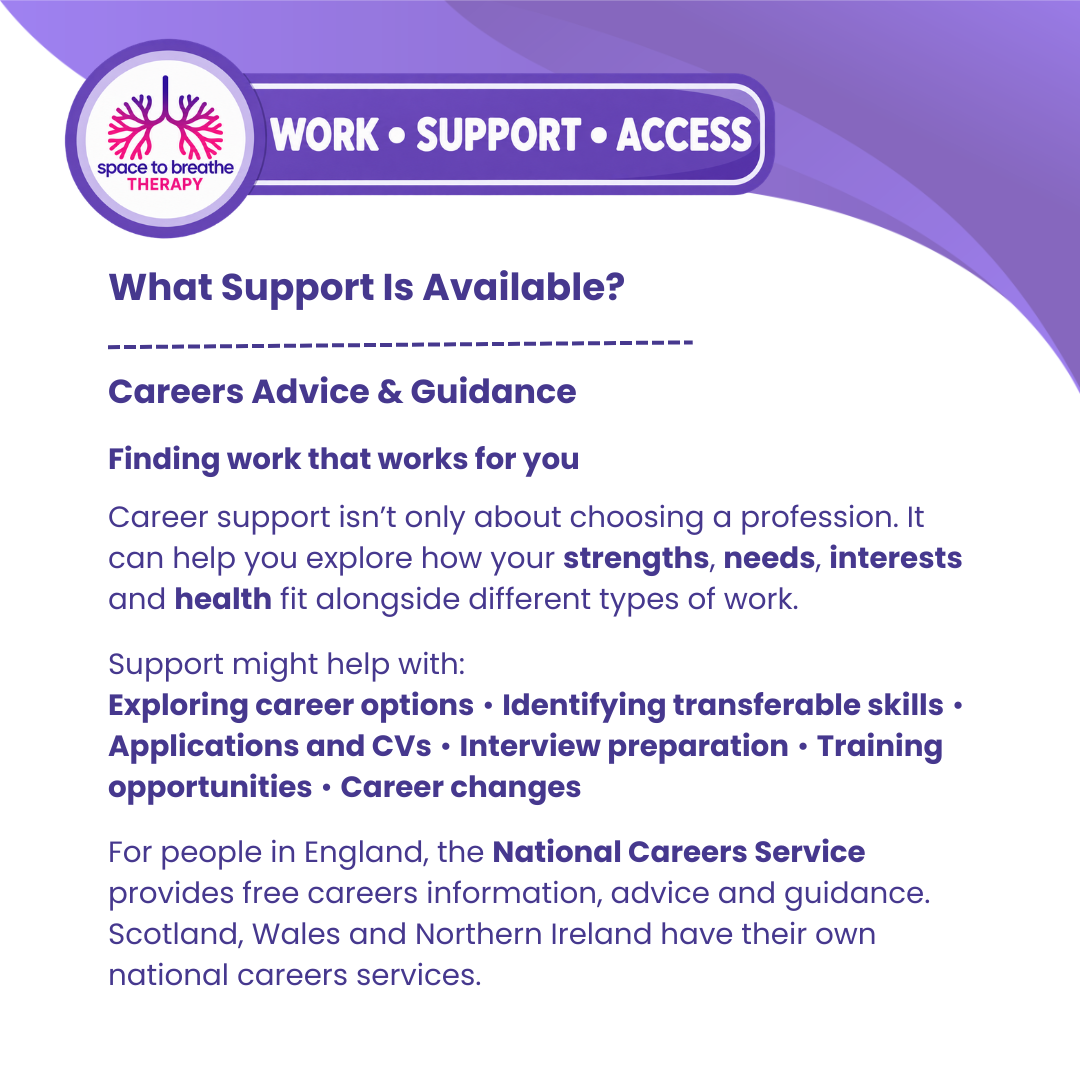
Careers Advice & Guidance – Finding Work That Works for You
What this resource is for
Career support is not only about deciding what job you want to do. It can also help you understand what kind of work, environment and working pattern may suit you as an individual.
Your strengths, interests, needs, health, skills and circumstances can all influence how well a particular job works for you.
For someone who is disabled, neurodivergent, living with a physical or mental health condition, returning to employment after time away, or considering a career change, this can be particularly important.
The aim does not have to be simply:
“How do I get a job?”
It can also be:
“How do I find work that is sustainable and works for me?”
What can careers support help with?
Careers advice and guidance can help you explore different possibilities rather than feeling that you have to work everything out by yourself.
Depending on the service, this might include:
Career options • Transferable skills • CVs and applications • Interview preparation • Training opportunities • Qualifications • Career changes • Returning to work • Developing confidence • Understanding different industries and roles
It can also give you space to think about something that can sometimes be overlooked:
What do I actually want and need from work?
A careers conversation can be an opportunity to look at the whole picture — not simply what jobs are available, but what might realistically work for you.
Start with yourself, not the job title
It is very easy to start with a job advertisement and ask:
“How can I fit myself into this?”
Another approach is to start with you.
Think about:
What am I good at?
What do I enjoy?
What gives me energy?
What drains my energy?
What environment helps me work well?
Do I prefer routine or variety?
Do I work better independently or alongside others?
How much social interaction works for me?
Do I need flexibility around my disability or health?
What sensory or physical environment suits me?
What working hours are realistic and sustainable?
These questions can be just as important as qualifications and previous employment.
A job may look perfect on paper, but if the environment, hours or expectations continually work against your needs, it may be very difficult to sustain.
Equally, a role you had never previously considered might suit your strengths extremely well once you understand more about how you work best.
Recognising transferable skills
You may have more workplace skills than you realise.
Transferable skills are abilities that can be useful across different jobs and industries.
These might include communication, organisation, problem-solving, creativity, listening, practical skills, technology, leadership, supporting others, attention to detail or managing competing demands.
And skills don't only come from paid employment.
Caring responsibilities, volunteering, education, running a household, community involvement and personal projects can all involve valuable skills and experience.
Sometimes another person can help you recognise strengths that you have stopped noticing because they feel ordinary to you.
Something you do naturally may actually be a valuable skill in another workplace.
A Personal Perspective from Maggie
Something I've learned through my own working life, and through supporting people at Space to Breathe Therapy, is that careers don't always follow a neat or predictable path — and I don't think they have to.
Sometimes we spend years trying to fit ourselves into ways of working that simply don't suit us. When we struggle, it can be very easy to think:
“Maybe I'm just not good enough at this.”
But sometimes ability isn't the problem at all.
The environment might be wrong. The hours might be unsustainable. The way information is communicated might not work for you. You might need more flexibility, a different structure or support that you've never previously realised you were allowed to ask for.
I think this is particularly important for neurodivergent people. You can be incredibly capable at something when you are able to approach it in a way that works for your brain, yet struggle enormously when you're expected to do that same job within a rigid system.
Sometimes the job is right, but the way you're being asked to do it isn't.
When I support someone with their career, I don't want to begin with:
“What job can we get you into?”
I want to know:
Who are you?
What are you good at?
What interests you?
What gives you energy?
What drains you?
What environment brings out the best in you?
What support would make work more sustainable?
I've also met people who tell me they have “nothing to put on a CV” because they haven't worked for a while or haven't followed a traditional career path.
Then we start talking.
They've cared for people. Managed difficult situations. Organised households. Volunteered. Solved problems. Learned things independently. Supported others. Created things. Adapted when life changed.
Suddenly, there is a whole collection of skills that they simply hadn't recognised as skills.
And I think that's important.
Your career history isn't the only measure of what you have to offer.
You are also allowed to change direction.
What suited you at 20, 30 or 40 may not suit you now. Your circumstances change. You learn more about yourself. Your priorities change.
Changing direction doesn't erase everything that came before it.
You take your experience with you.
For me, good careers guidance isn't about squeezing somebody into the nearest available job. It's about helping them understand themselves well enough to begin finding work that works for them.
— Maggie, Space to Breathe Therapy
Finding the right working environment
Finding suitable work isn't necessarily about finding a completely barrier-free job.
It can be about understanding:
“What helps me function at my best?”
Someone may have all the skills required to perform a job but struggle because of the environment in which that job is carried out.
For example, you might work better with:
Remote or hybrid working • A quieter environment • Predictable routines • Flexible hours • Clear written instructions • Smaller teams • Practical work • Less customer-facing work • Regular breaks • A structured workload
These aren't necessarily signs that you are less capable.
They are information about the conditions in which you are more likely to work effectively and sustainably.
Understanding your working preferences can help narrow down career options and identify questions you may want to ask potential employers.
Applications and interviews
Once you have identified work you would like to pursue, careers support can become much more practical.
It might include help with creating or updating a CV, completing applications, writing supporting statements and preparing for interviews.
If interviews are particularly difficult, preparation might involve practising questions, identifying examples from your experience and thinking about how you want to communicate your strengths.
For disabled and neurodivergent applicants, it can also be useful to consider whether reasonable adjustments during recruitment would help remove a barrier.
An interview should give you an opportunity to demonstrate your suitability for the role. A communication or accessibility barrier within the recruitment process should not unnecessarily prevent you from demonstrating your skills and experience.
Training and changing direction
You do not necessarily have to remain in the same type of work throughout your life.
Health, disability, caring responsibilities, burnout, redundancy, changing interests or simply reaching a different stage of life can all lead someone to reconsider their career.
Careers guidance can help you explore whether your existing skills transfer into another area or whether training, qualifications, volunteering or work experience might help you move towards something different.
You may discover that you already have many of the skills needed for another role.
A career change does not mean starting again from nothing.
You take your existing knowledge, experience, strengths and skills with you.
Where can I get careers support?
For people in England, the National Careers Service provides free careers information, advice and guidance.
Scotland, Wales and Northern Ireland have their own national careers services.
Depending on your circumstances, additional support may also be available through employment programmes, Jobcentre Plus, charities, local services and specialist disability employment organisations.
There isn't necessarily one service or professional that will suit everybody.
Just as with job coaching and other forms of support, it can be worth finding someone whose approach fits you and what you are trying to achieve.
How this connects with the other resources
Careers guidance can be the beginning of a much wider employment-support journey.
Careers advice can help you explore:
“What kind of work might suit me?”
Employment support programmes may help you prepare for and move towards employment.
Disability Confident can help when researching employers participating in the government scheme.
A Health Adjustment Passport can help you put your workplace needs into words.
Assistive technology, specialist equipment, communication support, job coaches and support workers may help remove particular workplace barriers.
And Access to Work may provide eligible people with practical support relating to disability or health-related barriers in employment.
You may need one of these, several of them, or something completely different.
The important thing is that support is built around your individual needs rather than assumptions about what somebody with a particular diagnosis should need.
Remember
There is no single definition of a “good job.”
A role that works extremely well for one person may be completely unsuitable for another.
Finding work that works for you can involve understanding the relationship between:
Strengths → Interests → Needs → Environment → Support
So instead of only asking:
“Can I do this job?”
consider asking:
“Can I do this job in a way that is realistic and sustainable for me?”
“Does the environment allow me to use my strengths?”
“What support would help me?”
“Is this workplace a good fit for me, as well as me being a good fit for them?”
The goal isn't to force yourself to fit a particular idea of employment.
It is to explore where your skills, abilities, interests and individual needs can come together in a way that works for you.
Finding the right career isn't only about finding somewhere you can work. It can also be about finding somewhere you can be yourself, use your strengths and have the support you need to do your best work.
This resource provides general careers information. Services, eligibility and available employment support can change, so current guidance should be checked when accessing a particular service.




