





Disability Confident Employers – Finding More Inclusive Workplaces
What this resource is for
When you are looking for work, the job itself is only part of the picture. The environment you will be working in, the people around you and how an employer responds to individual needs can matter just as much.
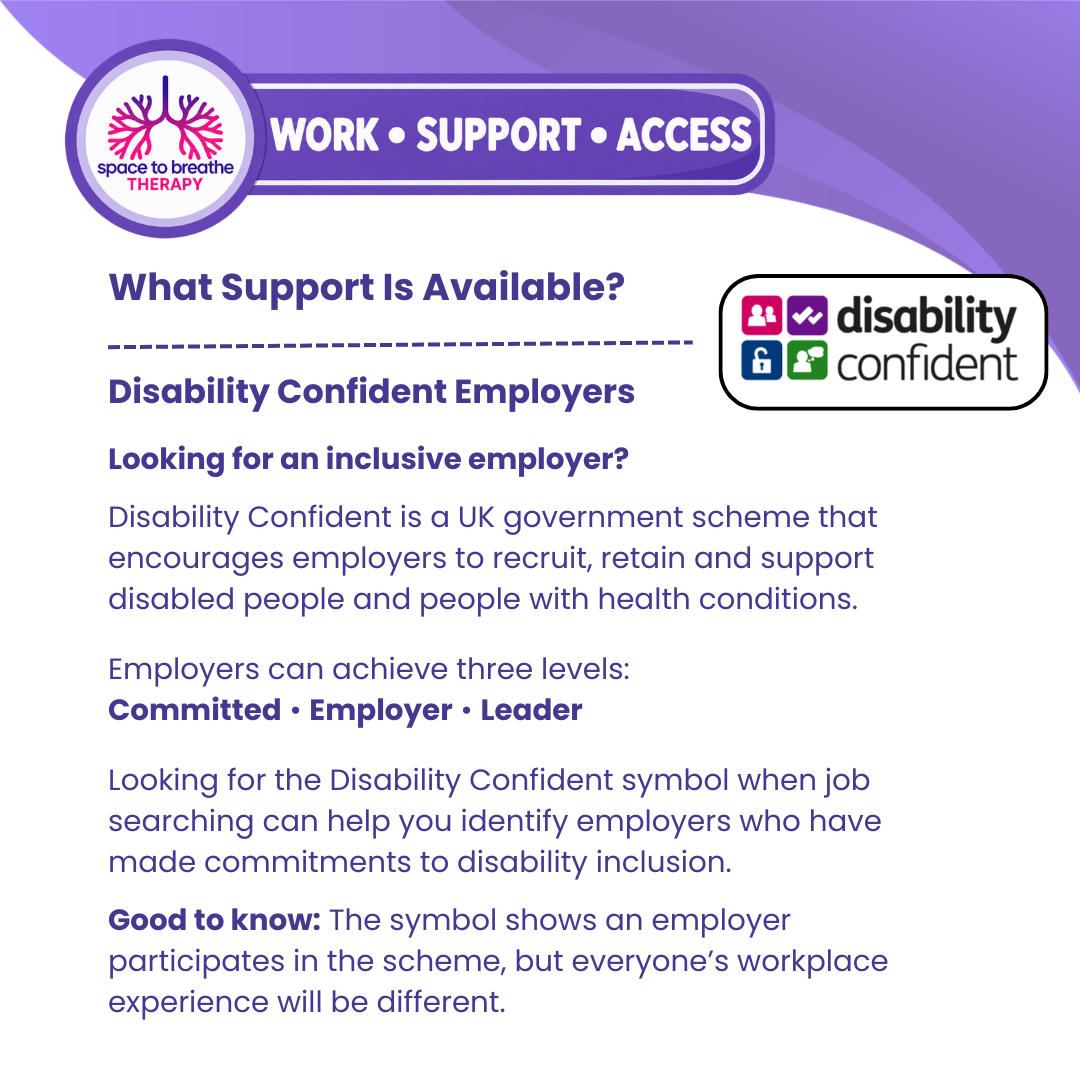
The Disability Confident scheme is a UK government initiative designed to encourage employers to think differently about disability and take action to recruit, retain and develop disabled people and people with health conditions.
Seeing the Disability Confident symbol can therefore be a useful starting point when researching an employer, particularly if you are looking for a workplace where disability inclusion has been actively considered.
What does Disability Confident mean?
Employers participating in the scheme can progress through three levels:
Disability Confident Committed → Disability Confident Employer → Disability Confident Leader
As employers progress through the scheme, they make further commitments around disability inclusion.
This can include areas such as inclusive recruitment, workplace adjustments, retaining disabled employees, supporting people who develop health conditions and improving disability awareness within organisations.
However, it is important to remember that a scheme or logo cannot tell you everything about what it will actually feel like to work somewhere.
What should I look for when job searching?
You may see the Disability Confident symbol on job advertisements, employer websites, recruitment pages, careers information or application materials.
It tells you that the employer participates in the scheme, but use it as one part of your research rather than the only thing you consider.
Take a look at how the organisation talks about:
Reasonable adjustments • Accessible recruitment • Flexible working • Disability and neurodiversity • Workplace wellbeing • Employee support • Equality and inclusion
You might also notice how easy it is to find information about requesting adjustments. Sometimes the way an organisation communicates about accessibility can tell you a great deal.
A Personal Perspective from Maggie
One thing I often encourage people to remember is that finding the right workplace can be just as important as finding the right job.
You can have all the skills and experience needed for a role and still struggle if the environment around you continually creates barriers.
Through my work at Space to Breathe Therapy, I have spoken with people who have spent years believing they were the problem at work. When we begin looking at what was actually happening, we sometimes find that they were trying incredibly hard to function within an environment that simply wasn't meeting their needs.
That is why I would never suggest choosing an employer based on a Disability Confident logo alone.
Use it as a starting point, then look a little deeper.
What does the organisation actually say about disability? How do they respond when you ask about an adjustment? Do you feel listened to? Are they interested in what helps you work well rather than simply what condition you have?
And remember that you are allowed to consider whether they are right for you, not only whether you are right for them.
An interview is partly an employer deciding whether you can do the job, but it can also be your opportunity to understand whether this is somewhere you could realistically work, develop and feel supported.
— Maggie, Space to Breathe Therapy
Disability Confident and reasonable adjustments
Disability Confident does not replace an employer's responsibilities around reasonable adjustments.
If you experience a barrier during recruitment or once you are employed, you can discuss your individual needs with the employer.
For example, someone might need additional processing time, an accessible interview location, communication support, written information, assistive technology or changes to aspects of the working environment.
Rather than thinking:
“What adjustments should somebody with my diagnosis receive?”
it can be more useful to ask:
“What barrier am I experiencing, what is the impact on me, and what adjustment could help?”
This connects with the Health Adjustment Passport resource, which can help you begin putting those needs into words.
What about Access to Work?
Disability Confident and Access to Work are different forms of support, but they can sit alongside one another.
Disability Confident focuses on encouraging employers to develop more inclusive approaches to recruiting, retaining and supporting disabled people.
Access to Work can potentially provide eligible individuals with practical support where disability or a health condition creates additional barriers to working.
Someone could therefore work for a Disability Confident employer and also receive Access to Work support.
That support might potentially involve areas covered elsewhere in this section, including assistive technology, specialist equipment, communication support, job coaching or support workers.
Before applying for a job
If disability inclusion is important to you, give yourself permission to research the employer as well as the role.
Consider:
Do they explain how to request recruitment adjustments?
Is accessibility mentioned in their recruitment information?
Do their policies appear inclusive?
Do they talk about disability and neurodiversity positively?
Would I feel able to discuss my needs with them?
Can I find evidence of how they support disabled employees?
And if you require an adjustment during recruitment, you do not necessarily have to wait until you have been offered the job before discussing it.
If an employer isn't Disability Confident
Not displaying the Disability Confident symbol does not automatically mean an employer will be unsupportive.
Equally, displaying it does not guarantee that every person's experience within that organisation will be positive.
There may be excellent inclusive employers outside the scheme, just as experiences can vary between different teams, departments and managers within the same organisation.
This is why looking at the wider picture is so important.
How this connects with the other resources
This resource sits alongside the other information within Work • Support • Access.
You might use careers advice to explore the type of work that suits you, employment support programmes to help you move towards work, the Disability Confident scheme when researching employers, the Health Adjustment Passport to describe your needs, and Access to Work to explore practical support for barriers you experience.
These aren't necessarily separate pathways. Several different types of support can form part of the same employment journey.
Good to know
The Disability Confident symbol shows that an employer participates in the government scheme. It should not be treated as a guarantee that every disabled employee will have the same experience or that every workplace barrier has already been removed.
Use it as one useful indicator, alongside the job itself, the working environment, accessibility, flexibility and the employer's willingness to listen and respond to individual needs.
Remember
Finding suitable employment isn't only about asking:
“Can I do this job?”
It is also reasonable to ask:
“Can I do this job well in this environment, and will I have the opportunity and support I need to thrive?”
Sometimes finding the right job is also about finding the right place to do it.