





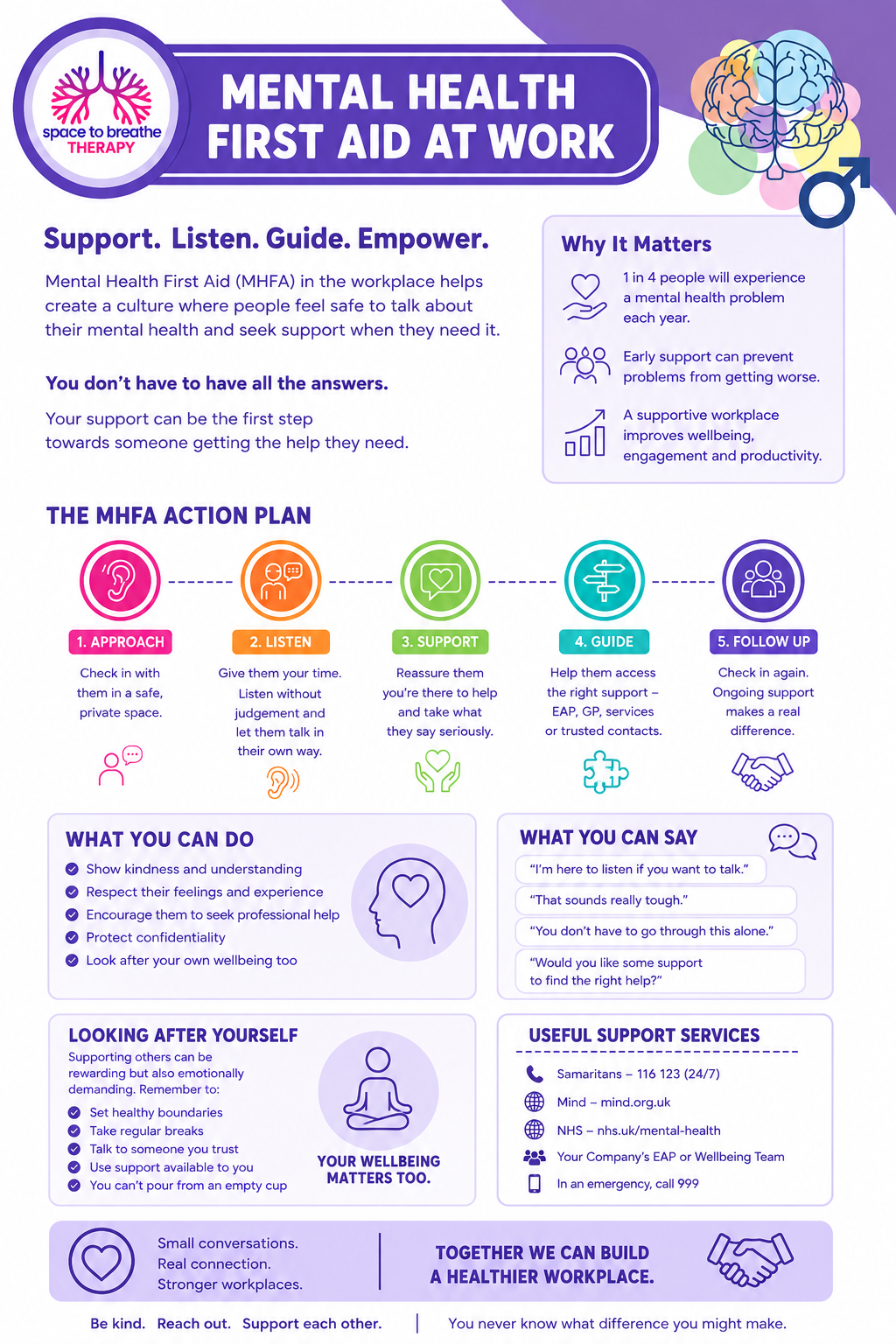
Mental Health First Aid at Work
Support. Listen. Guide. Empower.
Mental Health First Aid at work is about creating a workplace where people feel safe enough to say when they are struggling and confident that they will be met with compassion rather than judgement.
We don't have to wait until somebody reaches crisis point before offering support. Changes in behaviour, becoming quieter than usual, struggling with concentration, increased absence, appearing overwhelmed or simply seeming “not quite themselves” can all be reasons to gently check in.
You don't have to have all the answers.
Mental Health First Aid isn't about becoming someone's therapist. Your role may simply be to notice, approach, listen, support and help guide them towards the right help.
What Can I Actually Say?
This is something people often worry about.
We can become so concerned about saying the wrong thing that we avoid the conversation altogether. But supportive conversations don't need complicated language.
You could simply say:
“I'm here to listen if you want to talk.”
“I've noticed things seem difficult at the moment. How are you doing?”
“That sounds really tough.”
“You don't have to manage everything on your own.”
Or:
“Would you like me to help you find some support?”
The important part isn't having a perfect script. It's showing the person that you have noticed, you care and you are prepared to listen.
A Few Tips From Me
Give people time.
Not everyone can immediately explain how they are feeling. Silence doesn't mean the conversation has gone wrong. Give them time to process and find their words.
Don't immediately try to fix it.
Sometimes our natural response is to offer solutions. Before doing that, listen. You might even ask, “Would you like me to listen, or would you like us to think about what might help?”
Take what someone tells you seriously.
Something that feels manageable to one person may feel enormous to another. Their experience doesn't need to make sense to us for it to deserve compassion.
Remember to follow up.
This is one of the most important parts for me. Don't let the first conversation be the last. A simple “I was thinking about you — how are things today?” can mean more than we realise.
Know when the situation is beyond your role.
Supporting someone doesn't mean taking responsibility for their mental health. Help them connect with appropriate professional, workplace or emergency support when necessary.
Looking After Yourself Matters Too
There are always two people in a supportive conversation.
When you're someone who naturally cares for others, it can be very easy to keep giving without noticing what it's costing you.
Have boundaries. Take breaks. Talk to somebody you trust. Use the support available to you and recognise when you need to step back.
You can care deeply about someone without carrying everything for them.
A Message From Me
Throughout my work, one thing I continue to believe is that small conversations really can make a big difference.
We don't always know what somebody is carrying when they arrive at work.
The colleague who has become unusually quiet.
The person who keeps saying they're “fine.”
The employee who suddenly seems overwhelmed by things they would normally manage.
Sometimes the most powerful thing we can do is notice.
Ask.
Listen.
And remind another human being that they don't have to navigate everything alone.
Creating a mentally healthier workplace isn't the responsibility of one Mental Health First Aider or one manager. It's something we can all contribute to.
Be kind. Reach out. Support each other.
You never know what difference you might make.
Until next time, give yourself — and others — Space to Breathe.
Maggie
Space to Breathe Therapy




