





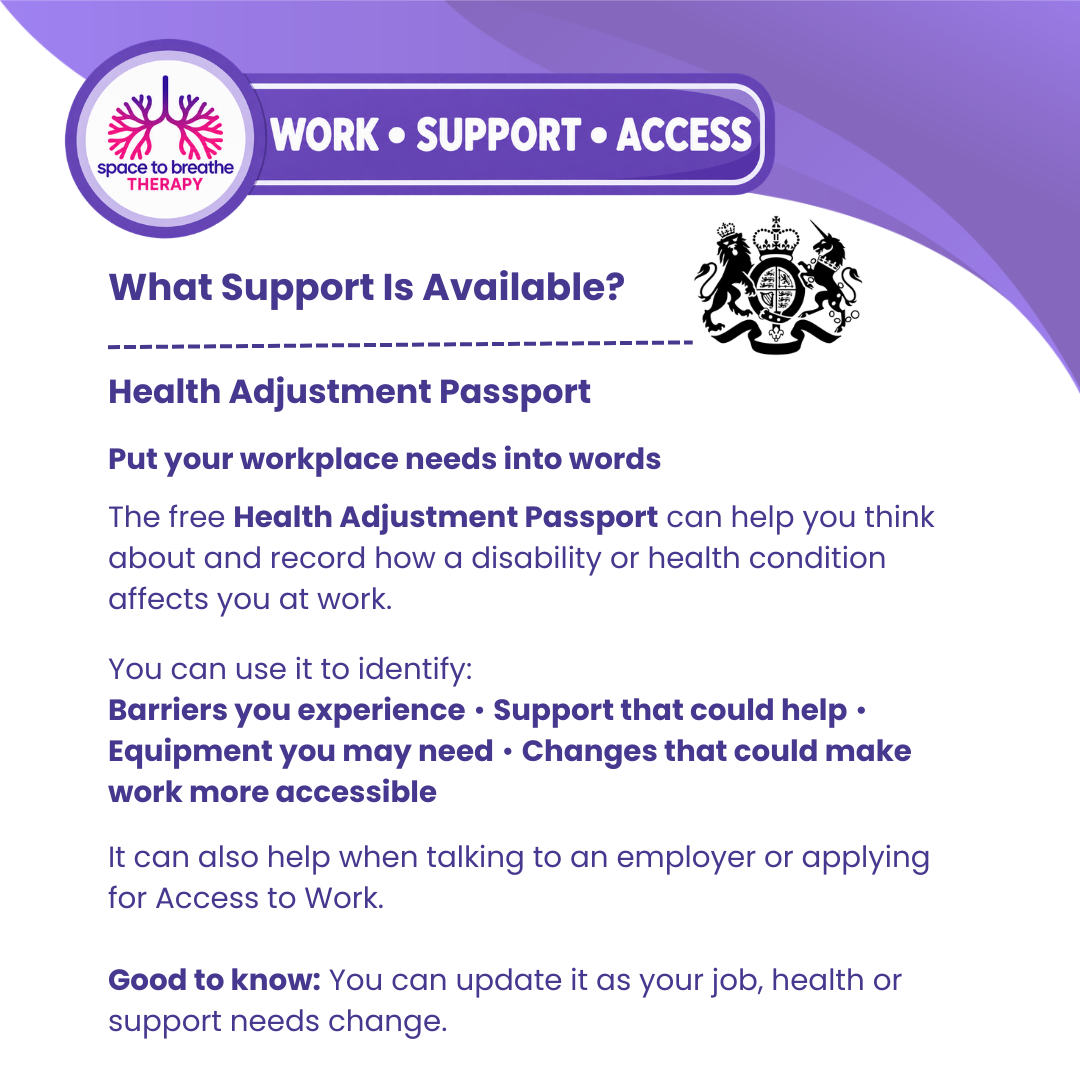
Health Adjustment Passport – Putting Your Workplace Needs Into Words
What this resource is for
The Health Adjustment Passport is a free document designed to help you think about and record how a disability or health condition affects you at work and what support may help.
It can be particularly useful when you know that something about work is difficult but find it hard to explain what the barrier is or what adjustment you might need.
Rather than focusing only on a diagnosis or condition, the passport helps you describe your individual experience of work and begin putting your needs into words.
What can I record in it?
You can use the Health Adjustment Passport to think about areas such as:
Tasks you find difficult • Barriers within your working environment • Communication needs • Equipment or technology that may help • Support from another person • Changes to working arrangements • Adjustments that have helped previously
For example, instead of simply writing:
“I have ADHD.”
you might describe:
“I find it difficult to retain several verbal instructions at once. Having instructions provided in writing helps me organise and complete tasks independently.”
That gives someone a much clearer understanding of both the barrier you experience and the possible adjustment that could help.
A helpful way to think about your needs
As you complete the passport, try thinking about:
Barrier → Impact → Adjustment
Barrier: What part of work creates difficulty?
Impact: What happens because of that difficulty?
Adjustment: What could reduce or remove the barrier?
You don't have to identify everything immediately. Sometimes we become so used to compensating for difficulties that we don't initially recognise them as barriers.
You can build the document gradually as you understand more about how you work and what helps you work effectively.
How can the passport be used?
The passport can provide a useful starting point for conversations with an employer, manager or workplace support professional.
It may help you explain your needs without having to remember everything during a meeting or find the right words when you are put on the spot.
It can also be useful when considering reasonable adjustments or preparing information about the barriers you experience when applying for Access to Work.
The passport itself does not automatically award adjustments or Access to Work funding. Its purpose is to help you identify, organise and communicate your workplace needs.
Keep it relevant to you
Two people with exactly the same diagnosis may need completely different workplace support.
One person may need assistive technology, another may benefit from written communication, another may need changes to their physical environment, and someone else may need human support or changes to how particular tasks are organised.
This is why describing what actually happens to you at work can be much more useful than simply listing your conditions.
A Personal Perspective from Maggie
One thing I have learned, both through my own experiences and through supporting people at Space to Breathe Therapy, is that putting your needs into words can sometimes be one of the hardest parts of asking for support.
For years, we can develop our own ways of coping. We compensate, work around difficulties, rely on other people or simply use far more energy than anyone around us realises.
After a while, those things can become so normal that we don't necessarily recognise them as workplace barriers.
That is one of the reasons I really like the idea behind the Health Adjustment Passport.
It encourages you to look at what is actually happening, rather than feeling that everything has to be explained or justified by a diagnosis.
I often work with people who know something isn't working but struggle when somebody asks:
“What adjustment do you need?”
Sometimes we have to work backwards together.
What happened?
Where did you get stuck?
What made that task harder?
What are you already doing to compensate?
How much additional energy is that taking?
What would have made it easier?
Those conversations can uncover needs that someone hadn't previously recognised.
I've also learned personally that our needs don't always stay the same. A strategy that worked in one job, environment or stage of life might not work somewhere else.
Changing what you need isn't failing — it's responding to where you are now.
For me, a Health Adjustment Passport shouldn't become a list of everything someone can't do.
It can be a way of saying:
“This is how I work. These are the barriers I experience. These are the things that help me. And with the right support, this is what enables me to do my job well.”
— Maggie, Space to Breathe Therapy
Your needs can change
A Health Adjustment Passport does not have to remain the same forever.
You can revisit it if:
Your role changes • You start a new job • Your working environment changes • Your health changes • You discover a new strategy that helps • Your responsibilities change • An adjustment stops meeting your needs
Something that wasn't previously a barrier may become one when your role changes. Equally, you may discover new equipment, strategies or ways of working that make a significant difference.
Keeping your passport updated can make future workplace conversations easier because you are building an ongoing picture of what helps you work at your best.
How this connects with the other resources
The Health Adjustment Passport can sit alongside the other information in the Work • Support • Access section.
You can explore information about reasonable adjustments, specialist equipment, assistive technology, communication support, job coaches and support workers, and Access to Work, and then use the Health Adjustment Passport to begin thinking about how those different forms of support might relate to your own circumstances.
You don't need to decide what you need based on your diagnosis.
Start with the barrier.
A useful starting question
Instead of asking:
“What adjustments should someone with my condition have?”
try asking:
“What creates a barrier for me at work, what impact does it have, and what could make that part of my job more accessible?”
The answer may be equipment.
It may be technology.
It may be communication.
It may be a change in the environment.
It may be another person.
Or it may be a combination of several things.
The important thing is that the support is based on you, your work and what you actually need to be able to do your job effectively.




