





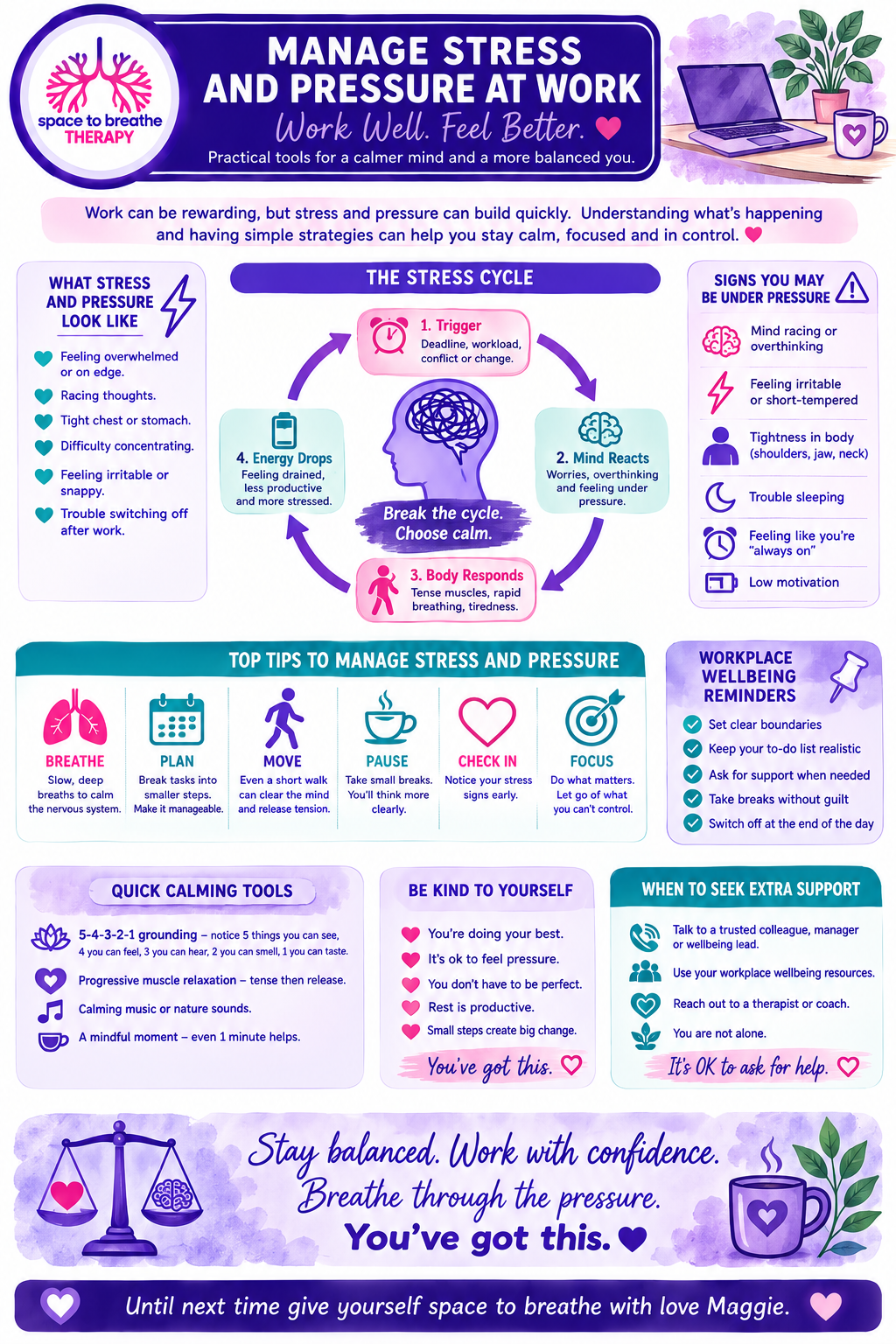
Managing Stress and Pressure at Work
When Your Working Day Starts Following You Home
A certain amount of pressure at work can help us feel motivated and focused. But there is a difference between a busy day and feeling as though you're constantly running on high alert.
Workplace stress often builds gradually.
One extra deadline.
Another email.
Someone needs something urgently.
Lunch gets pushed back.
You stay a little later.
You think about work on the drive home.
Then you're lying in bed mentally preparing for tomorrow.
Before long, work hasn't just taken over your working hours — it's taking up space in your head when you're no longer there.
Stress Doesn't Always Look Like Stress
Sometimes we don't recognise how much pressure we're under because we've become used to functioning that way.
You might notice yourself:
Becoming impatient with colleagues.
Finding it harder to make decisions.
Reading the same email several times.
Feeling exhausted but unable to switch off.
Clenching your jaw or holding tension in your shoulders.
Losing motivation.
Dreading Monday on Sunday morning.
Or feeling as though you're permanently “on.”
These can all be signals that your mind and body need some attention.
Catch the Stress Cycle Earlier
Stress can become a cycle.
Something happens.
Your mind starts racing.
Your body responds.
Your energy drops.
Then because you're tired, everything becomes harder to manage — creating even more stress.
The earlier we recognise our own cycle, the easier it can be to interrupt it.
One question I encourage people to ask is:
“What happens to me first when I'm becoming stressed?”
Your answer might be very different from somebody else's.
Learn your early warning signs.
They are useful information.
Make the Day Smaller
When your workload feels enormous, looking at the whole thing can make you feel even more overwhelmed.
Instead of:
“How am I going to get all of this done?”
try:
“What's the next thing I need to do?”
One email.
One phone call.
One task.
Then reassess.
Breaking work into smaller pieces can help your brain move from overwhelm into action.
A Tip From Me – Stop Treating Breaks as a Reward
You don't have to finish everything before you're allowed to stop.
If you wait until your work is completely finished before taking a break, you may never take one.
A short pause can help you return with better concentration and more capacity.
Stand up.
Stretch.
Get some water.
Step outside.
Move away from the screen.
Even a few minutes can create a useful interruption in the stress cycle.
Decide What Is Actually Yours to Carry
Stress can increase when we begin taking responsibility for things outside our control.
Ask:
“Is this mine to solve?”
“Can somebody else help?”
“Does this genuinely need doing today?”
“Am I putting pressure on myself that nobody else has asked for?”
“Do I need to ask for an adjustment or support?”
Being responsible doesn't mean carrying everything.
Create an End to Your Working Day
Your brain sometimes needs a clear signal that work has finished.
Before leaving, write down what needs doing tomorrow.
Close the laptop.
Clear your immediate workspace if that helps.
Turn off work notifications where possible.
Then deliberately transition into something else.
Music.
A walk.
Changing clothes.
Cooking.
Time with family.
Anything that tells your brain:
“Work has finished for today.”
If Work Is Consistently Too Much
Stress management shouldn't become a way of teaching somebody to tolerate an unhealthy working situation.
Sometimes the problem isn't that you need to breathe more deeply.
The workload may genuinely be too high.
The environment may not meet your needs.
You may need clearer boundaries, changes to duties, reasonable adjustments, additional support or a conversation with your manager.
Individual self-care matters.
But workplaces have responsibilities too.
A Message From Me
Please don't wait until you're completely exhausted before deciding that your stress is important enough to address.
Notice yourself earlier.
Take the lunch break.
Ask for help.
Break the task down.
Move your body.
Set the boundary.
Have the conversation.
And remember that being good at your job shouldn't require you to sacrifice your wellbeing to prove it.
You can be committed to your work and still have limits.
You can be professional and still need support.
And you can care about your job without allowing it to consume every part of your life.
Work well. Protect your energy. And leave some of yourself for the life waiting for you when the working day ends.
Until next time, give yourself Space to Breathe.
, Maggie
Space to Breathe Therapy




