





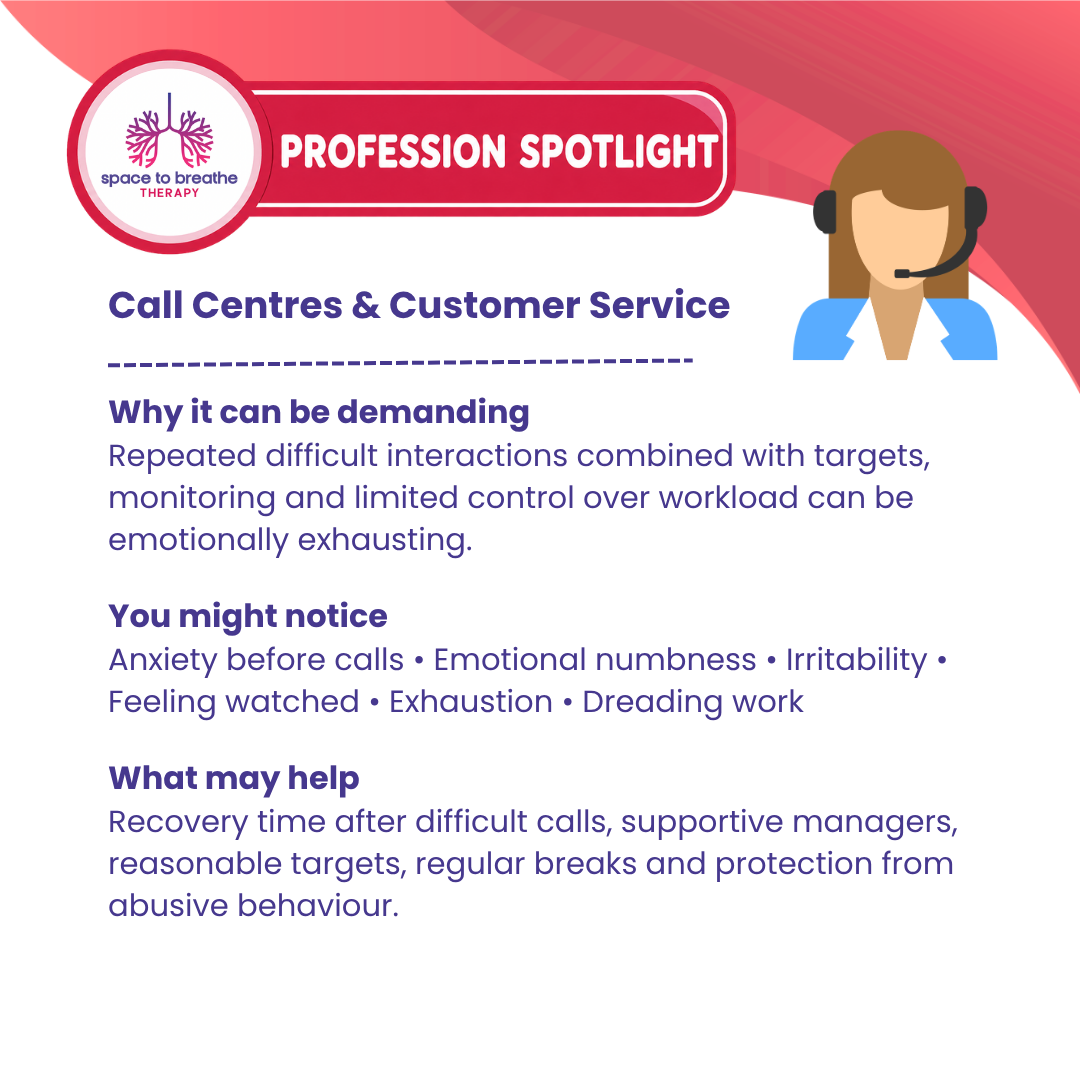
Profession Spotlight: Call Centres & Customer Service
The Emotional Impact of Being the Person on the Other End of the Line
Call centre and customer service work can sometimes be viewed as simply answering calls, responding to messages or solving customer problems. In reality, these roles can involve continuous emotional regulation, performance monitoring, repetitive demands, time pressure and frequent exposure to frustration or aggression from other people.
Workers are often expected to remain calm, friendly and professional regardless of how the person they are speaking to behaves. Doing this repeatedly throughout a shift can be mentally and emotionally exhausting.
Why can customer service work be demanding?
A typical working day may involve moving immediately from one interaction to another with very little opportunity to recover.
Workers may be expected to:
- answer a high volume of calls, emails or live chats
- resolve complicated problems quickly
- follow scripts and procedures
- meet call-handling or response-time targets
- document conversations accurately
- manage complaints
- communicate with people who are distressed or angry
- remain polite when someone is rude
- switch rapidly between different problems
- maintain concentration for long periods
- meet quality and performance measures.
One difficult interaction might be manageable. The greater strain can come from having dozens of emotionally demanding interactions repeatedly throughout the working day.
Emotional labour
Customer service involves significant emotional labour.
A worker may feel frustrated, upset, anxious or angry while simultaneously being required to sound calm and reassuring.
They may have just experienced an abusive call and then be expected to answer the next person with exactly the same positive tone.
Continually having to regulate or suppress emotional reactions can become tiring.
Someone may finish their shift feeling emotionally depleted even though their job has involved relatively little physical activity.
Dealing with angry or distressed customers
Customer frustration is often directed towards the person who answers the phone or message, even when that employee did not create the problem.
Workers may hear:
- shouting
- personal criticism
- insults
- threats
- swearing
- discriminatory comments
- repeated complaints
- distressing personal circumstances.
Understanding that someone's anger is about a situation does not necessarily stop the interaction from affecting the worker.
Being trained to manage difficult customers does not mean abusive behaviour becomes emotionally harmless.
The pressure of constant monitoring
Many call centre environments use performance measures to understand service delivery.
Depending on the workplace, employees may experience monitoring of areas such as call length, availability, customer satisfaction, quality, response times or productivity.
Performance information can be useful, but excessive pressure around metrics can leave workers feeling as though every minute of their day is being measured.
This can create a sense of being continually watched or evaluated, particularly when employees have limited control over the complexity of the calls they receive.
A five-minute target can feel very different when the person on the telephone is distressed and genuinely needs more time.
Limited control can increase stress
One particularly difficult combination is high responsibility with limited control.
A worker may be responsible for resolving someone's problem while having little authority to change the policy that caused it.
They might understand exactly why a customer is frustrated but still be unable to offer the solution that person wants.
This can create feelings of:
- helplessness
- frustration
- guilt
- anxiety
- emotional conflict
- fear of receiving poor feedback.
Workers can end up positioned between the expectations of the customer and the requirements of the organisation.
Moving straight onto the next call
After an upsetting interaction, the nervous system may need a moment to settle.
But in some roles, another call arrives almost immediately.
There may be no opportunity to stand up, breathe, have a drink or speak to a colleague before another person needs help.
Repeatedly moving from distress directly back into customer-facing work can make emotional recovery difficult.
Where possible, brief recovery time following particularly challenging or abusive interactions can be valuable.
Repetition and mental fatigue
Customer service work can involve a curious combination of repetition and unpredictability.
The structure of the calls may be repetitive, while the behaviour and needs of customers can be completely unpredictable.
Workers therefore need to remain alert even when completing similar processes repeatedly.
Over a long shift, this sustained attention can contribute to mental fatigue.
Someone may notice that towards the end of the day they are:
making more mistakes,
struggling to concentrate,
forgetting information,
becoming more irritable,
or finding relatively small problems overwhelming.
These experiences may indicate fatigue rather than a lack of ability.
Anxiety before calls
When someone has experienced repeated difficult interactions, they may begin anticipating the next one.
They might notice tension when the telephone rings or worry about what kind of customer will appear in the next queue.
Thoughts might include:
“What if this is another angry caller?”
“What if I can't solve their problem?”
“What if I say the wrong thing?”
“What if I don't meet my target?”
Anticipatory anxiety can mean the body is already preparing for difficulty before the conversation has even begun.
Emotional numbness
Some workers respond to repeated emotional demands by becoming increasingly detached.
They may notice themselves feeling less emotionally engaged with customers or simply wanting conversations to finish as quickly as possible.
This can sometimes lead to guilt:
“I used to care more.”
But emotional numbness can occur when somebody has been under sustained pressure.
Rather than immediately judging the worker, it may be more useful to consider workload, recovery, stress levels, support and the frequency of difficult interactions.
The impact of masking emotions
Customer-facing workers are frequently expected to appear cheerful regardless of how they actually feel.
Someone may be dealing with difficulties in their own life while spending an entire shift sounding positive and reassuring.
Continually presenting an emotional state that differs from what someone is experiencing internally can require considerable effort.
Workers should not have to perform happiness to prove professionalism.
Calm, respectful communication is very different from expecting employees to be endlessly cheerful.
Signs that the job may be taking a toll
Someone experiencing sustained workplace stress might notice changes such as:
Emotionally:
Irritability, anxiety, numbness, frustration, tearfulness or feeling emotionally drained.
Physically:
Headaches, muscle tension, fatigue, disrupted sleep or feeling physically tense before work.
Cognitively:
Poor concentration, forgetfulness, overthinking conversations or difficulty making decisions.
At work:
Dreading calls, watching the clock, reduced patience, fear of making mistakes or feeling increasingly overwhelmed by targets.
Outside work:
Replaying conversations, needing silence after shifts, withdrawing socially, struggling to switch off or having little emotional energy left for family and friends.
Recognising these changes early can make it easier to identify what support may be needed.
The importance of breaks
Breaks are not simply interruptions to productivity.
Customer service work requires sustained attention and emotional regulation.
Even brief opportunities to step away from the screen or headset can allow workers to move, drink, eat, use the bathroom and mentally reset.
Where possible, organisations should consider the emotional intensity of the work, rather than measuring productivity only by the amount of time somebody is actively handling customers.
Support after abusive interactions
Employees should not simply be expected to accept abuse because they work with the public.
Clear organisational procedures can help workers understand:
- what behaviour is unacceptable
- when they can end an interaction
- when a call should be escalated
- how threats are handled
- how discriminatory abuse is addressed
- what support is available afterwards.
Knowing that a manager will support them can make a substantial psychological difference.
Supportive management matters
Managers have an important role in creating psychologically safer customer service environments.
Helpful management can include:
- checking in following difficult interactions
- listening when employees raise concerns
- recognising emotional demands
- providing realistic expectations
- allowing appropriate recovery time
- responding seriously to abusive behaviour
- offering constructive rather than fear-based feedback
- ensuring employees understand escalation procedures.
A worker who feels supported is in a very different position from someone who believes they must simply absorb whatever happens.
Targets need context
Performance targets can help organisations understand efficiency, but numbers do not always capture the complexity of human interactions.
Some customers need longer conversations.
Some problems require investigation.
Some callers may be vulnerable, confused, distressed or experiencing significant personal circumstances.
Good customer service sometimes requires time, judgement and flexibility.
Performance systems work best when they recognise this complexity rather than encouraging workers to choose between helping somebody properly and meeting a number on a screen.
What can help?
Supporting wellbeing in call centres and customer service can include:
- reasonable workloads and targets
- regular protected breaks
- recovery following particularly difficult calls
- clear procedures around customer abuse
- supportive and approachable managers
- appropriate staffing
- flexibility where possible
- good training
- opportunities to raise concerns
- realistic performance expectations
- peer support
- recognition of emotional labour.
Individual wellbeing strategies can help, but responsibility should not be placed entirely on employees.
Workplace conditions matter.
Switching off after work
After spending an entire day talking, listening and solving other people's problems, some workers need quiet.
That does not necessarily mean they are being antisocial.
Their communication capacity may simply be depleted.
Creating a transition between work and home can help some people psychologically finish the working day.
This could involve changing clothes, walking, exercising, listening to music, sitting quietly or deliberately doing something that does not require interaction.
There is no single correct way to decompress.
Remember
You are not responsible for every customer's emotions.
You can provide good customer service without accepting abuse.
Needing a moment after a difficult interaction does not mean you are incapable of doing your job.
Finding constant monitoring stressful does not automatically mean you cannot cope with feedback.
Feeling exhausted after talking to people all day is understandable when your job requires continuous concentration and emotional regulation.
And needing support does not mean you have failed at customer service.
The person answering the call is a person too.
Space to Breathe Therapy
Good customer service should never require someone to sacrifice their own wellbeing in order to protect everyone else's.
This resource provides general workplace wellbeing information and is not a substitute for individual mental-health care, occupational-health advice or workplace policies and procedures.