





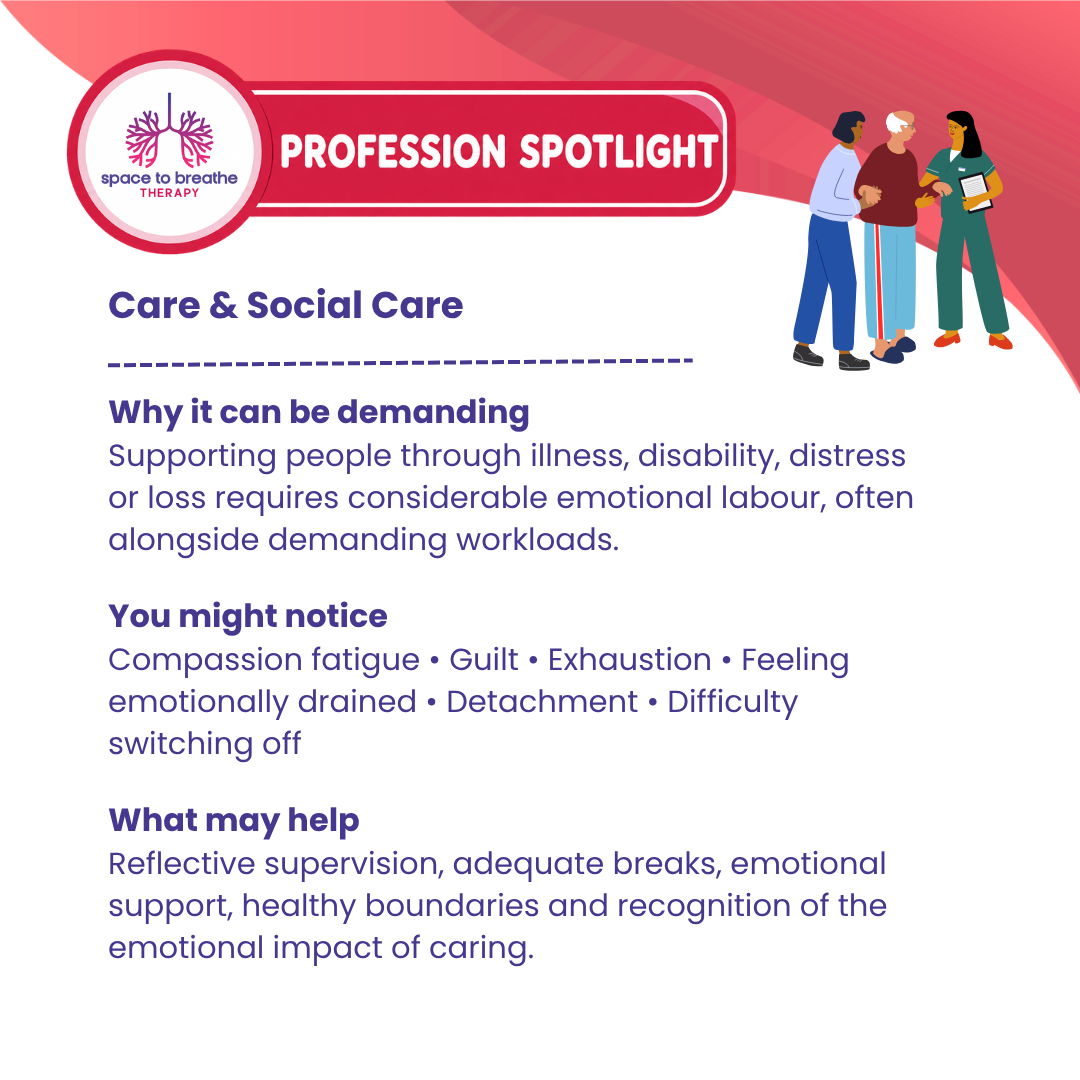
Profession Spotlight: Care & Social Care
Caring for Others Without Losing Sight of Yourself
Working in care and social care can be incredibly meaningful, but it can also carry a significant physical, emotional and psychological load.
Care workers, support workers, social care professionals and others in caring roles may support people through illness, disability, distress, bereavement, declining health, behavioural difficulties, loneliness and major changes in independence. At the same time, they may be managing busy shifts, documentation, safeguarding responsibilities, staff shortages and the practical demands of providing safe care.
The emotional impact of this work deserves to be recognised.
Why can care work be so demanding?
Caring roles often require workers to meet another person's needs while managing their own emotional response.
During one working day, somebody may need to:
- provide personal and practical care
- support someone who is frightened or distressed
- communicate with families
- respond to challenging situations
- manage changing needs
- follow care plans and procedures
- document important information
- recognise safeguarding concerns
- maintain dignity and confidentiality
- remain calm under pressure
- make difficult decisions
- move quickly between different people's needs.
This combination of emotional labour, responsibility and workload can become exhausting when there is insufficient opportunity for recovery.
Emotional labour in caring professions
Care workers do not simply complete practical tasks.
Much of the work involves relationships.
Workers may reassure someone who is frightened, remain patient when a person is distressed, listen to somebody who is lonely or provide comfort during extremely difficult moments.
This requires genuine emotional energy.
A worker may finish a shift physically tired while also feeling as though they have nothing emotionally left to give.
That experience should not automatically be interpreted as a lack of compassion. It can be an indication that someone's emotional resources need replenishing.
Compassion fatigue
Continually supporting people experiencing distress can sometimes contribute to compassion fatigue.
Someone might notice:
- feeling emotionally drained
- reduced patience
- irritability
- feeling detached
- difficulty concentrating
- feeling overwhelmed by other people's needs
- finding it harder to access empathy
- wanting to withdraw
- feeling guilty about needing distance.
People in caring professions can sometimes judge themselves harshly for these feelings because caring is central to their role.
But workers cannot continually give emotional energy without opportunities to recover.
When you become attached to the people you support
Professional boundaries do not prevent genuine human connection.
When someone has supported another person regularly for months or years, relationships naturally develop.
A worker may know someone's routines, preferences, personality, communication style and family.
When that person's health deteriorates, they move services or they die, staff can experience genuine grief.
This grief may sometimes receive less recognition because the relationship existed within a professional setting.
But professional grief is still grief.
Supporting people through loss and deterioration
Some care environments involve repeated exposure to illness, deterioration and death.
A worker may support one person through a difficult experience and then need to immediately continue caring for somebody else.
There may be little opportunity to emotionally process what has happened.
Over time, repeatedly moving from loss back into responsibility can become emotionally demanding.
Teams need space where difficult experiences can be acknowledged rather than simply absorbed.
Challenging behaviour and distress
People receiving care may sometimes communicate distress through behaviour.
Depending on the environment, workers might encounter shouting, aggression, confusion, repeated questioning, emotional outbursts, self-injury or other complex behaviours.
Understanding why behaviour is occurring does not mean it has no impact on the worker.
Someone can be compassionate towards the person they support while also acknowledging:
“That situation was difficult for me.”
Both can be true.
The impact of staff shortages
Staffing levels can significantly affect wellbeing.
When teams are short-staffed, workers may feel responsible for filling the gaps.
This can mean:
- missed or shortened breaks
- working additional hours
- rushing between people
- increased physical demands
- less time for meaningful interaction
- difficulty completing documentation
- feeling unable to provide the standard of care they want.
This can create moral distress — the uncomfortable feeling of knowing how you would like to provide care but being restricted by circumstances, resources or time.
The pressure to keep going
Caring professionals can become accustomed to putting other people's needs first.
A worker might ignore hunger because someone needs assistance, delay going to the toilet, miss a break or continue working despite exhaustion.
Occasionally responding to an urgent situation is very different from routinely working without basic opportunities for recovery.
Rest, hydration, food and breaks are not luxuries.
They support the worker's ability to continue providing safe and compassionate care.
Guilt can become part of the problem
Care workers may experience guilt about:
taking annual leave
saying no to overtime
taking a break when colleagues are busy
feeling tired
becoming frustrated
not being able to solve someone's difficulties
leaving work on time
But caring does not require unlimited availability.
Being committed to the people you support and having personal limits can exist together.
Difficulty switching off
After a demanding shift, somebody may continue thinking about work.
They might wonder whether a person is okay, replay an incident, worry about something they said or think about what will happen during their next shift.
When this happens regularly, the nervous system may have difficulty moving from responsibility into recovery.
A small end-of-shift routine can sometimes help create psychological separation.
That might mean changing clothes, walking, listening to music, showering, having something to eat or consciously recognising:
“My shift has finished. I have handed over. I am allowed to rest.”
Physical exhaustion matters too
Care work can also be physically demanding.
Workers may spend long periods standing, walking, assisting with mobility and completing repetitive tasks.
Physical tiredness can interact with emotional stress.
When the body is exhausted, patience, concentration and emotional regulation can become more difficult.
Supporting staff wellbeing therefore needs to consider the whole person, not simply their mental health.
Signs that work may be taking a toll
Changes may appear gradually.
Someone might notice:
Emotionally:
Feeling numb, irritable, tearful, anxious, guilty, detached or overwhelmed.
Physically:
Fatigue, poor sleep, headaches, tension or feeling physically depleted.
Cognitively:
Forgetfulness, reduced concentration, difficulty making decisions or repeatedly thinking about work.
At work:
Dreading shifts, feeling rushed, losing confidence, becoming less patient or feeling unable to provide the quality of care you want.
Outside work:
Withdrawing from others, having little energy for relationships, struggling to switch off or needing increasing amounts of time to recover.
These can be useful signals that something needs attention.
Reflective supervision
Good supervision should be more than checking whether tasks have been completed.
Reflective supervision can provide space to think about:
- emotionally difficult situations
- relationships with the people being supported
- professional boundaries
- safeguarding concerns
- ethical dilemmas
- workload
- personal reactions
- grief and loss
- learning and development.
Having somewhere appropriate to process difficult experiences can help prevent workers from carrying everything alone.
Peer support matters
Colleagues often understand the realities of care work in ways that people outside the profession may not.
A supportive team culture can make a significant difference.
Checking in after a difficult incident, allowing somebody time to compose themselves or simply saying “That was a difficult shift” can help people feel recognised.
Support does not always need to involve solving the problem.
Sometimes being acknowledged matters.
Boundaries are part of compassionate care
Healthy professional boundaries protect both workers and the people they support.
Boundaries may include recognising what belongs within your role, understanding when something needs escalating, taking appropriate breaks, maintaining confidentiality and recognising when you are becoming too emotionally involved.
A boundary is not a withdrawal of compassion.
It can help make compassion sustainable.
What organisations can do
Wellbeing cannot be placed entirely on individual workers.
Telling somebody to practise self-care will have limited impact if they are working in an environment with excessive workloads and insufficient support.
Organisations can help by providing:
- adequate staffing
- realistic workloads
- protected breaks
- supportive management
- appropriate training
- reflective supervision
- clear safeguarding procedures
- support following difficult incidents
- opportunities for staff to raise concerns
- psychologically safe team cultures
- recognition of the emotional impact of caring work.
Supporting staff wellbeing ultimately supports the people receiving care too.
Remember
You can care deeply about the people you support and still become tired.
You can be compassionate and need boundaries.
You can understand someone's distress and still be affected by their behaviour.
You can love your profession and have difficult days.
You can be excellent at caring for other people and sometimes need somebody to care about how you are doing too.
The aim is not to become unaffected by the work.
It is to create a way of working where compassion, responsibility, boundaries, support and recovery can exist together.
Space to Breathe Therapy
Caring for others matters. Caring for the person doing the caring matters too.
This resource provides general wellbeing information and is not a substitute for individual mental-health care, occupational-health advice, professional supervision or organisational safeguarding procedures.




