





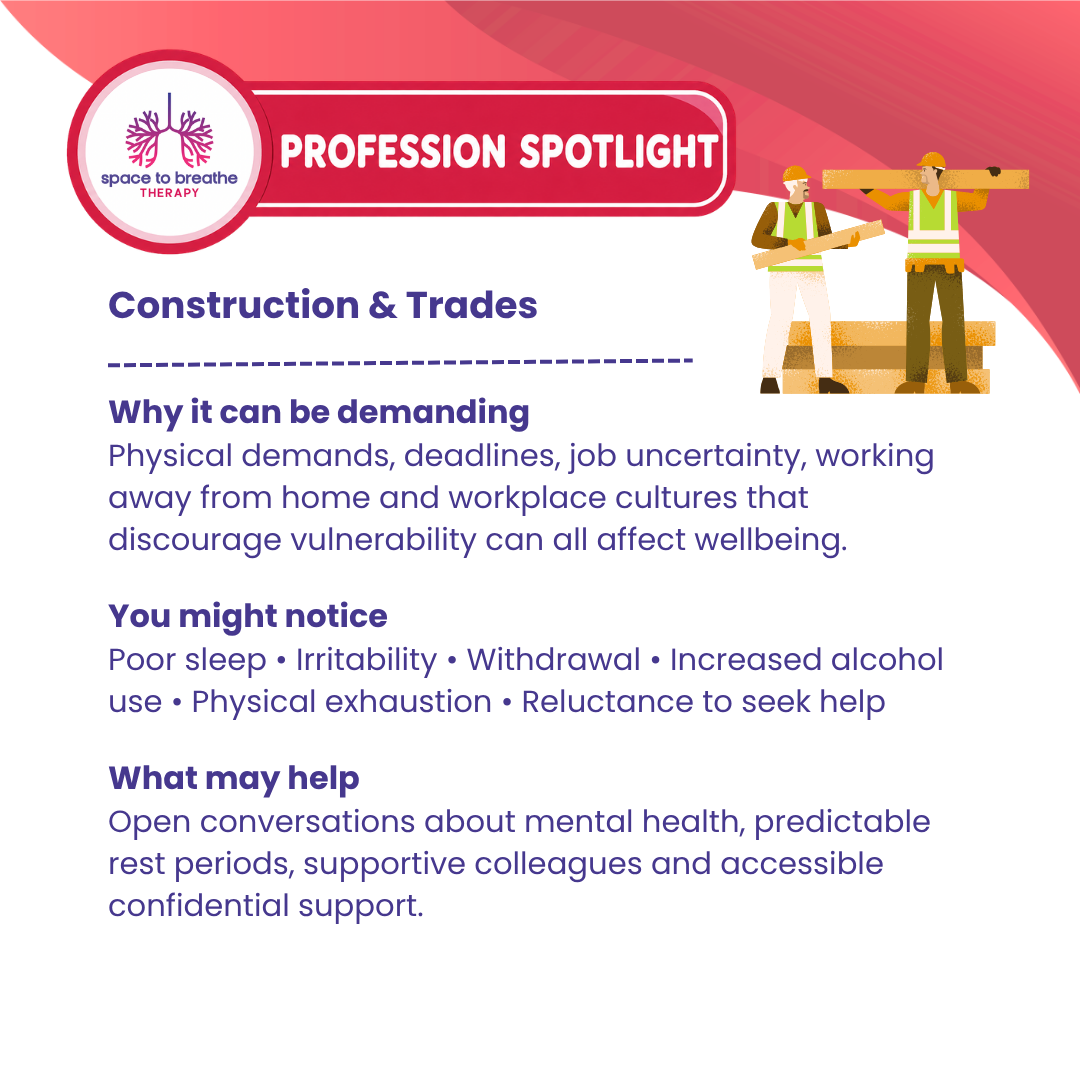
Profession Spotlight: Construction & Trades
The Physical and Mental Load Behind the Job
Construction and trade work can be skilled, rewarding and practical, but it can also place significant demands on both physical and mental wellbeing. Builders, electricians, plumbers, carpenters, roofers, decorators, engineers, labourers and other tradespeople may work in environments where physical effort, safety, deadlines, changing contracts and financial pressures exist at the same time.
There can also be a strong culture of “getting on with it”, where talking about stress, anxiety or emotional difficulties may feel uncomfortable.
Being able to cope with a demanding job does not mean the job has no impact.
Why can construction and trade work be demanding?
The demands are rarely just physical.
A working day might involve:
- heavy or repetitive physical work
- working at height or around machinery
- maintaining constant awareness of safety
- early starts and long days
- travelling significant distances
- working outdoors in difficult weather
- pressure to complete jobs on time
- delays outside your control
- managing customers and contractors
- responsibility for other workers
- changing sites and environments
- financial uncertainty
- periods working away from home.
When several of these pressures occur together, there may be little opportunity for genuine recovery.
Physical exhaustion affects mental wellbeing too
Construction and trade work can involve lifting, carrying, climbing, bending, standing and repetitive movements for many hours.
Physical fatigue does not remain separate from mental wellbeing.
When somebody is exhausted, they may find it harder to:
concentrate,
regulate emotions,
make decisions,
remain patient,
manage frustration,
or cope with unexpected problems.
Rest and recovery are therefore not simply about physical comfort. They can also support attention, emotional regulation and safe decision-making.
Safety requires constant concentration
Many trades involve genuine physical risk.
Working with tools, machinery, electricity, vehicles, heights or hazardous environments requires concentration.
Stress, poor sleep and exhaustion can make sustained attention more difficult.
This is one reason mental wellbeing should not be viewed as separate from workplace safety.
Someone who has barely slept but feels pressure to “push through” may not have the same concentration and reaction time they normally would.
Recognising when you are depleted is part of looking after yourself and the people working around you.
Deadline pressure
Construction projects frequently operate around deadlines.
A delay in one area can affect several others.
Weather, deliveries, suppliers, unexpected structural problems, other contractors or customer decisions can all change a schedule.
Yet the worker may still feel responsible for getting everything completed.
This can create a constant feeling of:
“We're already behind.”
When every working day becomes an attempt to catch up, the body and mind may remain in a prolonged state of pressure.
Job and income uncertainty
Not everyone working in construction has predictable employment.
Self-employed tradespeople, subcontractors and people moving between projects may experience periods of uncertainty about where the next job is coming from.
This can create financial pressure alongside the practical demands of the work.
Someone may worry about:
- gaps between contracts
- customers paying late
- materials becoming more expensive
- losing work through illness
- maintaining equipment or vehicles
- finding future projects
- supporting their family.
For self-employed workers in particular, taking time away from work can sometimes mean losing income.
That can make it difficult to rest even when rest is genuinely needed.
Working away from home
Some construction workers spend significant periods away from their usual support networks.
Long journeys, temporary accommodation and unfamiliar environments can affect routine.
Someone may have less access to:
- family
- friends
- regular meals
- exercise routines
- hobbies
- community
- their normal sleeping environment.
The workday may finish, but the person is still away from the place where they normally recover.
Over time, this can contribute to loneliness, disrupted sleep and difficulty maintaining relationships.
Workplace culture matters
Some construction environments have traditionally valued toughness and self-reliance.
Those qualities can be useful, but problems arise when being strong becomes confused with never admitting that anything is difficult.
Someone may be experiencing anxiety, depression, grief, financial stress or relationship difficulties while continuing to turn up and work every day.
From the outside, they may appear completely fine.
Comments such as:
“Man up.”
“Just get on with it.”
or
“Everyone's stressed.”
can make it even harder for somebody to speak.
A healthier workplace culture allows people to be capable and resilient while also acknowledging when something is wrong.
Stress does not always look like sadness
Mental distress can appear in many different ways.
Someone struggling may become:
- quieter
- more irritable
- angry
- withdrawn
- impatient
- unusually reckless
- less interested in socialising
- exhausted
- distracted
- less reliable
- increasingly negative.
They may also begin working longer hours or keeping themselves constantly busy.
Changes in behaviour can sometimes be easier to notice than somebody openly saying:
“I'm struggling.”
Poor sleep
Early starts, long working days, physical discomfort, stress and irregular schedules can all interfere with sleep.
Poor sleep can then contribute to:
- irritability
- slower thinking
- reduced concentration
- lower frustration tolerance
- emotional sensitivity
- fatigue
- difficulty remembering information.
When somebody is already working in a physically hazardous environment, persistent sleep difficulties deserve attention.
Alcohol and coping
After a physically demanding day, alcohol may become associated with switching off, socialising or relaxing.
For some people, drinking can gradually shift from something social into a way of managing stress, anxiety, sleep difficulties or emotional distress.
The important question is not simply “Do I drink?”
It may be more useful to ask:
“What am I using alcohol to do for me?”
If it has become the main way someone relaxes, sleeps, manages difficult feelings or disconnects from work, additional ways of coping may be needed.
Pain and mental wellbeing
Injuries and ongoing pain can have a significant psychological impact.
A tradesperson may worry about whether they will be able to continue doing their job, particularly when their income depends on physical ability.
Someone may continue working through pain because they cannot afford time away.
Persistent pain can also affect:
sleep,
mood,
concentration,
relationships,
energy,
and confidence.
Physical and mental wellbeing often interact rather than existing as separate issues.
The pressure of being self-employed
Running a trade business can mean being both the worker and the business owner.
The day may involve physical work followed by an evening of:
quoting jobs,
ordering materials,
answering customers,
sending invoices,
chasing payments,
organising schedules,
and completing paperwork.
Someone can technically finish work at 5pm while still working mentally until late in the evening.
Creating boundaries around administration where possible can help prevent work from occupying every available hour.
Signs you may need more recovery or support
You might notice:
Physical changes:
Persistent exhaustion, headaches, tension, pain, disrupted sleep or feeling physically depleted.
Emotional changes:
Irritability, anger, anxiety, low mood, numbness or feeling constantly under pressure.
Behavioural changes:
Withdrawing, drinking more, working excessive hours, becoming more reckless or avoiding people.
Cognitive changes:
Poor concentration, forgetfulness, difficulty making decisions or repeatedly worrying about work.
At home:
Having little patience or energy left for relationships, struggling to switch off or feeling that work has taken over everything.
One sign alone does not necessarily mean somebody has a mental-health condition. What matters is noticing changes from what is normal for you, particularly when they persist or begin affecting everyday life.
Looking out for colleagues
Sometimes a colleague notices the change before the individual does.
You do not need to diagnose somebody or know exactly what to say.
A simple:
“You don't seem yourself lately. How are things?”
can open a conversation.
If they say they are struggling, listening without immediately trying to fix everything can be valuable.
The aim is not to become their therapist.
It is to make it easier for someone to acknowledge that they may need support.
What can employers and site managers do?
Workplace wellbeing should not depend entirely on individual resilience.
Supportive construction environments can include:
- realistic workloads and deadlines
- predictable rest periods
- appropriate staffing
- clear communication
- safe working practices
- respectful management
- access to confidential support
- opportunities to raise concerns
- sensible approaches to working hours
- support following serious incidents
- a culture where mental-health conversations are acceptable.
Mental wellbeing belongs alongside physical safety rather than being treated as something completely separate.
Recovery matters
Recovery does not have to mean doing nothing.
For different people it might involve:
sleep,
time with family,
exercise,
walking,
hobbies,
sport,
quiet,
being outdoors,
social connection,
or simply having time where nobody needs anything from them.
The important part is having periods where the body and mind are not continuously responding to work demands.
Remember
Being physically strong does not make someone immune to stress.
Being good at your trade does not mean you should cope with unlimited pressure.
Talking about mental health does not make someone less capable.
Taking a break is not laziness.
Asking for help is not weakness.
And being the person everyone relies upon does not mean you must manage everything alone.
Strength can also mean recognising when something needs to change.
Space to Breathe Therapy
You spend your working life building, repairing and keeping things going. Your own wellbeing deserves maintenance too.
This resource provides general workplace wellbeing information and is not a substitute for individual medical or mental-health care, occupational-health advice or workplace health and safety procedures.