





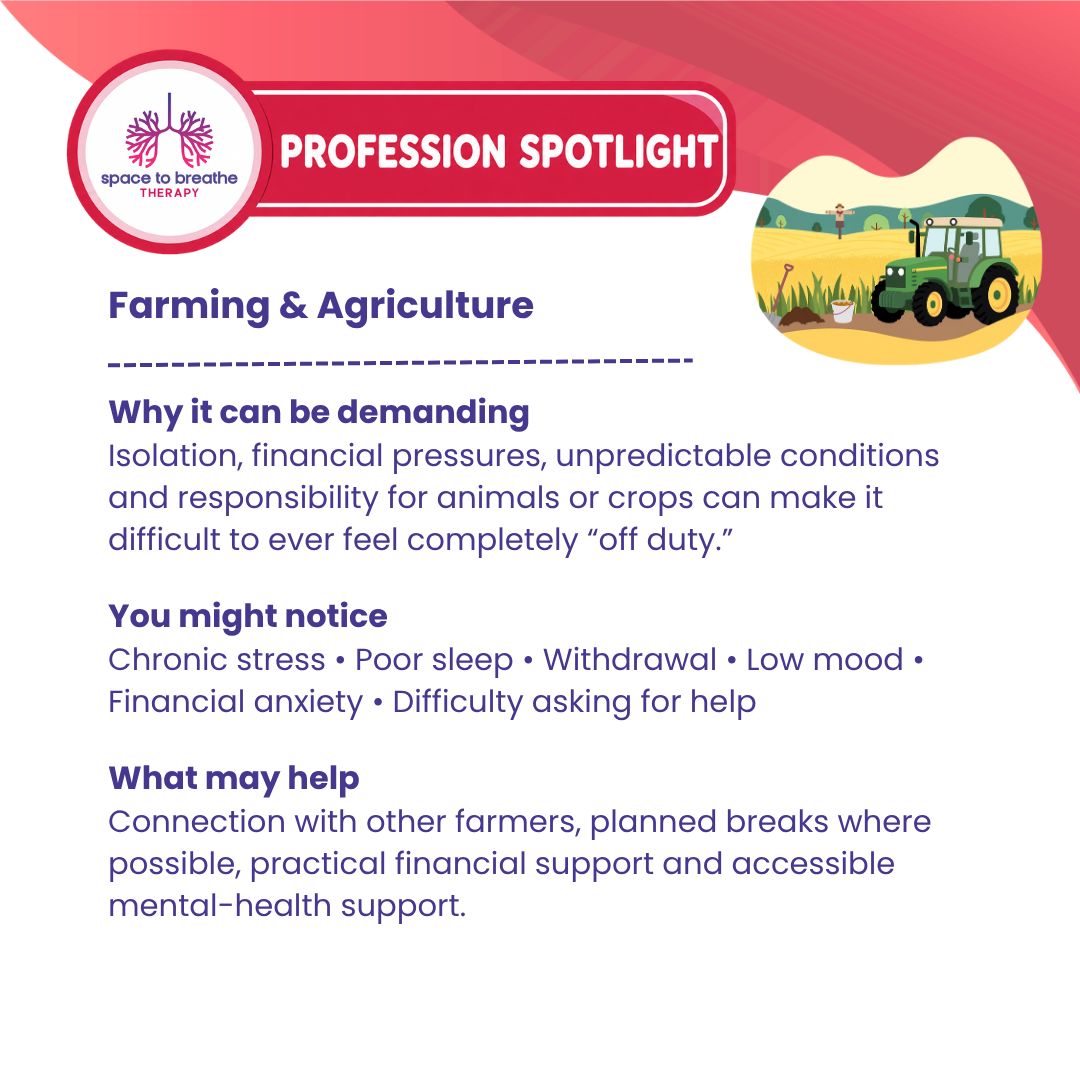
Profession Spotlight: Farming & Agriculture
The Mental-Health Impact of Working in Agriculture
Farming and agricultural work can provide a powerful sense of purpose, independence, connection with the land and pride in producing food and caring for animals. At the same time, it can involve a combination of pressures that are difficult to leave behind at the end of a working day.
For many farmers, home, work, family, finances and identity are closely connected. When something goes wrong within the business, it can therefore affect far more than someone's job.
Why farming can be demanding
Agricultural work is influenced by many things that cannot be completely controlled.
These can include:
- unpredictable weather
- crop failure or poor yields
- livestock illness or loss
- fluctuating market prices
- increasing operating costs
- machinery breakdowns
- long and physically demanding days
- seasonal workload
- working alone
- financial uncertainty
- responsibility for employees
- changing regulations and paperwork
- succession and family-business pressures.
Unlike many occupations, it may not be possible to simply finish work at five o'clock and leave the workplace behind.
Animals still need feeding. Crops still need attention. Equipment may need repairing. Weather conditions can suddenly change plans.
That constant responsibility can make genuine recovery time difficult.
The impact of isolation
Agricultural work can involve spending long periods alone.
Some people may work for hours without meaningful contact with another person, particularly during busy seasonal periods or when working in remote locations.
Being comfortable alone is not the same as having enough connection.
When somebody is struggling, isolation can make it easier to withdraw further. There may also be fewer opportunities for another person to notice changes in their mood or behaviour.
Regular contact with other farmers, friends, family, agricultural groups or community organisations can therefore be important.
Financial pressure
Farming businesses can carry significant financial responsibility.
Income may be affected by circumstances outside an individual's control while many costs continue regardless.
Financial pressure can lead to:
constant worry → difficulty sleeping → exhaustion → reduced concentration → feeling less able to cope.
Financial stress can also feel extremely personal when a farm has belonged to a family for generations.
Seeking financial or business advice early can sometimes help someone see options that become difficult to recognise when they are overwhelmed.
When the farm is also your home
For many agricultural workers there is very little physical separation between work and home.
Looking out of the window may mean looking directly at unfinished work.
This can make switching off psychologically difficult.
Even when somebody technically takes a break, their attention may remain on what needs doing next.
Creating small boundaries can still be useful, even when complete separation is impossible.
That might mean protecting one evening where possible, having meals away from paperwork, taking a short walk that is not connected with checking livestock, or deliberately creating periods where business conversations stop.
Responsibility for animals
Caring for livestock can bring enormous satisfaction, but it also carries emotional responsibility.
Farmers may experience:
- worry about animal health
- difficult births
- illness
- injury
- livestock losses
- difficult decisions about treatment
- euthanasia or culling
- concern about maintaining welfare during extreme weather.
Repeated exposure to loss does not necessarily make someone emotionally unaffected by it.
It is possible to understand something as part of agricultural life while still finding individual situations upsetting.
Physical exhaustion affects emotional wellbeing
Agriculture can be physically demanding.
Long hours, early mornings, interrupted sleep and strenuous work can gradually reduce someone's capacity to manage additional stress.
When exhausted, people may become:
more irritable,
less patient,
more emotional,
less able to concentrate,
more forgetful,
or less motivated.
These changes are sometimes interpreted as personal weakness when the body may simply have been operating without enough recovery.
Seasonal pressure
Some periods of agricultural work are particularly intense.
Harvesting, lambing, calving, planting and other seasonal responsibilities may involve long days and disrupted sleep.
Short periods of increased workload may be manageable, but difficulty can arise when one demanding period repeatedly runs into another without meaningful recovery.
Recovery should therefore be considered part of maintaining the ability to work — not simply something earned after everything has been completed.
On a farm, everything may never be completely finished.
You might notice
Stress does not look the same in everyone.
Someone struggling may notice:
Physical changes
Poor sleep, exhaustion, headaches, muscle tension or changes in appetite.
Emotional changes
Low mood, anxiety, irritability, frustration, hopelessness or feeling constantly under pressure.
Behavioural changes
Withdrawing from other people, working increasingly long hours, neglecting breaks or relying more heavily on alcohol or other coping behaviours.
Thinking changes
Difficulty concentrating, forgetfulness, indecision, excessive worrying or feeling unable to see solutions.
Sometimes the first sign is simply:
“I don't feel like myself anymore.”
That is worth paying attention to.
The pressure to keep going
Farming cultures can sometimes place considerable value on resilience, independence and getting the job done.
Those qualities can be strengths.
But resilience does not mean coping alone indefinitely.
Someone can be capable, experienced and hardworking while still needing support.
Asking for help does not erase years of independence.
When your identity is connected to farming
For some people farming is much more than an occupation.
It can represent:
family,
history,
community,
responsibility,
identity,
and generations of work.
This can make difficulties within the farm feel like personal failure.
They are not the same thing.
A difficult season does not make someone a bad farmer.
Financial difficulty does not determine someone's value.
Needing support does not mean somebody is incapable of running their business.
What may help
Support does not always have to begin with formal therapy.
It might start with:
- speaking honestly with someone trusted
- connecting regularly with other farmers
- sharing responsibilities where possible
- planning realistic breaks during intensive periods
- protecting sleep whenever circumstances allow
- getting practical financial or business advice
- addressing physical-health concerns
- noticing increased alcohol use rather than ignoring it
- creating small boundaries between home and work
- accessing confidential emotional support
- speaking to a GP or mental-health professional when difficulties persist.
Sometimes the most useful question is not:
“How can I cope with more?”
but:
“What could reduce some of the pressure I'm carrying?”
Supporting someone working in agriculture
If you are worried about someone, you do not need perfect words.
A simple conversation can begin with:
“You don't seem yourself lately. How are things really going?”
Listen without immediately trying to solve everything.
Practical support can also matter. Someone overwhelmed by farming responsibilities may find it difficult to engage with help if they believe stepping away will create even more work.
Remember
Farming asks people to manage uncertainty constantly.
Weather changes. Markets change. Animals become ill. Machinery breaks. Plans have to change.
You cannot control every variable.
Looking after the person carrying those responsibilities is part of looking after the farm.
Space to Breathe Therapy
You don't have to wait until everything becomes unmanageable before asking for support.
This resource provides general wellbeing information and is not a substitute for individual medical, mental-health, financial or occupational advice.




