





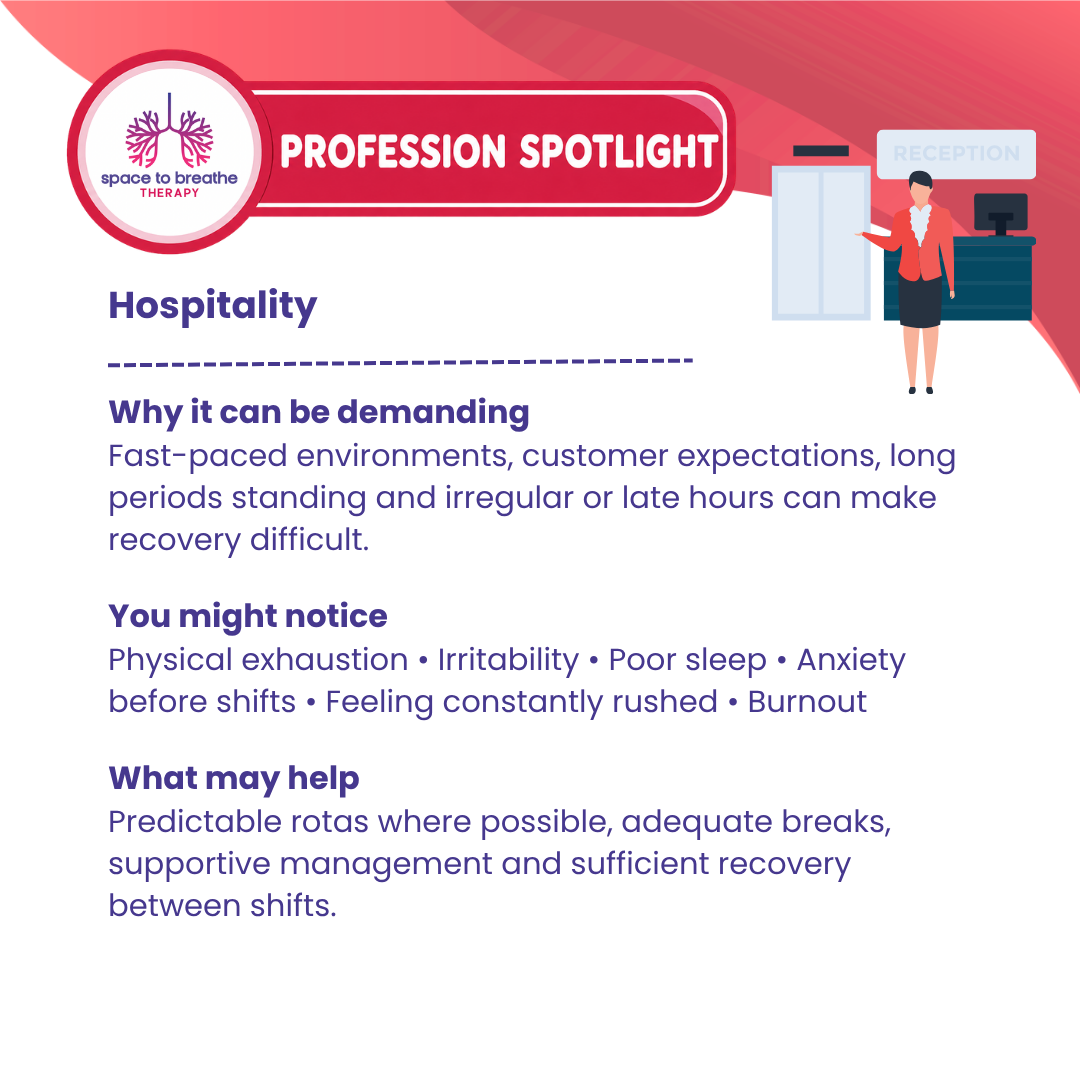
Profession Spotlight: Hospitality
Understanding the Mental, Emotional and Physical Demands of Hospitality Work
Hospitality is built around creating positive experiences for other people, but the people providing those experiences can work under considerable pressure.
Hotel staff, receptionists, restaurant teams, chefs, kitchen staff, bar staff, housekeeping teams, catering workers, event staff and hospitality managers may spend much of their working day responding to other people's needs while working at speed.
The combination of customer expectations, unpredictable demand, emotional labour, physical work, irregular hours and limited recovery time can make hospitality particularly demanding.
Why can hospitality feel so demanding?
Hospitality work often requires people to manage several demands simultaneously.
A receptionist might be answering the telephone while checking somebody in and dealing with a complaint. A server may be managing several tables while remembering dietary requirements and responding to delays from the kitchen. A chef may be coordinating multiple orders against strict timings in a hot, noisy environment.
Common pressures can include:
- fast-paced working environments
- unpredictable busy periods
- customer complaints
- difficult or aggressive behaviour
- pressure to remain friendly regardless of how you feel
- long periods standing or walking
- repetitive physical tasks
- lifting and carrying
- hot, noisy or crowded environments
- staff shortages
- covering absent colleagues
- irregular shifts
- late nights and early mornings
- weekend and bank-holiday working
- changing rotas
- limited opportunities for breaks
- pressure around service times
- responsibility for food safety and customer needs.
One busy shift may be manageable. The difficulty can develop when high pressure becomes the normal working environment without sufficient opportunity to recover.
The emotional labour of hospitality
Hospitality employees are frequently expected to appear calm, welcoming and helpful regardless of what is happening around them.
This is sometimes described as emotional labour—managing or displaying emotions as part of a professional role.
A customer may be angry about something outside an employee's control, yet the employee may still be expected to remain polite and reassuring.
Someone may have just dealt with an upsetting interaction and immediately need to smile and welcome the next customer.
Repeatedly regulating emotions in this way can be tiring.
Customer service does not mean employees should be expected to tolerate humiliation, harassment, threats or abuse.
When everything feels urgent
Hospitality can create a constant sense of urgency.
Orders need completing.
Rooms need preparing.
Customers are waiting.
Tables need clearing.
Phones are ringing.
Another guest has arrived.
Someone has called in sick.
When everything appears urgent, the nervous system may spend much of the shift in a heightened state of alertness.
Some people notice that this feeling continues after work. They arrive home exhausted but find it difficult to settle, relax or sleep.
Irregular hours and sleep
Hospitality rarely operates around conventional working hours.
Evenings, weekends, split shifts, early starts and late finishes may be part of the job.
Irregular schedules can make it more difficult to maintain consistent routines around sleep, meals, exercise, relationships and social activities.
Finishing work late does not necessarily mean somebody can immediately sleep. After several hours of noise, movement, problem-solving and customer interaction, the body and mind may need time to transition out of “work mode.”
When late finishes are followed by early starts, opportunities for recovery can become particularly limited.
Physical demands matter too
Hospitality stress is not purely psychological.
Many roles involve spending long periods standing, walking, bending, reaching, carrying or completing repetitive tasks.
Kitchen staff may work around heat and noise. Housekeeping can involve substantial repetitive physical activity. Waiting and bar staff may spend an entire shift on their feet.
Physical tiredness can reduce emotional capacity too.
When someone is already physically exhausted, dealing calmly with another complaint, unexpected request or change can become considerably harder.
Sensory overload
Some hospitality environments are extremely stimulating.
Music, conversations, kitchen noise, machinery, bright lighting, smells, movement and continual interruptions may all occur simultaneously.
For some people—particularly those with sensory sensitivities or neurodivergent employees—this can add another significant layer of demand.
Sensory overload might appear as irritability, headaches, difficulty concentrating, needing silence after work, becoming increasingly overwhelmed during busy periods or feeling completely depleted after a shift.
Where appropriate, reasonable workplace adjustments may help reduce unnecessary barriers.
Signs that work pressure may be building
People experience stress differently, but changes might include:
Physical: persistent tiredness, headaches, muscle tension, poor sleep or feeling physically depleted after shifts.
Emotional: irritability, anxiety, frustration, tearfulness, emotional numbness or becoming increasingly impatient.
Cognitive: difficulty concentrating, forgetfulness, feeling mentally overloaded or finding decision-making harder.
Behavioural: withdrawing from colleagues, skipping meals or breaks, working excessive hours, relying increasingly on alcohol to unwind or dreading upcoming shifts.
Someone may also notice that they are no longer recovering between shifts.
That can be an important warning sign.
Anxiety before a shift
Some hospitality workers begin feeling anxious hours before work.
They may be thinking:
Who am I working with?
Will we be short staffed?
How busy will it be?
Will that difficult customer return?
Will I finish on time?
What will go wrong tonight?
Occasional nerves before a particularly demanding shift are different from routinely losing large parts of your personal time to anticipatory anxiety.
If work begins affecting wellbeing before the shift has even started, it may be worth looking more closely at the pressures involved.
Burnout in hospitality
Burnout is associated with chronic workplace stress that has not been successfully managed.
Someone experiencing burnout may feel exhausted, increasingly detached from their job or less able to perform at their usual level.
They may become cynical about customers, lose enthusiasm for work or feel that every additional request is simply too much.
This does not necessarily mean they are uncaring or unsuitable for hospitality.
Sometimes it means they have been operating beyond their available emotional and physical resources for too long.
The impact of understaffing
Staff shortages can have a considerable effect on everyone working a shift.
Employees may work faster, miss breaks, take responsibility for additional areas and stay beyond their expected finishing time.
The remaining staff may feel responsible for preventing the service from falling apart.
Occasionally helping during an unexpected shortage is very different from chronic understaffing becoming the normal way a workplace operates.
Employees cannot continually compensate for structural staffing problems through personal exhaustion.
Breaks are part of safe working
Busy periods can make breaks feel inconvenient, but regularly missing opportunities to eat, drink, use the bathroom, sit down or mentally reset can contribute to exhaustion.
A break is not simply a reward for finishing everything.
In hospitality, there may never be a moment when absolutely everything is finished.
Protecting reasonable opportunities for recovery during a shift can therefore be important for both wellbeing and sustained performance.
Predictability can reduce unnecessary stress
Hospitality will always contain some unpredictability, but workplaces can avoid adding unnecessary uncertainty.
Where possible, advance rotas, clear responsibilities, good handovers and realistic expectations can help employees organise their lives and prepare for work.
Frequent last-minute rota changes can affect childcare, appointments, sleep, relationships and the ability to properly use time away from work.
Predictability itself can therefore support wellbeing.
Supportive management matters
Managers play an important role in hospitality wellbeing.
Support can include:
- responding appropriately to abusive customers
- ensuring employees know they will be backed when boundaries are crossed
- creating realistic staffing levels where possible
- encouraging appropriate breaks
- communicating rotas clearly
- listening when workload becomes unmanageable
- distributing responsibilities fairly
- recognising good work
- providing clear expectations
- avoiding a culture where exhaustion is treated as commitment.
Employees should not have to choose between protecting themselves and being considered a “team player.”
What might help?
Individual strategies cannot solve organisational problems, but some approaches may help reduce unnecessary strain.
Before a shift, having food, hydration and practical necessities available can reduce additional stress.
During work, taking available breaks, drinking regularly and asking for help before becoming completely overwhelmed can be useful.
After work, creating a short transition routine may help signal that the shift has ended.
This might involve changing clothes, showering, eating, taking a short walk, listening to music or spending a little time somewhere quiet.
The purpose is not to create another task that must be completed perfectly.
It is simply to help the body move from serving, responding and problem-solving into recovery.
When customers behave badly
Hospitality employees sometimes face behaviour that goes far beyond an ordinary complaint.
Being sworn at, sexually harassed, threatened, intimidated or personally insulted should not simply be accepted as “part of customer service.”
Workplaces should have clear procedures for managing unacceptable behaviour and employees should know when and how they can seek support.
A customer being unhappy does not remove an employee's right to dignity and safety at work.
Supporting colleagues
Hospitality teams often become close because people experience intense shifts together.
That makes colleagues well placed to notice changes.
Someone who is normally energetic may become withdrawn. Another person may become unusually irritable or begin saying they cannot face another shift.
A simple conversation can help:
“You seem exhausted lately. Are you doing okay?”
You do not need to diagnose someone or solve everything.
Sometimes being noticed matters.
Remember
You can be excellent at customer service and still have boundaries.
You can enjoy hospitality and still find the hours exhausting.
You can be a team player without continually sacrificing your own wellbeing.
You can be friendly without accepting abusive behaviour.
You can need a break without being lazy.
You can say that a workload is unrealistic without being incapable.
And you can love creating good experiences for other people while recognising that your experience at work matters too.
Hospitality asks people to look after others for much of their working day. The people providing that care, service and welcome deserve supportive workplaces as well.
Space to Breathe Therapy
You spend your working day creating space for other people's needs. Make sure there is some space left for yours.
This resource provides general information and does not replace individual medical, psychological, occupational-health or employment advice.