





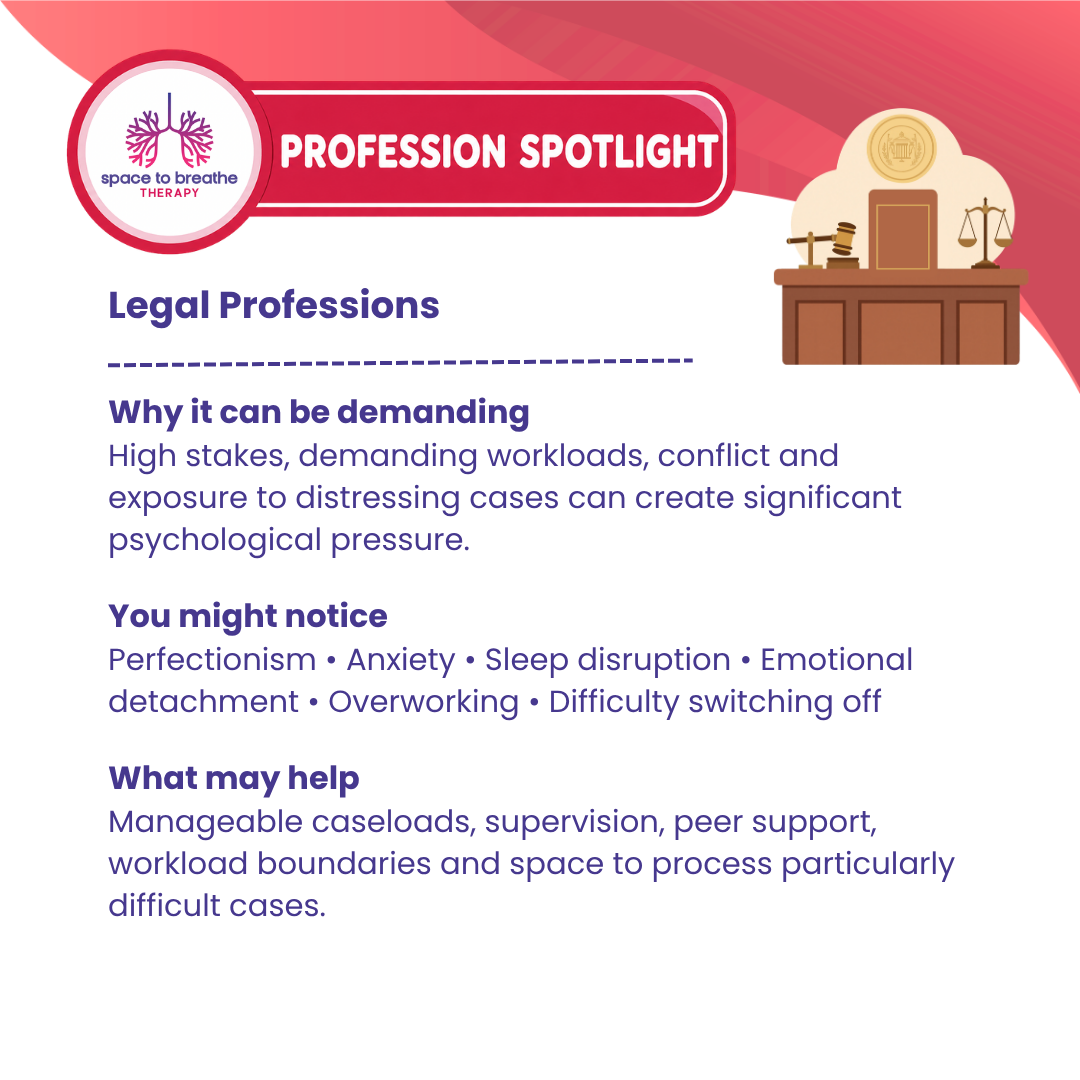
Profession Spotlight: Legal Professions
Mental Health, Pressure & Wellbeing in Legal Work
Working within the legal profession can be intellectually rewarding, purposeful and varied. Solicitors, barristers, paralegals, legal executives, court staff and others working within legal services may help people navigate some of the most important and difficult periods of their lives.
Alongside this responsibility can come high workloads, strict deadlines, demanding caseloads, conflict, responsibility for outcomes and exposure to distressing material. Over time, these pressures can affect emotional and physical wellbeing.
Why legal work can be demanding
Legal professionals may work in environments where accuracy matters and mistakes can have significant consequences.
Pressures can include:
- demanding caseloads
- court and filing deadlines
- long or unpredictable working hours
- responsibility for clients and cases
- emotionally distressed or demanding clients
- adversarial interactions and conflict
- pressure to meet financial or performance targets
- large amounts of detailed information
- constant decision-making
- expectations of professionalism regardless of how you feel
- difficulty taking uninterrupted breaks
- pressure to remain available outside normal working hours.
When several of these pressures happen together, someone can spend much of their working day in a state of heightened alertness.
The pressure to get everything right
Attention to detail is an important part of legal practice.
However, high professional standards can sometimes develop into perfectionism.
Someone may begin repeatedly checking work, worrying excessively about mistakes or finding it difficult to feel that something is finished.
Thoughts might include:
“What if I've missed something?”
“I should check it again.”
“I can't afford to make a mistake.”
“Everyone else seems to be coping better than I am.”
Checking and preparation are necessary parts of legal work. The difficulty comes when fear rather than professional judgement begins driving them.
Carrying responsibility
Legal professionals often work with people facing circumstances that can significantly affect their lives.
A client may be dealing with:
divorce,
bereavement,
criminal proceedings,
employment difficulties,
financial problems,
housing issues,
child arrangements,
immigration concerns,
abuse,
injury,
or other major life events.
The legal professional needs to remain focused on the case while also communicating with someone who may be frightened, angry, grieving or overwhelmed.
That emotional labour can be substantial.
Exposure to traumatic material
Some areas of legal practice involve repeated exposure to disturbing accounts, photographs, evidence or testimony.
Professionals working with criminal cases, family law, abuse, serious injury or other traumatic material may find that some cases stay with them after work.
This does not mean they are unable to do their job.
Repeated indirect exposure to another person's trauma can have an emotional impact on professionals too.
Possible experiences can include intrusive thoughts, emotional numbness, irritability, disturbed sleep or finding it increasingly difficult to hear distressing material.
Good supervision and opportunities to process particularly difficult work can therefore be important.
Emotional detachment
Professional boundaries are necessary.
But there is a difference between having boundaries and becoming emotionally disconnected as a way of surviving the workload.
Someone may begin to notice:
“I don't feel anything anymore.”
Or they may become unusually irritable, cynical or impatient.
Emotional detachment can sometimes be a sign that a person has been carrying too much for too long rather than evidence that they no longer care.
Difficulty switching off
Legal work can follow someone home mentally even when the files remain at work.
You might replay conversations, think about tomorrow's hearing, remember something you need to check or worry about a client's situation.
Technology can make this harder.
Emails, messages and remote working can create the sense that work is permanently accessible.
Without boundaries, availability can gradually become expectation.
Creating a defined end to the working day where possible can help the brain transition out of professional problem-solving mode.
Sleep and legal work
When the brain remains focused on unresolved problems, sleep can become difficult.
Someone may lie awake:
rehearsing arguments,
remembering tasks,
thinking about deadlines,
or worrying about something they might have overlooked.
Poor sleep can then affect concentration, emotional regulation and decision-making the following day.
This can create a cycle:
Pressure → worry → poor sleep → fatigue → reduced concentration → increased worry about performance.
Recognising the cycle can be the first step towards interrupting it.
You might notice
Signs that workplace pressure is beginning to affect wellbeing can include:
Emotionally:
Anxiety, irritability, low mood, emotional numbness, frustration, guilt or feeling overwhelmed.
Cognitively:
Overthinking, difficulty concentrating, indecision, forgetfulness, repeatedly checking work or worrying excessively about mistakes.
Physically:
Poor sleep, exhaustion, headaches, muscle tension or feeling constantly physically activated.
Behaviourally:
Working increasingly long hours, skipping breaks, withdrawing from colleagues, avoiding certain tasks or finding it difficult to leave work unfinished.
Professionally:
Loss of confidence, reduced motivation, feeling detached from clients, dreading particular cases or believing you must work harder simply to keep up.
These experiences do not automatically indicate a mental-health condition, but they can be important signs that something needs attention.
When overworking becomes normal
Legal cultures can sometimes reward long hours, responsiveness and high productivity.
Someone who is struggling may respond by working even more.
But additional hours do not always produce additional capacity.
Once someone becomes exhausted, tasks may take longer, concentration can become more difficult and mistakes may become more likely.
Rest is therefore not the opposite of professional performance.
Recovery helps support sustainable performance.
What may help
Protective strategies can include:
- manageable caseloads where possible
- clear workload priorities
- appropriate supervision
- peer support
- protected breaks
- realistic expectations around availability
- boundaries around emails outside working hours
- opportunities to discuss difficult cases
- regular annual leave
- separating urgent work from work that can wait
- recognising perfectionistic working patterns
- maintaining relationships and activities outside the profession
- seeking professional support when stress becomes persistent.
Sometimes a useful question is:
“What am I carrying that doesn't actually need to be carried alone?”
The role of supervision
Supervision should not only be about whether work has been completed.
Good supervision can provide space to discuss workload, professional uncertainty, challenging client relationships and the emotional impact of difficult cases.
Being able to say “This case is affecting me” should not be interpreted as professional incompetence.
Awareness of your own emotional responses can be part of safe and reflective professional practice.
Supporting colleagues
Changes in a colleague may be subtle.
Someone who was previously sociable may become withdrawn.
A normally organised colleague may begin forgetting things.
Someone may work increasingly late, stop taking breaks or become unusually irritable.
Rather than assuming poor performance or lack of commitment, it can be helpful to ask:
“I've noticed you seem under a lot of pressure recently. How are you doing?”
That conversation may be more valuable than you realise.
For legal organisations
Workplace wellbeing cannot rely entirely on individuals becoming better at coping with excessive pressure.
Organisations can support staff through:
- realistic caseload expectations
- psychologically safe management
- appropriate staffing
- protected breaks
- meaningful supervision
- respectful workplace cultures
- appropriate responses to bullying or harassment
- support following traumatic cases
- clear expectations around out-of-hours communication
- reasonable adjustments where required
- confidential routes to support.
A wellbeing initiative cannot compensate for consistently unmanageable workloads.
Remember
Being able to work under pressure does not mean pressure has no effect on you.
Professionalism does not require emotional invulnerability.
You can care deeply about your clients while maintaining boundaries.
You can be highly competent and still need support.
And asking for help does not undermine your professional ability.
Space to Breathe Therapy
You spend a great deal of time helping other people navigate difficult situations. Your own wellbeing deserves attention too.
This resource provides general wellbeing information and is not a substitute for individual medical, mental-health, occupational-health or legal advice.




