





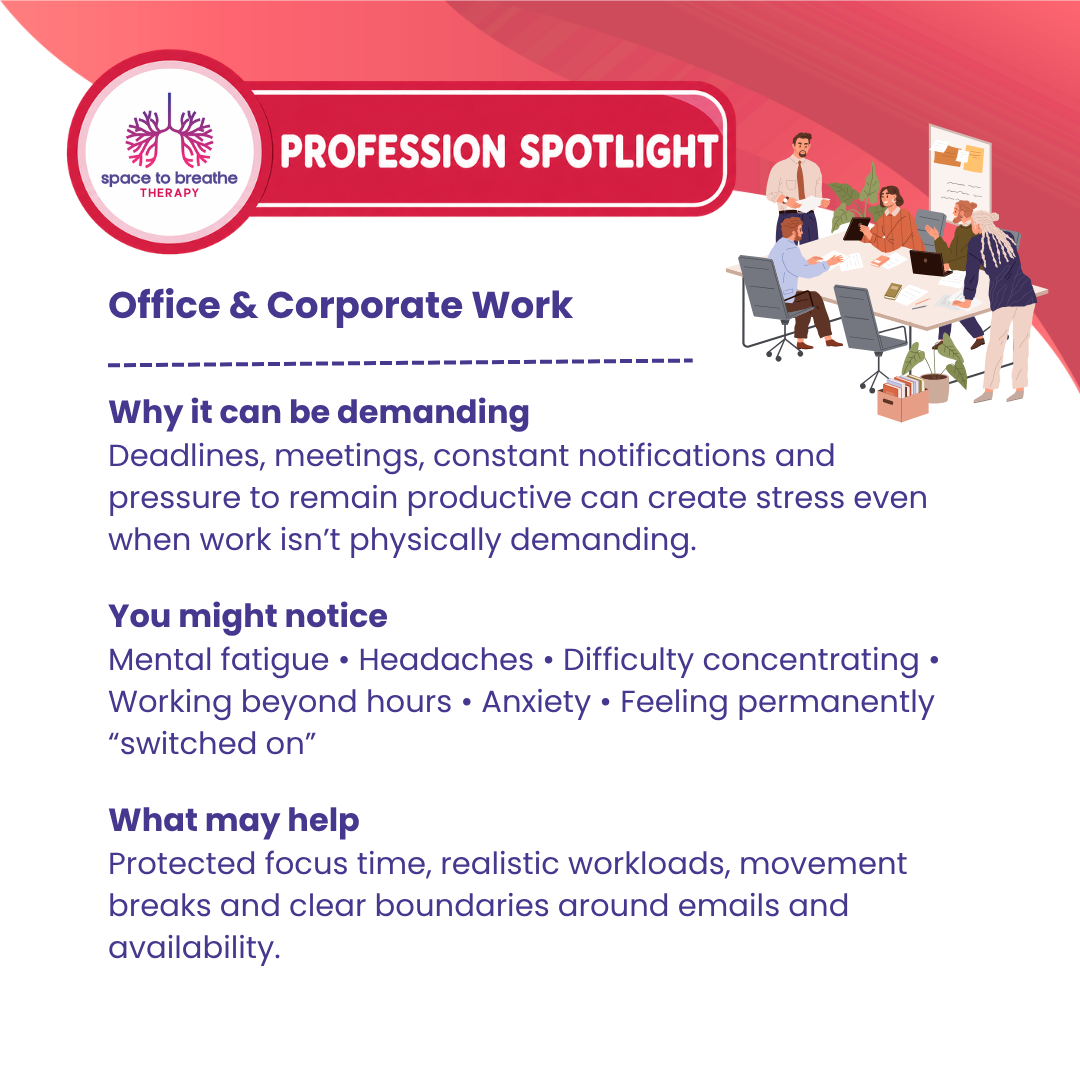
Profession Spotlight: Office & Corporate Work
Mental Health, Cognitive Load & Wellbeing at Work
Office and corporate work may not always appear physically demanding, but it can place a significant cognitive and emotional load on people. Deadlines, meetings, emails, targets, changing priorities and constant digital communication can mean the brain is processing information for much of the working day.
Modern office work can also create an expectation of being permanently available. When emails, messages and notifications continue beyond normal working hours, it can become difficult to feel that the working day has actually ended.
Why office and corporate work can be demanding
Pressure can come from many different directions at once, including:
- heavy or competing workloads
- frequent deadlines
- back-to-back meetings
- constant emails and notifications
- performance targets
- changing priorities
- unclear expectations
- office politics or difficult workplace relationships
- limited control over workload
- organisational change or restructuring
- long periods sitting at a desk
- pressure to appear productive
- expectations around availability
- hybrid or remote-working challenges.
Individually these demands may feel manageable. When they repeatedly overlap without enough recovery time, they can contribute to workplace stress and exhaustion.
The hidden workload of constant switching
Office work often requires people to move rapidly between tasks.
You may be writing a report when an email arrives. Then a message appears. A colleague asks a question. A meeting begins. Afterwards, you return to the original task and have to remember where you were.
This repeated switching can be mentally tiring.
Someone may finish the day feeling exhausted while also wondering:
“What have I actually achieved today?”
That does not necessarily mean they have been unproductive. A considerable amount of their mental energy may have been spent responding, switching attention, remembering, prioritising and reorganising.
Meeting overload
Meetings can be useful, but too many meetings can reduce the uninterrupted time available to complete other work.
Someone may spend most of the day discussing tasks and then feel they need to stay late to actually complete them.
Back-to-back meetings can also remove natural opportunities to:
stand up,
get a drink,
use the bathroom,
eat,
process information,
or mentally prepare for the next task.
Even a short gap between meetings can create valuable transition time.
Digital overload
Email, messaging platforms, shared documents, calendars and workplace systems can make communication easier.
They can also create a continuous stream of information.
When every notification feels urgent, the nervous system receives repeated prompts to redirect attention.
Helpful boundaries might include:
- reducing unnecessary notifications
- creating periods for focused work
- checking email at planned intervals where the role allows
- using status settings to protect concentration
- distinguishing genuinely urgent communication from routine communication.
Being reachable every second of the day is not the same as being productive.
The pressure to appear productive
Corporate cultures can sometimes unintentionally reward visible busyness.
Being constantly online, replying immediately, attending every meeting and working beyond contracted hours may begin to be interpreted as commitment.
This can create pressure to demonstrate productivity rather than work sustainably.
Someone may continue working while exhausted because stopping feels as though they are falling behind.
Over time, this can contribute to stress and burnout.
Working beyond your hours
Technology has made the boundary between work and home increasingly easy to cross.
A quick email after dinner becomes another email.
Checking tomorrow's calendar becomes reading a message.
Opening the laptop for five minutes becomes another hour of work.
When this happens regularly, the brain receives less opportunity to move fully out of work mode.
Clear expectations around availability can therefore protect wellbeing.
Mental fatigue
Mental fatigue can develop even when someone has spent most of the day sitting down.
You might notice:
difficulty concentrating
forgetfulness
slower decision-making
irritability
difficulty finding words
reduced creativity
making simple mistakes
feeling mentally 'foggy'
These experiences can become more noticeable towards the end of a demanding working day.
Taking breaks before reaching complete exhaustion can be more useful than waiting until concentration has disappeared.
Physical wellbeing matters too
Desk-based work can involve long periods of sitting and screen use.
People may become so absorbed in work that they forget to move, drink, eat or change position.
Small actions throughout the day can help:
stand during an appropriate call,
walk briefly between tasks,
change position,
look away from the screen,
refill a drink,
or take a proper lunch break.
A break does not need to be long to interrupt hours of continuous sitting and concentration.
Workplace relationships
Office wellbeing is not only about workload.
Relationships with colleagues and managers can significantly influence how work feels.
Stress may increase when there is:
- poor communication
- bullying or exclusion
- micromanagement
- unclear responsibilities
- conflict
- inconsistent management
- lack of recognition
- fear of making mistakes
- little psychological safety.
A demanding job can feel very different when someone feels supported compared with when they feel they must manage everything alone.
Remote and hybrid working
Working from home can provide flexibility and reduce commuting, but it can also create different challenges.
Some people experience:
- isolation
- fewer informal conversations
- difficulty switching off
- working through breaks
- blurred home/work boundaries
- reduced movement
- pressure to demonstrate that they are working.
Others may find home working considerably easier because it reduces distractions, sensory demands or commuting stress.
There is no single working arrangement that suits everybody.
Neurodivergence in office environments
Office environments can create additional demands for some neurodivergent employees.
Open-plan offices, interruptions, fluorescent lighting, noise, changing priorities, unclear instructions and expectations around social interaction can all increase cognitive or sensory load.
Helpful adjustments will differ between individuals but may include quieter working areas, headphones where appropriate, written instructions, predictable communication, flexible working, clearer priorities or protected focus time.
The aim is not to lower someone's potential.
It is to remove unnecessary barriers that interfere with their ability to work effectively.
You might notice
When office pressure is becoming difficult to manage, someone may experience:
Mental:
Difficulty concentrating, overthinking, forgetfulness, decision fatigue or feeling permanently mentally occupied.
Emotional:
Anxiety, irritability, low mood, frustration, reduced confidence or emotional exhaustion.
Physical:
Headaches, fatigue, muscle tension, disrupted sleep or discomfort associated with prolonged sitting.
Behavioural:
Skipping breaks, working longer hours, repeatedly checking emails, withdrawing from colleagues or struggling to stop working.
Professional:
Reduced motivation, difficulty prioritising, increased mistakes, procrastination or feeling that the workload can never be completed.
These signs do not automatically mean someone has a mental-health condition, but they can indicate that workload, working practices or support need attention.
What may help
Useful workplace strategies can include:
- protected periods for focused work
- realistic workloads and deadlines
- regular movement breaks
- proper lunch breaks
- clearer priorities
- fewer unnecessary meetings
- reducing non-essential notifications
- boundaries around email and availability
- supportive management
- regular workload conversations
- reasonable adjustments
- flexible working where appropriate
- taking annual leave and allowing genuine recovery
- seeking support when stress becomes persistent.
Sometimes productivity improves not by adding another system, but by removing unnecessary demands.
For managers and organisations
Workplace wellbeing should not depend entirely on employees becoming more resilient.
Organisations can consider whether the working environment itself is contributing to unnecessary stress.
Questions worth asking include:
Are workloads genuinely achievable within contracted hours?
Do employees understand what their priorities are?
Are people expected to respond outside working hours?
Are meetings leaving enough time to complete actual work?
Can employees raise concerns without fear of negative consequences?
Are reasonable adjustments understood and supported?
Are managers noticing sustained changes in someone's wellbeing or performance?
Supporting wellbeing can benefit both employees and organisations.
Remember
Being busy all day does not necessarily mean your brain has unlimited capacity.
Concentration needs recovery.
Your body needs movement.
Your nervous system needs periods when it is not responding to another notification, deadline or request.
And finishing work at the end of the working day is not a lack of commitment.
Sustainable working means creating enough space to return tomorrow with something left to give.
Space to Breathe Therapy
Your wellbeing matters at work, not just after work. Give yourself space to breathe.
This resource provides general wellbeing information and is not a substitute for individual medical, mental-health or occupational-health advice.