





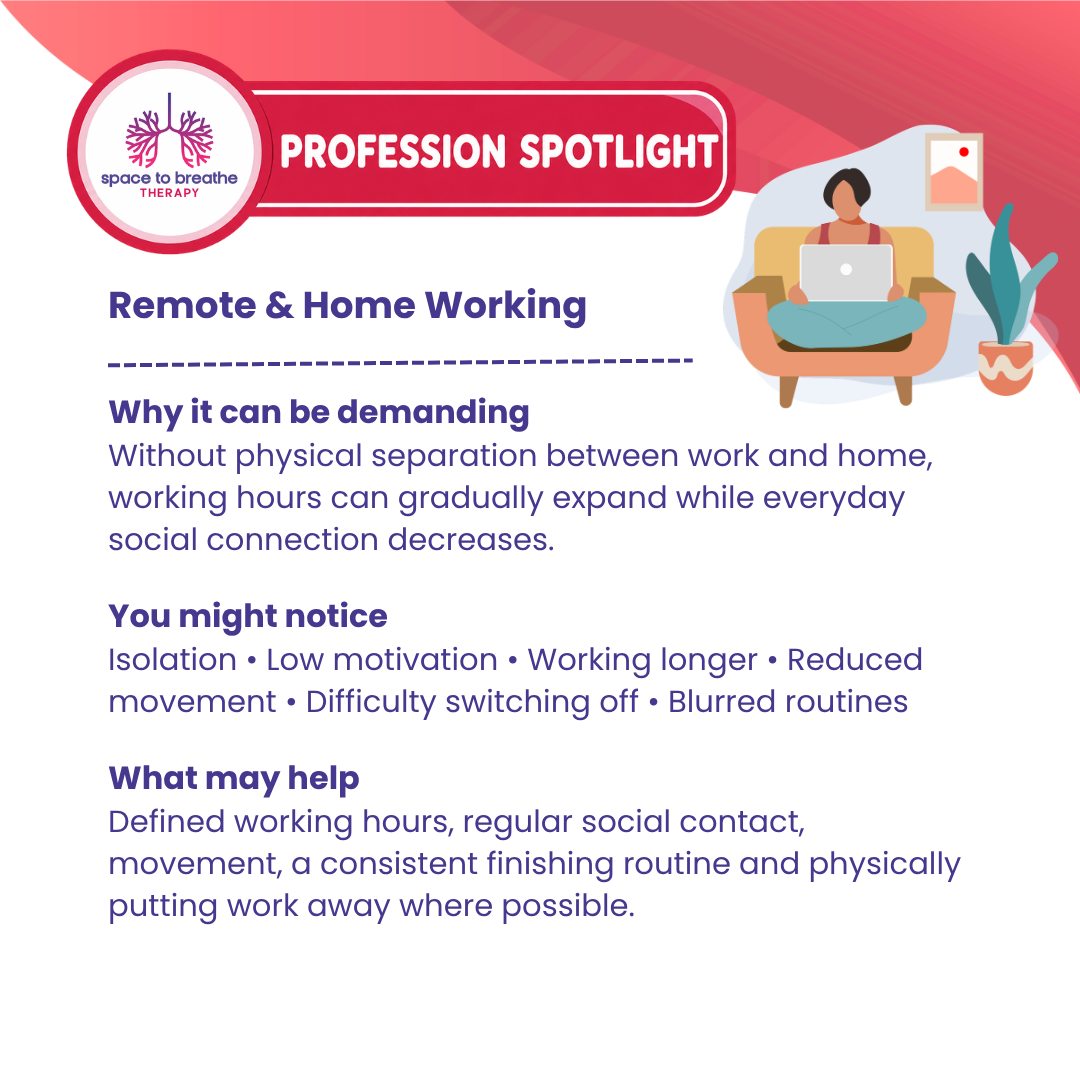
Profession Spotlight: Remote & Home Working
Mental Health, Boundaries & Wellbeing When Home Becomes the Workplace
Remote and home working can offer significant benefits. It may reduce commuting, provide greater flexibility, make work more accessible and give people more control over their environment.
But working from home can also create challenges that are easy to overlook. When the place where you work is also the place where you eat, rest, socialise and sleep, the boundaries between “work time” and “my time” can gradually disappear.
For some people, home working improves wellbeing enormously. For others, isolation, reduced movement, digital overload and difficulty switching off can contribute to stress and exhaustion. Many people experience a mixture of both.
Why remote working can become demanding
In a traditional workplace, the journey home creates a natural transition between work and personal life. When you work from home, that transition may disappear.
The laptop may remain visible. Emails can still be accessed. A notification may arrive while you are making dinner. It can become very easy to think:
“I'll just finish this one thing.”
Over time, working hours can quietly expand.
Remote workers may also experience:
- fewer natural breaks
- reduced face-to-face contact
- long periods sitting
- back-to-back online meetings
- digital communication overload
- pressure to demonstrate productivity
- difficulty separating work from home
- distractions or caring responsibilities
- loneliness or isolation
- fewer informal conversations with colleagues.
The flexibility of home working can therefore be both an advantage and a challenge.
The difficulty of switching off
Leaving a physical workplace provides the brain with environmental signals that the working day has finished.
At home, those signals may be weaker.
You may close the laptop but continue thinking about unfinished tasks. You might check an email from the sofa or mentally rehearse tomorrow's workload while trying to relax.
This can leave someone feeling as though they are never completely at work and never completely away from work.
Creating a deliberate finishing routine can help establish a clearer psychological boundary.
That might mean shutting the computer down completely, putting work equipment away, changing clothes, going for a short walk, making a drink or moving into a different room.
The activity itself does not have to be complicated. The important part is giving the brain a repeated signal:
Work has finished for today.
Isolation and reduced social connection
A workplace provides many small social interactions that we may barely notice until they disappear.
Saying good morning.
Talking while making a drink.
Asking someone a quick question.
Having lunch with another person.
Sharing a joke.
These moments can contribute to connection and belonging.
Remote workers may spend hours communicating digitally while still experiencing very little meaningful human contact.
Video calls do not necessarily replace spontaneous social interaction.
For people living alone in particular, an entire working day may pass without being physically around another person.
Regular contact with colleagues, friends, family or community activities can therefore become an important part of maintaining wellbeing.
Movement can easily disappear
Working from home can dramatically reduce everyday movement.
There may be no walk to the car, train or bus.
No stairs between departments.
No walk to a meeting room.
No trip outside for lunch.
Someone can move from bed to desk and remain in the same area for much of the day.
Reduced movement may contribute to stiffness, discomfort and fatigue, while prolonged sitting can become an unnoticed part of the working routine.
Small movement opportunities can make a difference.
Stand while taking an appropriate phone call. Walk around between meetings. Stretch. Refill your drink. Step outside at lunchtime. Change working position where possible.
Movement does not always need to mean formal exercise.
The home office is still a workplace
Working from the sofa or bed may feel comfortable initially, but regularly working in positions that provide poor support can contribute to physical discomfort.
Where possible, consider:
- screen height
- seating position
- keyboard and mouse placement
- lighting
- glare
- temperature
- noise
- opportunities to change position.
Not everyone has access to a separate home office, but small environmental changes may still make working more comfortable.
Employers also continue to have responsibilities around health, safety and appropriate working arrangements when employees work remotely.
Digital fatigue
Remote working often relies heavily on screens.
Meetings, conversations, training, supervision, collaboration and informal communication may all happen digitally.
Someone may move directly from one video call to another without leaving their chair.
By the end of the day they may feel mentally exhausted despite having barely moved physically.
Helpful practices can include leaving gaps between meetings where possible, reducing unnecessary video calls, taking screen breaks and considering whether every conversation genuinely requires a meeting.
Sometimes a short email or telephone conversation may be enough.
Pressure to prove you are working
Some remote workers feel pressure to demonstrate that they are productive because their manager cannot physically see them.
This can lead to behaviours such as:
- responding immediately to messages
- remaining permanently online
- avoiding breaks
- working through lunch
- working beyond contracted hours
- feeling guilty when stepping away from the computer.
Productivity should not require constant digital visibility.
Clear expectations about availability, communication and outcomes can reduce this pressure.
Home distractions and competing demands
Home working does not automatically mean a quiet environment.
People may be managing children, pets, deliveries, household noise, shared working spaces, caring responsibilities or other family members working from home.
Trying to concentrate while repeatedly switching between professional and domestic demands can increase cognitive load.
Where possible, having agreed working periods, communicating boundaries with other household members and creating a defined workspace can help.
But it is also important to recognise that people's home circumstances differ considerably.
Neurodivergence and home working
Remote working can be particularly beneficial for some neurodivergent people.
It may reduce:
- commuting stress
- sensory overload
- unpredictable interruptions
- social demands
- fluorescent lighting
- office noise
- pressure to mask.
Being able to control lighting, noise, clothing, movement and sensory input can make work considerably more accessible.
However, home working can also create different challenges.
Some people may struggle with:
- initiating tasks
- time awareness
- maintaining routines
- transitioning between tasks
- hyperfocus
- remembering breaks
- isolation
- knowing when the working day has finished.
This is why flexible working should not assume that everyone needs the same environment or structure.
You might notice
When remote working is beginning to affect wellbeing, you may notice changes such as:
Emotional:
Loneliness, irritability, anxiety, low mood, frustration or reduced motivation.
Cognitive:
Brain fog, difficulty concentrating, procrastination, forgetfulness or feeling overwhelmed by relatively small tasks.
Physical:
Headaches, tiredness, stiffness, back or neck discomfort, disrupted sleep or reduced energy.
Behavioural:
Working longer hours, skipping meals, forgetting breaks, staying indoors all day, repeatedly checking messages or working from bed.
Social:
Withdrawing from colleagues, avoiding calls, feeling disconnected from the team or going long periods without meaningful social contact.
These experiences do not automatically indicate a mental-health condition. They may be signs that working patterns, boundaries or support need attention.
What may help
Healthy remote working often needs to be created deliberately.
Helpful strategies can include:
- defined starting and finishing times
- a consistent morning routine
- regular movement
- leaving the house during the day where possible
- proper meal breaks
- protected focus periods
- reducing unnecessary notifications
- regular social contact
- a designated workspace where possible
- clear expectations about availability
- putting work equipment away after finishing
- taking annual leave rather than remaining permanently connected.
Create a commute without commuting
Some people find it helpful to recreate the psychological transition that commuting once provided.
Before starting work, you might take a short walk, listen to music, have breakfast away from your desk or spend ten minutes outside.
At the end of the day, repeat another transition.
This creates a boundary between:
home → work → home
even when all three happen in the same building.
For managers and organisations
Successful remote working should not rely entirely on individual employees managing everything themselves.
Managers can support remote workers by asking:
Are workloads achievable within working hours?
Are employees expected to respond immediately?
Are there too many online meetings?
Do people feel connected to the team?
Are remote workers receiving the same opportunities and recognition as office-based colleagues?
Are people taking appropriate breaks and annual leave?
Do employees know when they are expected to be available—and when they are not?
Are reasonable adjustments being considered individually?
Trust, clarity and communication can be more helpful than constant monitoring.
Remember
Working from home does not mean you have to be available simply because your workplace is nearby.
You are still allowed to take breaks.
You are still allowed to have a lunch period.
You are still allowed to finish your working day.
You are still allowed to close the laptop.
And your home deserves to feel like your home, not somewhere you are permanently waiting for the next email.
Space to Breathe Therapy
When the working day ends, allow yourself to leave work—even when you haven't left the house. Give yourself space to breathe.
This resource provides general wellbeing information and is not a substitute for individual medical, mental-health or occupational-health advice.