





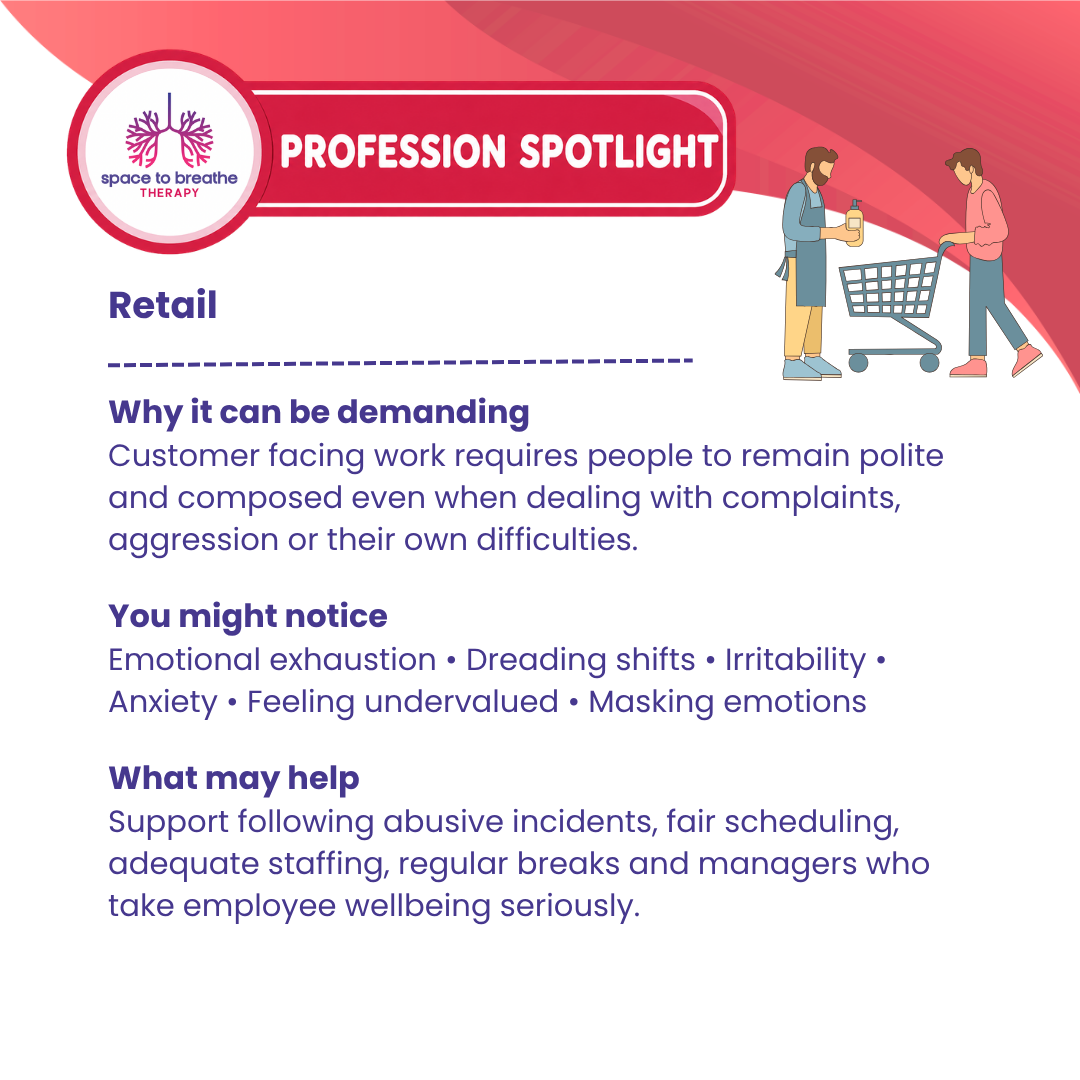
Profession Spotlight: Retail
Understanding the Mental, Emotional and Physical Demands of Working in Retail
Retail work can sometimes be underestimated because many of its demands are invisible. Behind every shop floor, till, customer-service desk, stockroom and online collection point are employees balancing customer expectations, physical tasks, time pressure, targets, staffing levels and emotional demands.
Retail employees are often expected to remain friendly, patient and professional regardless of how busy the environment becomes or how customers behave. Doing this repeatedly can be emotionally and physically tiring, particularly when workers have little control over staffing, rotas, workload or customer behaviour.
Why can retail work be so demanding?
A retail shift can involve far more than serving customers.
Depending on the role, employees may be expected to:
- serve customers and operate tills
- answer questions and resolve complaints
- replenish and organise stock
- receive deliveries
- meet sales or productivity targets
- monitor queues
- process returns and refunds
- manage online or click-and-collect orders
- maintain displays
- complete cleaning and safety tasks
- manage stock discrepancies
- respond to theft or challenging behaviour
- work evenings, weekends and seasonal periods
- cover colleagues during staff shortages.
These demands often happen simultaneously.
An employee may be trying to complete stock tasks while answering customer questions, responding to a queue and being reminded about a target—all while remaining visibly calm and approachable.
The emotional labour of customer service
Customer-facing work involves significant emotional labour.
Employees are generally expected to appear polite, welcoming and composed even when they are tired, stressed or dealing with difficult behaviour.
A customer may be frustrated about pricing, stock availability, company policy or waiting times. The employee standing in front of them may have had no control over the situation, yet they can become the person who receives that frustration.
Repeatedly suppressing your natural emotional response and maintaining a professional presentation can be tiring.
Being good at customer service does not mean being unaffected by the way people speak to you.
Abuse should not be accepted as part of retail
Retail employees can sometimes experience verbal abuse, intimidation, threats, harassment or aggressive behaviour.
Being customer-facing does not remove someone's right to feel safe and respected at work.
Employers should have appropriate procedures for dealing with violence and aggression, and employees should know how to report incidents and access support afterwards.
A workplace culture that simply tells employees to ignore abuse can leave people feeling unsupported and undervalued.
Feeling constantly watched or measured
Some retail environments involve considerable performance monitoring.
Employees may be measured against sales targets, transaction times, customer feedback, loyalty-card sign-ups, stock productivity or other performance indicators.
Targets can provide useful structure, but unrealistic or competing expectations can also increase pressure.
For example, an employee might simultaneously be expected to provide excellent personalised customer service and keep queues moving quickly.
When expectations conflict, workers can feel that whatever they choose to prioritise will be wrong.
Clear and realistic expectations can therefore make a significant difference.
Physical demands matter
Retail is not simply customer service.
Many roles involve spending long periods standing, walking, bending, reaching, carrying, lifting or completing repetitive movements.
Employees working on deliveries or stock replenishment may perform physically demanding tasks throughout their shift.
Physical fatigue can affect mental wellbeing too.
When someone is already tired, hungry or physically uncomfortable, dealing calmly with an unexpected problem or difficult interaction may require considerably more effort.
Sensory overload
Retail environments can also be highly stimulating.
Bright lighting, music, announcements, conversations, tills, scanners, crowds, smells, movement and constant interruptions can create significant sensory demand.
For some neurodivergent employees or people with sensory sensitivities, this may be particularly exhausting.
Someone may appear to manage throughout their shift but arrive home needing complete quiet because they have spent hours processing a high level of sensory information.
Reasonable workplace adjustments can be important where sensory or neurodivergent needs create barriers at work.
Masking emotions
Retail employees may become very skilled at hiding how they actually feel.
They might smile and say:
“Of course, no problem.”
while internally feeling overwhelmed, anxious, angry or exhausted.
The ability to remain professional can be useful, but constantly masking emotional responses has a cost.
Some people find that after holding themselves together throughout a shift, their emotions emerge once they get home.
They may become tearful, irritable, withdrawn or need considerable time alone.
That does not necessarily mean home is causing the problem.
It may be where they finally feel safe enough to stop performing.
Dreading shifts
Occasionally not wanting to go to work is common.
But repeatedly experiencing anxiety or dread before shifts deserves attention.
Someone may begin thinking about work hours before they need to leave:
Who am I working with?
Will we be short staffed again?
Will it be busy?
Will that customer come back?
Will I reach my targets?
Will I actually get my break?
When work begins taking up significant emotional space before a shift has even started, recovery time can become increasingly limited.
Staffing levels make a difference
Understaffing can dramatically change the experience of a retail shift.
Fewer employees may mean longer queues, increased customer frustration, missed breaks and greater pressure on the people who are working.
Employees may begin rushing between tasks, apologising repeatedly for delays and trying to compensate for circumstances outside their control.
Occasionally helping during unexpected absence is different from routinely operating with insufficient staffing.
Employees cannot continually compensate for organisational problems through personal exhaustion.
Rotas and predictability
Retail frequently requires evenings, weekends and bank-holiday working.
The difficulty can increase when rotas are unpredictable or change with little notice.
Unpredictable scheduling can affect sleep, childcare, appointments, relationships, social activities and the ability to properly plan recovery time.
Where possible, fair and predictable rotas can therefore contribute to employee wellbeing.
Knowing when you are working—and when you are genuinely off—matters.
Breaks are not laziness
During busy periods, employees may feel guilty about taking breaks.
But spending an entire shift standing, serving, concentrating and regulating emotions without adequate opportunities to eat, drink, use the bathroom or sit down can increase fatigue.
Breaks provide physical and psychological recovery.
A workplace does not need to become completely quiet before someone is allowed to pause.
In retail, there may always be another customer, another delivery or another task.
Feeling undervalued
Retail employees sometimes describe feeling that their work is taken for granted.
Yet retail requires considerable skill.
Employees regularly use:
- communication
- conflict management
- organisation
- problem-solving
- emotional regulation
- teamwork
- adaptability
- time management
- product knowledge
- decision-making.
Recognising the skill involved in retail work matters.
Feeling respected and valued can influence how people experience their workplace.
Signs that pressure may be building
Sustained workplace stress can affect people differently.
Someone might notice:
Emotional changes: irritability, anxiety, frustration, tearfulness, emotional exhaustion or feeling increasingly detached.
Physical changes: persistent fatigue, headaches, muscle tension, disrupted sleep or physical aches following shifts.
Cognitive changes: difficulty concentrating, forgetfulness, indecision or feeling mentally overloaded.
Behavioural changes: withdrawing from colleagues, avoiding certain customers or tasks, skipping breaks, working excessive hours or finding it increasingly difficult to switch off after work.
Another important sign can simply be:
“I don't feel like myself anymore.”
Burnout
Burnout is associated with chronic workplace stress that has not been successfully managed.
It can involve exhaustion, increased mental distance or negativity towards work and reduced professional effectiveness.
Someone experiencing burnout may become less patient with customers, feel detached from colleagues or stop caring about targets that previously mattered to them.
That does not automatically mean they are lazy or have a poor attitude.
Sometimes emotional detachment develops after somebody has spent too long functioning beyond their available resources.
What may help?
Individual coping strategies cannot fix unsafe staffing, abusive customers or unrealistic expectations. Workplace wellbeing therefore needs organisational involvement as well.
Helpful approaches may include:
- appropriate staffing
- fair and predictable scheduling
- regular breaks
- clear responsibilities
- realistic targets
- supportive management
- appropriate responses to abusive customers
- good communication
- recognition of employee contributions
- opportunities to raise concerns
- reasonable workplace adjustments
- adequate recovery between shifts.
Employees should know who they can speak to when work is affecting their wellbeing.
Supporting employees after difficult incidents
If a member of staff has experienced aggression, threats, harassment or another distressing incident, support should not end once the customer leaves.
Managers can check how the employee is feeling, make sure the incident is appropriately recorded, explain available support and consider whether the employee needs time away from the immediate situation.
Feeling that management takes an incident seriously can itself be important.
Supporting a colleague
Retail colleagues often notice when somebody is struggling.
A normally sociable colleague may become quiet. Someone patient may become unusually irritable. Another person may start repeatedly saying they cannot face their next shift.
You do not need to diagnose them.
A simple:
“You've had a lot to deal with lately. How are you doing?”
may create an opportunity for them to talk.
Sometimes support begins with being noticed.
Leaving work at work
After a difficult customer interaction, it is easy to replay the conversation:
“I should have said...”
“Why did they speak to me like that?”
“Did I handle that properly?”
Try to remember that another person's behaviour is not automatically a reflection of your competence.
Creating a small transition after work can help—changing clothes, eating, walking, listening to music, showering or spending a little time somewhere quiet.
The aim is simply to give your mind and body a signal:
The shift has finished.
Remember
You can provide excellent customer service without accepting abuse.
You can be professional without pretending that nothing affects you.
You can be hardworking without continually missing your breaks.
You can support your team without taking responsibility for chronic understaffing.
You can find customer-facing work emotionally tiring without being “too sensitive.”
You can ask for support and still be capable.
And your value as an employee is not determined by how much pressure you can silently tolerate.
Retail workers spend enormous amounts of time looking after customers. Their own wellbeing deserves to be taken seriously too.
Space to Breathe Therapy
Behind every good customer experience is a person — and that person's wellbeing matters.
This resource provides general information and does not replace individual medical, psychological, occupational-health or employment advice.




