





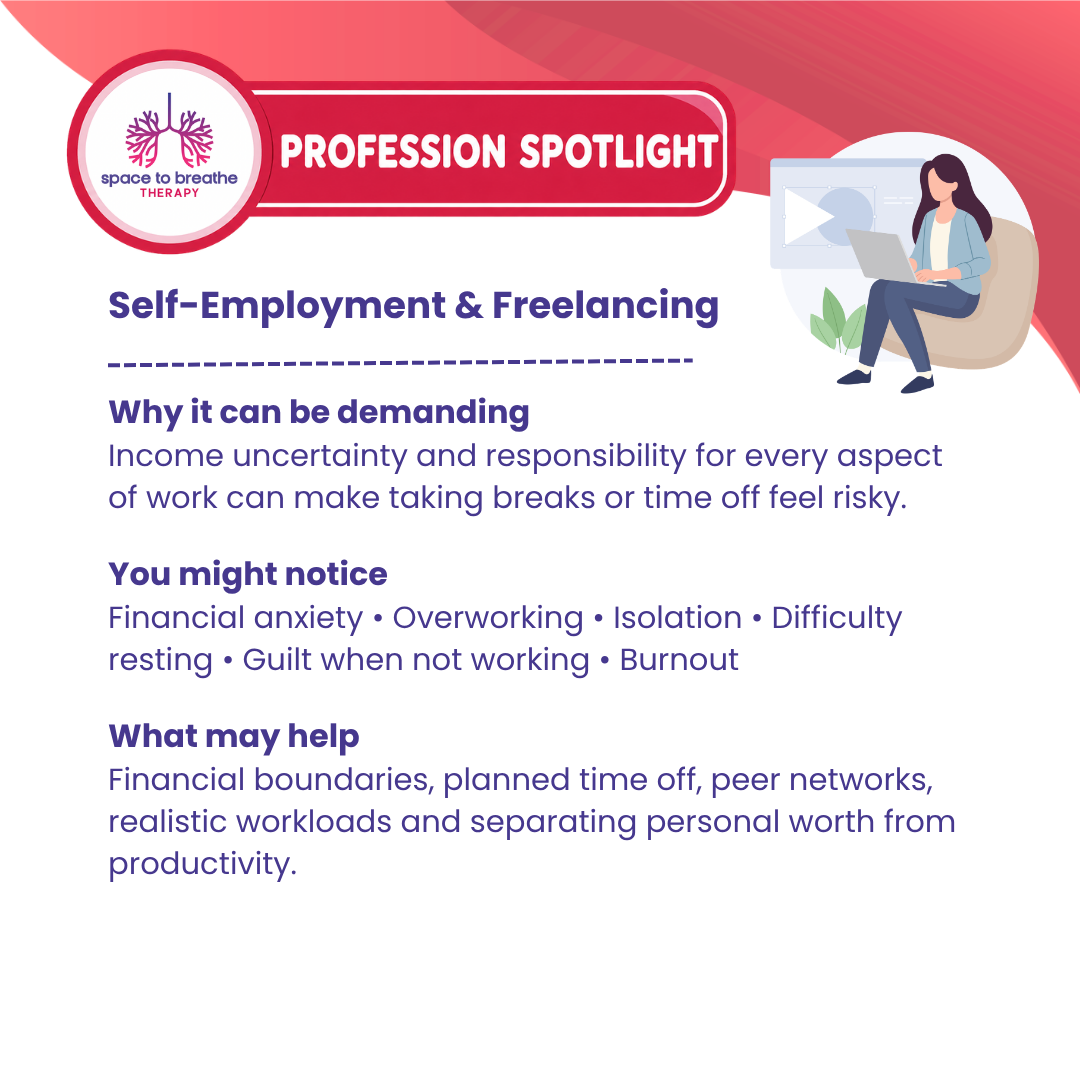
Profession Spotlight: Self-Employment & Freelancing
Mental Health, Boundaries & Wellbeing When You Work for Yourself
Self-employment and freelancing can provide freedom, flexibility, independence and the opportunity to build work around your own strengths and values. For many people, being able to choose when, where and how they work can be hugely positive.
But working for yourself can also carry a particular kind of pressure. There may be no guaranteed salary, paid annual leave, sick pay, manager to share responsibility with or colleague automatically available when something goes wrong.
When you are the business, it can become difficult to know when you are allowed to stop.
Why self-employment can become demanding
Self-employed people are often responsible for far more than the work their clients actually see.
Alongside providing the service or producing the work, there may be:
- emails and enquiries
- marketing and social media
- invoices and bookkeeping
- tax and financial planning
- appointments and scheduling
- customer service
- purchasing equipment
- maintaining websites
- professional development
- chasing unpaid invoices
- finding new clients
- managing cancellations
- completing paperwork and administration.
This means a person may finish their paid work and still have several hours of unpaid business work waiting.
The working day can quietly become much longer than expected.
The pressure of unpredictable income
Financial uncertainty can be one of the most stressful parts of self-employment.
Income may change from month to month. Clients cancel. Contracts end. Work can suddenly become quieter. Unexpected expenses appear.
Even during financially stable periods, there can be anxiety about what might happen next.
This uncertainty can encourage people to accept more work than they realistically have capacity for because saying “no”can feel financially unsafe.
A busy diary can therefore provide reassurance while simultaneously creating exhaustion.
When taking time off feels like losing money
For many self-employed people, there is a direct relationship between working and earning.
A day off may mean a day without income.
This can make holidays, illness and even ordinary rest feel uncomfortable.
You may find yourself thinking:
“I can't afford to take today off.”
“I should answer that email.”
“I'll rest when things become quieter.”
But sometimes things never become quieter.
Rest can gradually become something you believe you have to earn rather than something necessary for sustainable working.
Guilt when you are not working
One of the less obvious challenges of self-employment is the feeling that there is always something you could be doing.
If you are watching television, you could be answering emails.
If you are walking, you could be listening to professional training.
If you are having a weekend off, you could be updating your website.
If business is quiet, you could be marketing.
Because the potential workload has no natural endpoint, stopping has to become a deliberate decision.
Otherwise work can expand into almost every available space.
Isolation
Self-employment can sometimes be lonely.
Someone may communicate with clients all day while having very little contact with colleagues or peers.
There may be nobody beside you to say:
“That was a difficult day.”
There may also be fewer opportunities to share ideas, ask quick questions or receive reassurance that other people experience similar challenges.
Professional networks, peer groups, supervision, coworking spaces and regular social contact can provide valuable connection.
When personal worth becomes connected to productivity
When you create your own business, work can become closely connected to identity.
A quiet month may feel like personal failure.
A negative review may feel deeply personal.
A client choosing someone else may feel like rejection.
Social media can intensify this by presenting a constant stream of apparently successful businesses.
It is important to remember:
Your business performance is information about your business. It is not a measurement of your worth as a person.
You might notice
Signs that self-employment is beginning to affect wellbeing may include:
Emotional:
Anxiety, irritability, guilt, frustration, low mood, self-doubt or feeling unable to relax.
Cognitive:
Constantly thinking about work, difficulty concentrating, decision fatigue, racing thoughts or worrying about future income.
Physical:
Poor sleep, headaches, muscle tension, exhaustion, digestive difficulties or feeling physically depleted.
Behavioural:
Working evenings and weekends, checking emails repeatedly, skipping meals, cancelling social plans, avoiding holidays or continuing to work when unwell.
Professional:
Loss of enthusiasm, resentment towards clients, reduced creativity, procrastination, making more mistakes or feeling emotionally detached from work you previously enjoyed.
These experiences can be signs that workload, financial pressure, isolation or boundaries need attention.
The boom-and-bust cycle
Some self-employed people fall into a repeating pattern:
Work is available → take everything → become overwhelmed → work excessively → become exhausted → reduce workload → worry about income → take everything again.
Recognising this pattern can be important.
A consistently manageable workload may ultimately be more sustainable than repeatedly moving between overwork and exhaustion.
Boundaries with clients
When your reputation and income depend on clients, boundaries can feel difficult.
You may worry that someone will go elsewhere if you do not answer quickly.
But immediate availability can gradually become an expectation.
Helpful boundaries might include:
- clearly stated working hours
- realistic response times
- cancellation policies
- defined methods of contact
- protected days off
- scheduled administration time
- not routinely answering messages late at night
- clear expectations about what your service includes.
Boundaries are not about caring less about clients. They help create a working relationship that can remain sustainable.
Neurodivergence and self-employment
Self-employment can be particularly attractive to neurodivergent people because it may provide greater control over working conditions.
Someone may be able to choose their:
- working hours
- sensory environment
- clothing
- communication methods
- workload
- breaks
- workspace
- clients
- routines.
This flexibility can be extremely valuable.
However, self-employment also requires substantial executive functioning.
Planning, invoicing, remembering deadlines, switching tasks, prioritising, managing paperwork and regulating working hours can become difficult.
ADHD hyperfocus, for example, may mean someone works for many hours without noticing hunger, tiredness or the passing of time.
External structure can therefore still be useful even when you work independently.
Calendars, reminders, automated systems, body doubling, administrative support and scheduled breaks can reduce unnecessary cognitive load.
Financial boundaries are wellbeing boundaries
Financial planning cannot remove all uncertainty, but greater clarity can sometimes reduce the feeling that every available piece of work must be accepted.
Where appropriate, this may involve separating personal and business finances, planning for tax, understanding regular business costs, reviewing pricing and creating financial reserves when circumstances allow.
Professional financial advice may be useful where needed.
The aim is not simply financial organisation.
It is creating enough predictability that decisions about workload are not constantly driven by fear.
Build rest into the business
Instead of waiting until you are exhausted enough to justify stopping, consider making recovery part of how the business operates.
That might mean protecting:
- lunch breaks
- evenings
- weekends
- exercise
- holidays
- family time
- hobbies
- social connection
- completely work-free periods.
Rest is not time stolen from the business.
Sustainable businesses need sustainable people.
If you are struggling
You do not have to wait until you reach burnout before changing something.
Consider asking:
What am I doing because it genuinely needs doing?
What am I doing because I feel guilty if I stop?
Which tasks could be automated, delegated or simplified?
Are my prices and workload realistic?
When did I last have a completely work-free day?
Who supports me when work becomes difficult?
Does my business currently fit around my life—or has my life started fitting around my business?
Sometimes relatively small changes can create meaningful breathing space.
Remember
Being self-employed does not mean being permanently available.
You can care deeply about your business without giving it every hour you have.
You are allowed to finish for the day.
You are allowed to decline work when you do not have capacity.
You are allowed to take a holiday.
You are allowed to be ill.
You are allowed to rest without turning your rest into another productivity project.
And perhaps most importantly:
Your productivity, income and business success do not determine your value as a person.
Space to Breathe Therapy
Build a business that leaves room for the person running it. Until next time, give yourself space to breathe.
This resource provides general wellbeing information and is not a substitute for individual medical, mental-health, employment or financial advice.




