





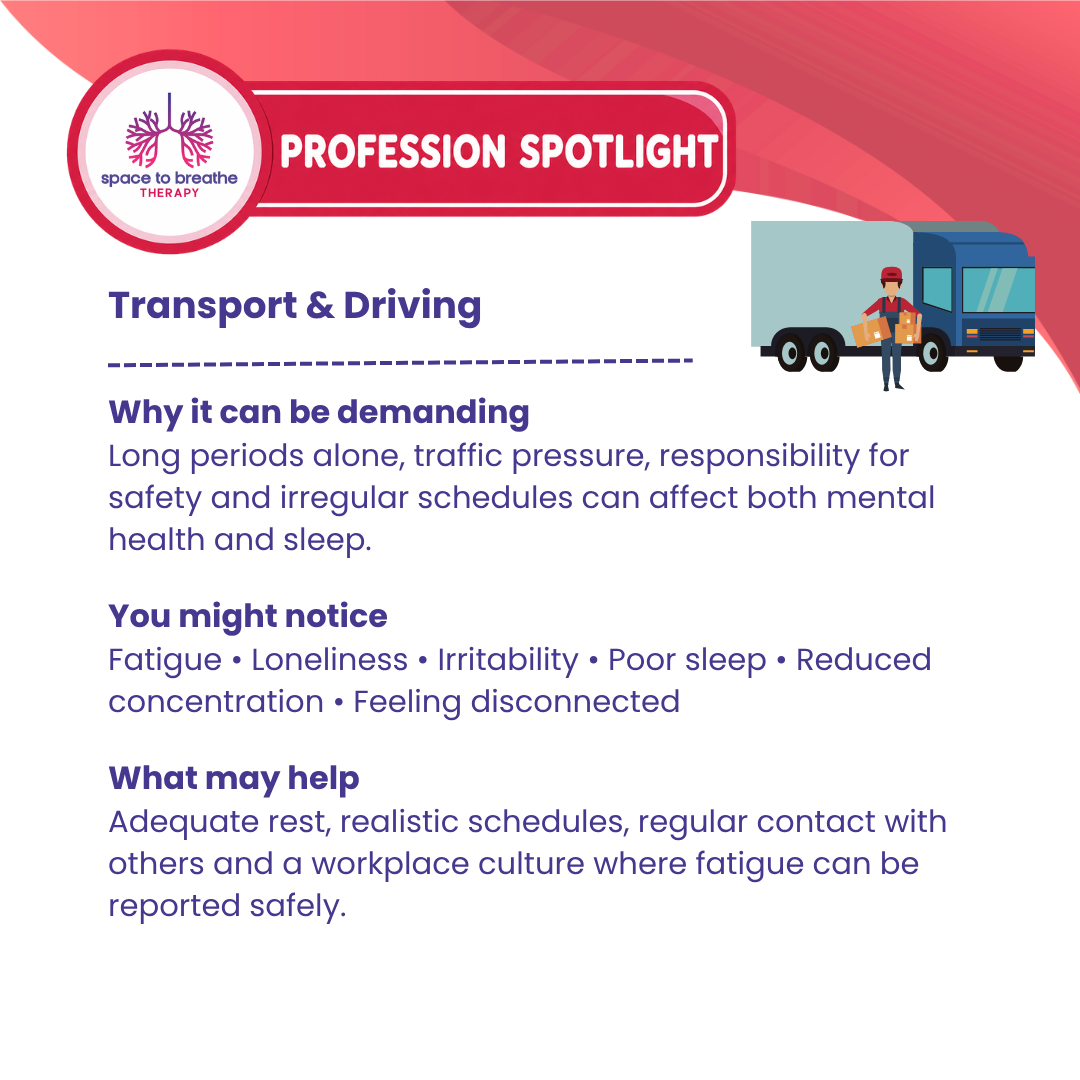
Profession Spotlight: Transport & Driving
Mental Health, Fatigue & Wellbeing on the Road
Working in transport and professional driving can involve much more than getting from one place to another. Drivers may spend long periods alone, work early mornings or late nights, deal with unpredictable traffic and deadlines, and carry significant responsibility for passengers, goods, vehicles and road safety.
For HGV and delivery drivers, taxi and private-hire drivers, bus and coach drivers, couriers and others working on the road, these pressures can gradually affect sleep, physical health, relationships and emotional wellbeing.
Why transport and driving can be demanding
Professional driving requires sustained concentration. Drivers continually monitor road conditions, other vehicles, pedestrians, navigation, timings and potential hazards.
At the same time, there may be pressure from:
- traffic and unexpected delays
- delivery or collection deadlines
- changing routes
- shift work
- long or antisocial hours
- customer or passenger interactions
- limited access to suitable breaks
- responsibility for safety
- vehicle problems
- time away from home
- working alone.
Even when someone appears to be “just sitting and driving”, their brain may be processing information and making safety-related decisions throughout the working day.
Fatigue matters
Fatigue is particularly important in driving because tiredness can affect concentration, alertness, reaction time and decision-making.
Fatigue is not always solved by simply pushing through.
Warning signs may include frequent yawning, heavy eyes, difficulty concentrating, irritability, slower thinking or struggling to remember parts of a journey.
Drivers should take tiredness seriously and follow their employer's procedures, working-time requirements and road-safety guidance.
Feeling too tired to drive safely is a safety issue, not a personal weakness.
Irregular hours and sleep
Early starts, night work, changing shifts and overnight journeys can interfere with normal sleep patterns.
Someone may technically have time away from work but still struggle to obtain restorative sleep.
Over time, disrupted sleep may contribute to tiredness, difficulty concentrating, irritability and reduced emotional resilience.
Protecting sleep therefore needs to be considered part of occupational wellbeing rather than something that only happens outside work.
Isolation on the road
Driving can be surprisingly lonely.
Some drivers may spend most of their working day without meaningful face-to-face contact. Others may speak to customers briefly while still having little opportunity for genuine connection.
When work is difficult, there may not be a colleague sitting nearby to notice.
Isolation can also make it easier to keep problems to yourself.
Regular contact with colleagues, friends and family can provide an important connection with life outside the vehicle.
Pressure to stay on schedule
Drivers can face competing demands.
They may be expected to arrive on time while simultaneously dealing with congestion, road closures, weather, vehicle problems and circumstances completely outside their control.
This can create frustration and anxiety, particularly when performance is measured against schedules.
A psychologically safer workplace recognises that deadlines should never override safe driving.
Physical wellbeing affects mental wellbeing
Professional driving often involves prolonged sitting, although some transport jobs also include lifting, loading and unloading.
Long working days can make regular meals, hydration, movement and exercise harder to maintain.
Small opportunities can still matter: getting out of the vehicle during appropriate breaks, stretching, walking when possible, drinking regularly and having accessible food available can support general wellbeing.
You might notice
When work pressures begin accumulating, someone might experience:
Physical changes: fatigue, headaches, muscle tension, disrupted sleep or feeling physically drained.
Emotional changes: irritability, anxiety, frustration, low mood or becoming less patient than usual.
Thinking changes: reduced concentration, forgetfulness, slower decision-making or difficulty switching off after work.
Behavioural changes: withdrawing from others, working excessive hours, skipping breaks or increasingly relying on unhealthy coping strategies.
Social changes: feeling disconnected from family or friends, missing social activities or feeling that other people do not understand the pressures of the job.
These experiences do not automatically mean someone has a mental-health condition, but persistent changes are worth noticing.
The transition from road to home
After spending hours concentrating and responding to potential hazards, it may take time to mentally transition out of “driving mode”.
Some people benefit from developing a simple end-of-shift routine.
That might involve changing clothes, showering, having something to eat, taking a short walk, listening to music or simply spending a few quiet minutes before moving into family responsibilities.
The aim is to create a psychological boundary between work time and personal time.
What workplaces can do
Driver wellbeing should not rely entirely on individual resilience.
Employers and organisations can contribute by creating realistic schedules, encouraging appropriate breaks, taking reports of fatigue seriously, addressing bullying or abusive behaviour, providing clear communication and ensuring workers know where support is available.
Workers should be able to raise concerns about tiredness, workload or mental wellbeing without fearing that they will automatically be viewed as incapable of doing their job.
What may help
Protecting wellbeing might include maintaining sleep routines where shifts allow, taking appropriate breaks, staying connected with others, planning food and hydration for longer journeys and talking about difficulties before they become overwhelming.
It can also mean recognising the difference between an ordinary difficult shift and a pattern that is beginning to affect everyday life.
If anxiety, low mood, sleep difficulties, stress or exhaustion continue or begin interfering significantly with daily functioning, seeking appropriate professional support can be an important next step.
A check-in for drivers
Every so often, ask yourself:
How tired am I before I begin driving?
Am I regularly finishing work completely exhausted?
Am I getting enough opportunity to recover between shifts?
Have I become more irritable, anxious or withdrawn?
Am I staying connected with people outside work?
Do I feel able to tell someone when I am struggling?
Is the way I am currently working sustainable?
Sometimes noticing the pattern early creates an opportunity to make changes before things become much harder.
Remember
Being able to cope with demanding work does not mean you should have to cope with everything indefinitely.
Professional drivers carry significant responsibility, and protecting the wellbeing of the person behind the wheel matters too.
Rest is part of safe working. Asking for support is responsible. And looking after yourself matters just as much as reaching the destination.
Space to Breathe Therapy
Take care of the person behind the wheel, not just the journey ahead. Until next time, give yourself space to breathe.
This resource provides general wellbeing information and is not a substitute for individual medical, mental-health, employment or road-safety advice.




