





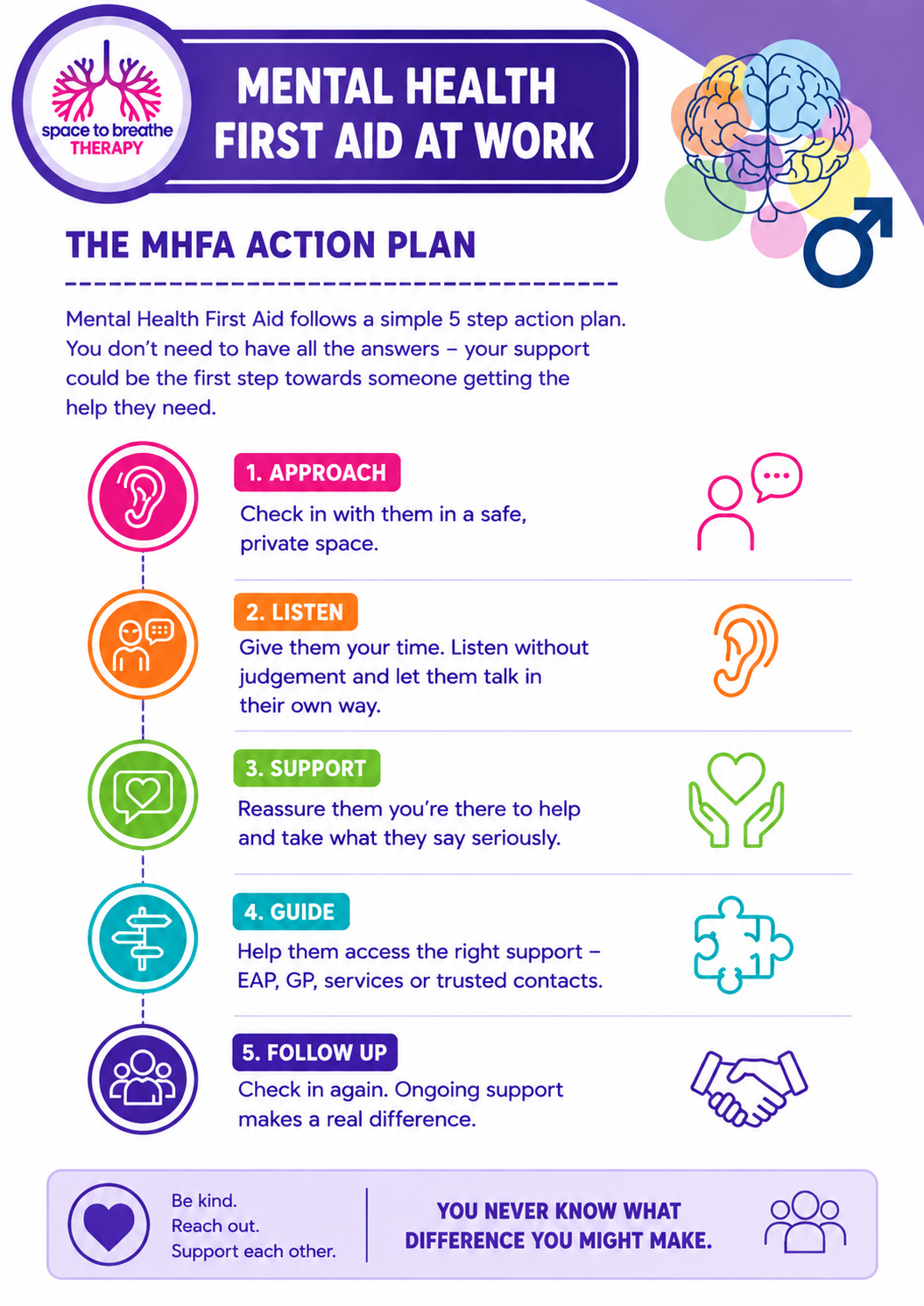
The Mental Health First Aid Action Plan
Five Simple Steps That Can Make a Difference
When we realise that somebody at work may be struggling with their mental health, one of the hardest questions can be:
“What do I actually do?”
We might worry about saying the wrong thing, making the situation worse or becoming involved in something we don't feel equipped to handle.
Having a simple framework can help.
This five-step Mental Health First Aid action plan — Approach, Listen, Support, Guide and Follow Up — provides a straightforward way of thinking about what we can do when somebody needs support.
You don't need to have all the answers. Sometimes your role is simply to help someone take the next step.
1. Approach
Choose a suitable moment and, where possible, somewhere quiet and private.
You don't need to start with a big conversation. You might simply say:
“I've noticed you seem a little quieter than usual. How are things?”
Try to approach with curiosity rather than assumptions.
A tip from me
Don't be frightened of asking.
If your instinct is telling you that somebody isn't quite themselves, a gentle check-in can be incredibly valuable.
You aren't diagnosing them. You're simply opening a door.
2. Listen
If somebody decides to talk, give them your attention.
Try not to interrupt, compare their experience with your own or immediately start suggesting solutions.
Listening can sometimes be the support.
A tip from me
Allow silence.
This is particularly important when supporting somebody who may need additional processing time.
Ask the question and give them time to answer.
We don't always have to fill the quiet.
3. Support
Acknowledge what the person has shared and take their experience seriously.
You might say:
“I'm really glad you told me.”
“That sounds like a lot to be dealing with.”
“What would feel helpful right now?”
Small statements like these can communicate something very important:
I hear you. I believe you. What you're experiencing matters.
A tip from me
Try not to jump straight to “Here's what you should do.”
Ask first.
Different people need different things, and empowering somebody to identify what might help can be much more supportive than deciding for them.
4. Guide
There will be times when listening and reassurance aren't enough.
You may be able to help the person identify appropriate support through their workplace, GP, Employee Assistance Programme, wellbeing service or another suitable professional.
Guiding doesn't mean taking over.
Where possible, involve the person in deciding what happens next.
A tip from me
Support independence rather than creating dependence.
You can walk alongside somebody while still allowing them to remain involved in their own choices and decisions.
5. Follow Up
Please don't underestimate this step.
If somebody has trusted you enough to tell you they're struggling, remember to check in again.
It doesn't have to become a formal meeting.
A simple:
“How have you been since we spoke?”
can be enough.
A tip from me
Remember the person after the difficult moment has passed.
Sometimes people receive lots of attention during a crisis and very little afterwards.
Recovery, adjustment and getting back on your feet can take time.
Knowing somebody still remembers can make a genuine difference.
One Final Reminder From Me
Mental Health First Aid isn't about being perfect.
It's about being human.
Approach with kindness.
Listen with patience.
Support without judgement.
Guide without taking over.
Follow up because people matter.
And remember that your wellbeing matters too.
You can care about someone, support them and help them access the right services without carrying responsibility for everything they are going through.
Sometimes a conversation won't change someone's whole situation.
But it might change that moment.
It might help them feel heard.
It might help them take the next step.
And sometimes, that next step is exactly what they need.
Be kind. Reach out. Support each other.
You never know what difference you might make.
Until next time, give yourself — and others — Space to Breathe.
Maggie
Space to Breathe Therapy




