





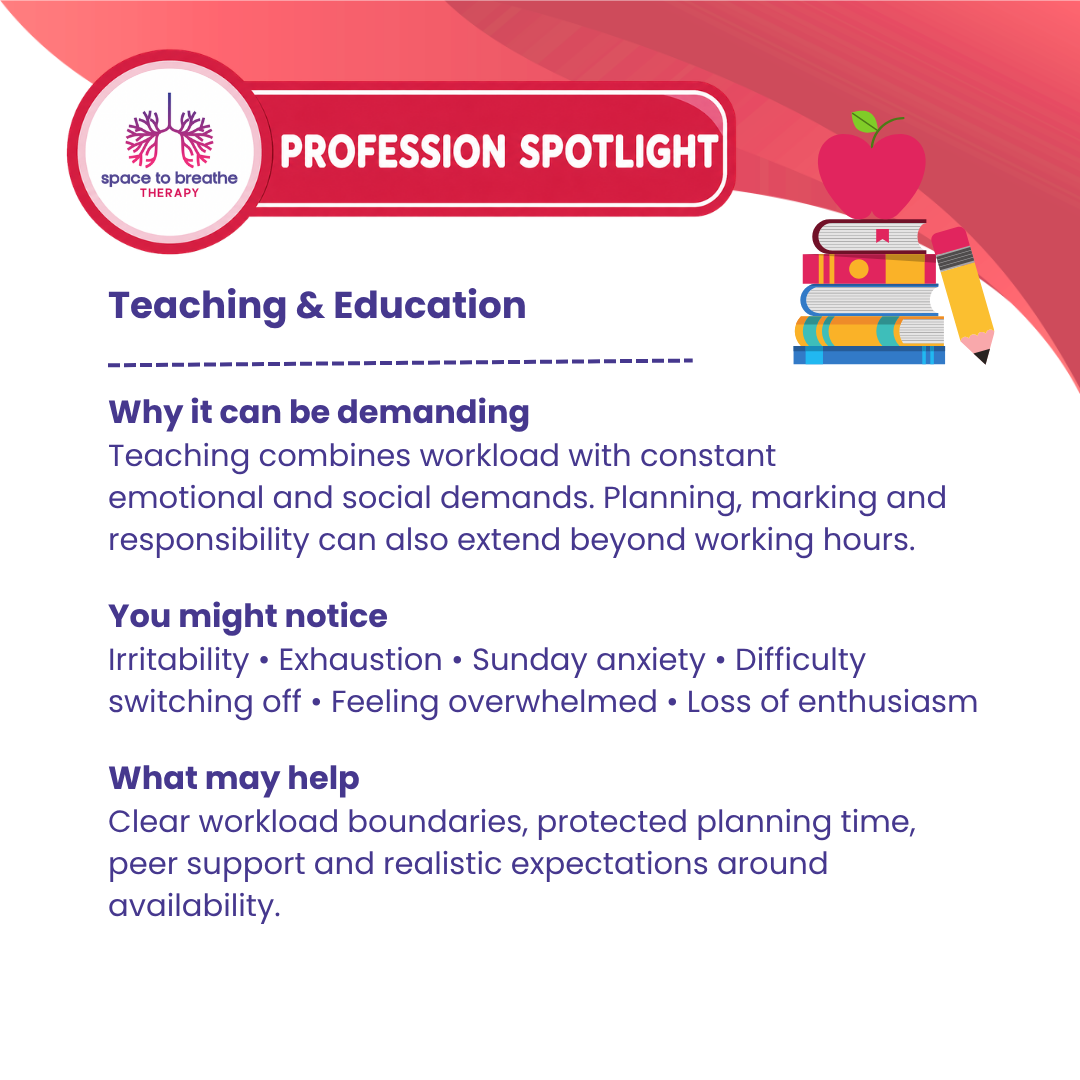
Profession Spotlight: Teaching & Education
Understanding the Emotional, Mental and Practical Demands of Working in Education
Working in education can be incredibly meaningful. Teachers, teaching assistants, lecturers, tutors, SEN staff, early-years practitioners and other education professionals can have a lasting influence on the lives of the people they support.
But education is also a profession with significant cognitive, emotional and social demands. The working day is rarely limited to the hours spent directly teaching. Planning, preparation, marking, assessment, safeguarding, meetings, administration, communication with families and responding to individual student needs can all add to the workload.
For some people, this means that work gradually begins to occupy evenings, weekends and even the mental space that should belong to rest.
Why can teaching and education feel so demanding?
Teaching involves managing many things simultaneously.
An education professional may be delivering a lesson while monitoring behaviour, adapting material for different learning needs, noticing whether a student appears distressed, remembering individual support plans and thinking ahead to what needs to happen next.
Outside direct teaching time there may also be:
- lesson planning and preparation
- marking and assessment
- record keeping and administration
- safeguarding responsibilities
- parent or caregiver communication
- meetings and training
- behaviour management
- supporting students with additional needs
- adapting resources
- managing targets and performance expectations
- responding to organisational changes
- covering staff absence
- preparing for inspections or observations.
The Health and Safety Executive identifies demands, control, support, relationships, role and organisational changeas important areas affecting workplace stress. These can all be relevant within educational environments.
The emotional side of education
Education is fundamentally relational.
Teachers and education staff do not simply deliver information. They build relationships, manage emotions, encourage confidence, recognise distress, respond to behaviour and often become trusted adults in children's and young people's lives.
This can involve considerable emotional labour.
A member of staff may spend part of the day supporting a distressed student, dealing with challenging behaviour or responding to a safeguarding concern and then be expected to immediately return to teaching, smiling and engaging another group.
There may be little time to emotionally process what has happened.
Over time, continually supporting other people's emotional needs without adequate recovery can become exhausting.
The invisible workload
Some of the most demanding parts of education are not always visible.
A lesson may last an hour, but preparing it, adapting it, delivering it, assessing learning and completing follow-up work can extend considerably beyond that hour.
There is also a significant mental workload.
Teachers may leave work while continuing to think about:
Did that student understand the lesson?
Have I completed that paperwork?
Did I respond to that parent?
What am I teaching tomorrow?
Is that child okay?
Have I prepared everything?
What have I forgotten?
Being physically away from work does not necessarily mean someone has mentally left work.
When this happens repeatedly, genuine recovery becomes difficult.
Sunday anxiety and anticipatory stress
Some education professionals notice their anxiety increasing towards the end of the weekend.
Thoughts about Monday may begin on Sunday afternoon—or sometimes earlier.
This might involve checking emails, thinking through lessons, worrying about a difficult class, remembering unfinished tasks or feeling overwhelmed by everything waiting for them.
This anticipatory anxiety can gradually reduce the amount of the weekend that actually feels restorative.
If Sunday repeatedly becomes another unofficial working day, it may be worth considering whether workload, boundaries or workplace support need attention.
Signs that pressure may be building
Stress does not look the same for everyone.
Someone experiencing sustained pressure may notice:
Emotional changes: irritability, anxiety, frustration, tearfulness, guilt, emotional exhaustion or feeling increasingly detached.
Cognitive changes: forgetfulness, difficulty concentrating, indecision, reduced creativity, difficulty prioritising or constantly thinking about work.
Physical changes: fatigue, headaches, muscle tension, disrupted sleep or gastrointestinal symptoms.
Behavioural changes: working increasingly long hours, skipping breaks, withdrawing from colleagues, checking work constantly, procrastinating because tasks feel overwhelming or finding it difficult to switch off.
A person may also notice that something they once loved about education no longer feels enjoyable.
Loss of enthusiasm does not necessarily mean you chose the wrong career
One of the most difficult experiences for education professionals can be losing the enthusiasm they once had for their work.
Someone who previously loved planning lessons or spending time with students may begin feeling detached, frustrated or simply exhausted.
That can create guilt:
“Why don't I enjoy this anymore?”
But loss of enthusiasm can sometimes be a sign of prolonged stress or exhaustion rather than evidence that someone no longer cares.
A person can still value education deeply while struggling with the conditions in which they are being expected to work.
Burnout in education
Burnout is associated with chronic workplace stress that has not been successfully managed.
It is characterised by exhaustion, increased mental distance or negativity towards work and reduced professional effectiveness.
Burnout is therefore more than simply having a difficult week.
Someone experiencing burnout may feel as though they are continually giving without having enough opportunity to recover.
They might become less patient, less emotionally available or increasingly detached—not because they have stopped caring about students, but because their own emotional resources are becoming depleted.
The pressure to do more
Education can create a particularly difficult boundary because there is almost always something else that could be done.
Another worksheet could be created.
Another lesson could be improved.
Another email could be answered.
Another resource could be prepared.
Another student's work could receive more detailed feedback.
Without boundaries, the job can expand into whatever time is available.
A useful question can therefore be:
“What is realistically achievable within the time and resources I have?”
rather than:
“What else could I possibly do?”
Supporting neurodivergent education professionals
Education environments can also present additional challenges for neurodivergent staff.
Noise, fluorescent lighting, busy corridors, frequent interruptions, unpredictable changes, constant social interaction and rapid transitions between tasks may increase sensory and cognitive demands.
Executive-function demands can also be considerable: remembering deadlines, prioritising multiple tasks, switching attention, organising paperwork and managing competing responsibilities.
Helpful workplace adjustments will vary between individuals but may include clearer written instructions, predictable communication, protected planning time, reduced unnecessary interruptions, quieter working areas, assistive technology or changes to working practices.
Support should be based on the individual's needs rather than assumptions about a diagnosis.
Breaks matter
A lunch break spent marking, supervising, answering emails or preparing the next lesson is not genuinely a break.
Even short opportunities to step away from demands can be valuable.
Where possible, breaks can provide time to:
eat and drink, use the bathroom, move the body, reduce sensory input, breathe, sit quietly or simply stop responding to other people's needs for a few minutes.
Rest should not have to be earned by reaching exhaustion first.
What can schools and education settings do?
Workplace wellbeing cannot rely solely on telling individual employees to practise self-care.
Organisational factors matter.
Supportive education environments can consider:
- realistic workloads
- protected planning and preparation time
- appropriate staffing
- clear expectations
- supportive supervision
- access to meaningful breaks
- respectful communication
- clear priorities when workloads increase
- appropriate support following safeguarding or distressing incidents
- reasonable workplace adjustments
- opportunities for staff to raise concerns safely
- realistic expectations around communication outside working hours.
Managers can also help by modelling healthy boundaries themselves.
If senior staff routinely send messages late at night, work through breaks or praise excessive working hours, employees may understandably feel that this is what commitment is supposed to look like.
What might help individually?
Not every pressure can be solved by the individual employee, but identifying what is within your control can still be useful.
Try separating tasks into:
Must be completed now
Important but can wait
Could be delegated or shared
Does not need to be done
It can also help to establish clearer boundaries around email, planning and marking where your role allows.
Instead of trying to complete everything before leaving work, consider identifying a realistic stopping point.
There will almost always be more work available.
Your working day still needs an ending.
Talking about workload
If workload is becoming unmanageable, try describing the specific problem rather than only saying that you feel stressed.
For example:
“I currently have more work than I can complete within my available hours.”
“I need help identifying which of these tasks should take priority.”
“I am regularly working beyond my expected hours to meet these requirements.”
“I need protected time to complete this responsibility.”
“This aspect of my role is affecting my wellbeing and I would like to discuss what support is available.”
Specific conversations can make practical problems easier to identify.
Supporting a colleague
Education staff often become very good at appearing capable even when they are struggling.
A colleague may still arrive every morning, teach their classes and meet essential responsibilities while privately feeling overwhelmed.
Changes worth noticing might include increased irritability, withdrawal, tearfulness, unusual mistakes, working much longer hours, repeatedly skipping breaks or saying that they cannot switch off.
You do not need to solve the problem.
Sometimes a genuine:
“You seem to have a lot on at the moment. How are you doing?”
can be an important beginning.
Remember
You can love teaching and still find teaching exhausting.
You can care deeply about your students and still need boundaries.
You can be an excellent teacher and still have days when you feel overwhelmed.
You can be committed without sacrificing every evening and weekend.
You can need support without being bad at your job.
And you can acknowledge that the workload is too much without that becoming a judgement about your resilience.
Your value as an educator is not measured by how exhausted you are willing to become.
Space to Breathe Therapy
Education is about helping other people grow — but the wellbeing of the people doing that work matters too.
This resource provides general information and does not replace individual medical, psychological, occupational-health or employment advice.




