





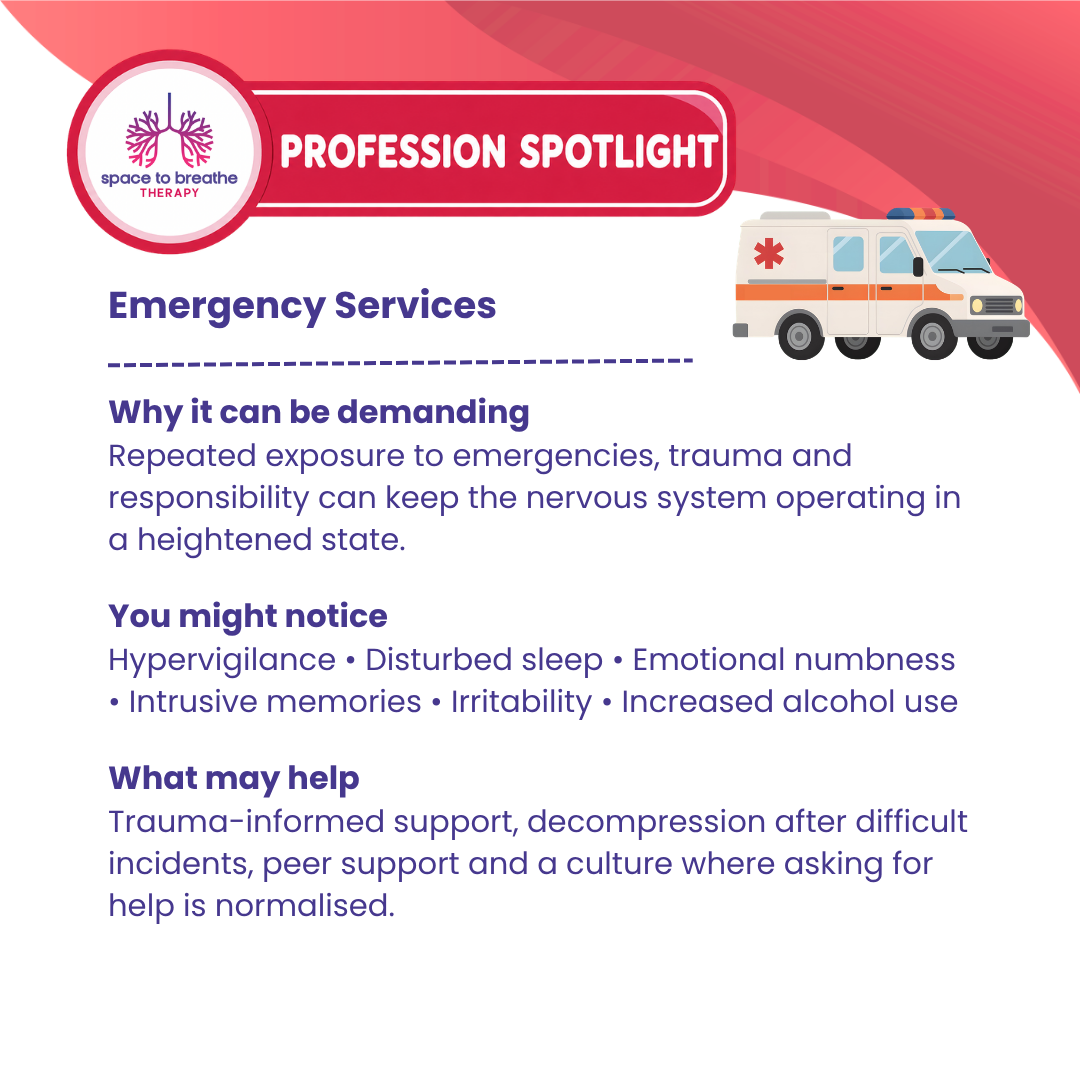
Profession Spotlight: Emergency Services
Understanding the Psychological and Emotional Impact of Emergency Response Work
Working in the emergency services can involve extraordinary levels of responsibility. Police officers, firefighters, paramedics, ambulance staff, emergency call handlers, coastguard personnel and others working in emergency response may regularly encounter situations involving serious injury, death, violence, distress, uncertainty and immediate risk.
These experiences are often combined with shift work, disrupted sleep, unpredictable workloads, time pressure and the responsibility of making important decisions quickly.
For many people, coping well with an emergency does not necessarily mean that the experience has had no impact. Sometimes reactions emerge later, after the immediate situation has passed.
Why can emergency service work be so demanding?
Emergency workers may repeatedly enter situations that most people experience rarely, if ever.
Depending on the role, this can include exposure to:
- serious accidents and injuries
- sudden or unexpected deaths
- suicide and attempted suicide
- violence or threats
- distressed children and families
- safeguarding situations
- traumatic scenes
- emergencies involving colleagues
- situations where somebody cannot be saved
- uncertainty and rapidly changing circumstances
- responsibility for decisions made under intense pressure.
The Health and Safety Executive recognises that work-related stress can occur when demands exceed a person's ability to cope, particularly where factors such as workload, working patterns, support, relationships, role and organisational change are involved.
Repeated exposure can matter
Emergency service workers may experience repeated or cumulative exposure rather than one isolated traumatic event.
A person might attend one difficult incident and recover relatively quickly, while months or years of repeated exposure can have a different effect.
The impact can also be highly individual. Two colleagues can attend exactly the same incident and experience it differently.
Personal meaning matters too. An incident involving a child of a similar age to your own, for example, may affect you differently from previous incidents.
There is no single “correct” response to potentially traumatic events.
Living in a heightened state
During an emergency, the body's stress response can be useful. Heart rate and alertness can increase, attention can narrow towards immediate threats and the body prepares to respond quickly.
The difficulty can come when switching out of that heightened state becomes harder.
Some emergency workers may notice:
Hypervigilance — feeling constantly alert or scanning the environment for potential danger.
Sleep disruption — difficulty falling asleep, waking frequently, nightmares or struggling to sleep after shifts.
Irritability — feeling unusually impatient, angry or easily overwhelmed.
Difficulty relaxing — feeling restless or uncomfortable when things are quiet.
Concentration problems — finding it harder to focus, remember information or make everyday decisions.
These experiences do not automatically mean someone has PTSD. Reactions following distressing events can occur without developing a mental health disorder.
Intrusive memories and reminders
After a distressing incident, memories may sometimes return unexpectedly.
A person might experience unwanted images, thoughts, dreams or memories connected to something they witnessed. Sounds, smells, locations, news reports or seemingly unrelated situations can sometimes act as reminders.
Some people may find themselves deliberately avoiding reminders of an incident because remembering it feels uncomfortable.
If intrusive memories, avoidance, heightened alertness or other trauma-related symptoms persist and significantly interfere with everyday life, seeking professional support can be important.
Emotional numbness
Not everybody responds to difficult experiences by becoming visibly emotional.
Some people notice the opposite.
They may feel:
- emotionally flat
- disconnected
- unusually detached
- less interested in things they previously enjoyed
- distant from family or friends
- as though they are functioning on “autopilot”.
Emotional detachment can sometimes develop as a way of continuing to function around repeated distress.
However, if that detachment begins affecting relationships, wellbeing or someone's ability to experience life outside work, it deserves attention.
The pressure to “just get on with it”
Emergency service cultures can place considerable value on resilience, reliability and remaining calm under pressure. These qualities are important, but they can become problematic if people begin believing that being affected by their work means they are weak or unsuitable for the profession.
Someone can be highly experienced, capable and resilient and still be affected by what they have witnessed.
Psychological responses are not a measurement of professional competence.
Sometimes the person who appears to be coping exceptionally well is also the person who has become very skilled at hiding how much they are carrying.
Alcohol and other coping behaviours
Some people may use alcohol or other behaviours to try to switch off after difficult shifts, reduce tension, avoid memories or help themselves sleep.
That may provide short-term relief without addressing the underlying stress or trauma.
Changes in alcohol use can therefore be worth noticing, particularly if someone finds that they increasingly needs alcohol to relax, sleep or stop thinking about work.
Other changes may include excessive working, withdrawing socially, emotional eating, gambling or spending increasing amounts of time distracting themselves from uncomfortable thoughts and feelings.
Rather than judging the behaviour alone, it can be helpful to ask:
“What am I trying not to feel, remember or think about?”
Shift work and recovery
Emergency services operate around the clock, which means night shifts, early starts, long shifts and changing working patterns may be unavoidable for many roles.
This can make recovery more complicated.
Someone may finish an intense night shift while the rest of their household is beginning the day. They may be physically exhausted while their nervous system remains highly activated.
Recovery therefore involves more than simply being away from the workplace.
Regular opportunities for sleep, food, hydration, movement, social connection and psychological decompression all contribute to wellbeing.
Decompression after difficult incidents
There is no single way everybody must process an incident.
Some people want to talk. Others initially need quiet, practical support or time before discussing what happened.
Support should therefore avoid forcing people to repeatedly describe traumatic experiences before they are ready.
What can be helpful is creating genuine opportunities for people to access appropriate support, speak confidentially and recognise when an experience continues to affect them.
Peer support
Colleagues can be particularly important in emergency services because they often understand aspects of the work that family and friends cannot fully appreciate.
A colleague might notice changes such as:
- becoming unusually quiet
- withdrawing from the team
- increased irritability
- repeatedly volunteering for overtime
- struggling with sleep
- drinking more
- appearing unusually anxious or watchful
- becoming emotionally detached
- losing confidence
- making unusual mistakes.
You do not need to diagnose somebody.
Sometimes saying:
“I've noticed you don't seem quite yourself lately. How are you doing?”
can create an important opportunity for conversation.
When professional support may be useful
Professional support may be worth considering when reactions continue, intensify or begin affecting everyday functioning.
This might include persistent nightmares, intrusive memories, avoidance, panic, significant changes in mood, difficulty functioning at work, relationship problems, increasing reliance on alcohol or feeling unable to switch off from what has been experienced.
Support might be available through occupational health, an employee assistance programme, a GP, psychological services, trauma-informed therapy, professional organisations or specialist emergency-services support.
Seeking support early does not require somebody to wait until they reach crisis point.
Organisations have responsibilities too
Emergency-service wellbeing cannot rest entirely on individual workers being told to become more resilient.
Employers have responsibilities around managing work-related stress. HSE's Management Standards identify demands, control, support, relationships, role and change as important areas in preventing and managing workplace stress.
A psychologically healthier working culture can include adequate staffing where possible, appropriate workloads, supportive management, access to breaks, good communication, appropriate supervision and accessible psychological support.
Perhaps most importantly, people need to feel that asking for help will not automatically be interpreted as an inability to do their job.
Remember
Being able to function during an emergency does not mean you must be unaffected by it afterwards.
You can be courageous and still feel frightened.
You can be experienced and still encounter an incident that stays with you.
You can be resilient and still become exhausted.
You can support other people and still need support yourself.
And you can be excellent at your job while acknowledging that repeatedly witnessing trauma carries a psychological load.
The aim is not to become unaffected by everything you experience. It is to recognise when the experiences you carry need somewhere safe to go.
Space to Breathe Therapy
For the people who respond when everyone else needs help — your wellbeing matters too.
This resource provides general information and does not replace individual medical, psychological or occupational-health advice.