





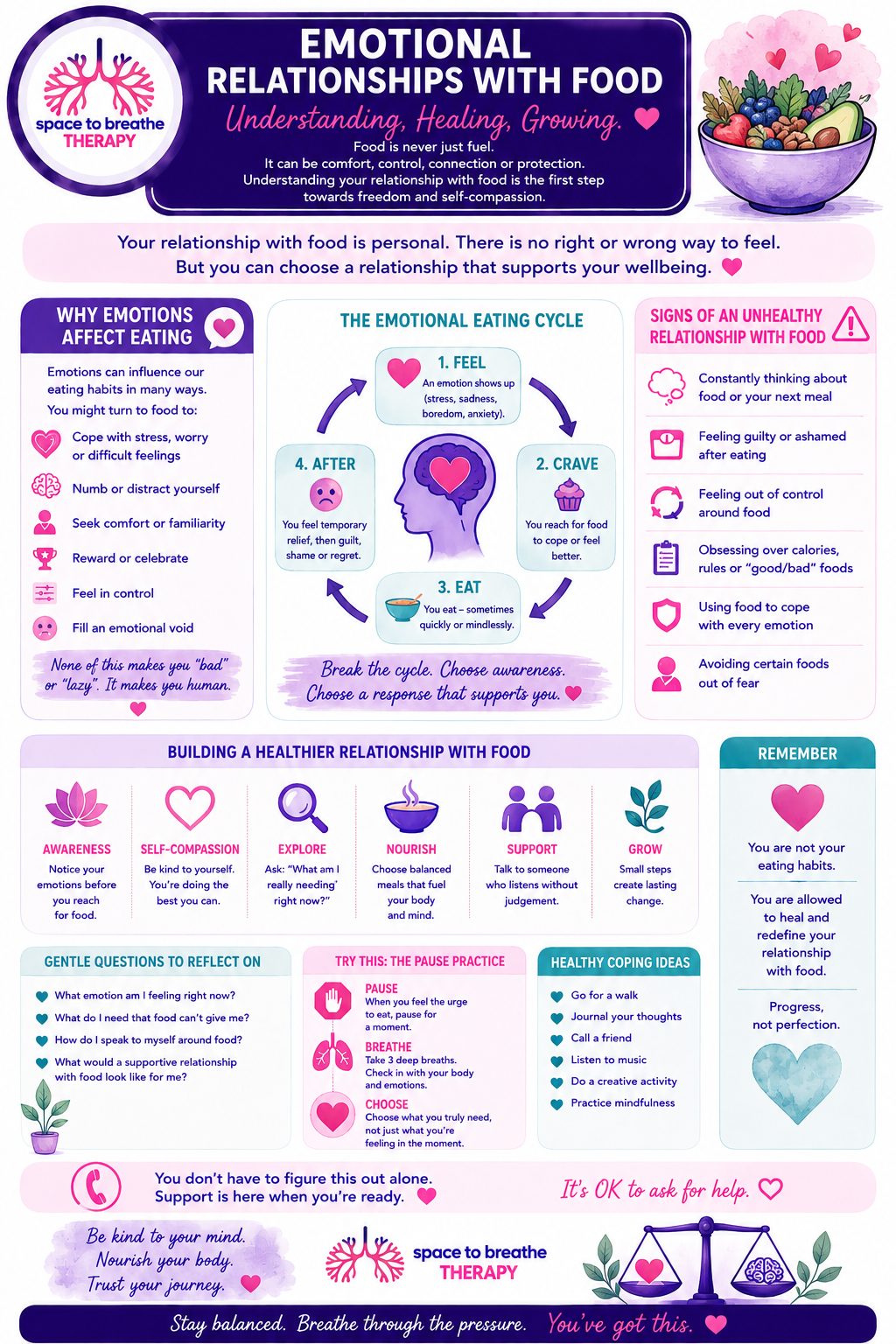
Emotional Relationships with Food
When Food Becomes About More Than Hunger
Our relationship with food can be complicated. What, when and how we eat can be influenced by far more than physical hunger.
Food can represent comfort, familiarity, safety, control, reward, connection or distraction. At different points in our lives, we may notice ourselves turning towards food — or away from it — depending on what is happening emotionally.
Understanding this isn't about blaming yourself or creating another set of food rules. It's about becoming curious about what your eating patterns might be communicating.
Understanding the Emotional Eating Cycle
Sometimes an uncomfortable emotion appears first — perhaps stress, loneliness, boredom, sadness or anxiety.
We look for something that will help us feel different, and food can provide comfort or distraction. Afterwards, however, we may experience guilt, regret or frustration.
That can create another difficult emotion, and the cycle begins again.
The aim isn't necessarily to remove food from the equation. Instead, we can begin creating a pause between the feeling and our response.
Ask yourself:
What am I feeling right now?
What do I actually need?
Would food help, or is there something else I need as well?
Sometimes the answer will still be food — and that's okay.
Food Can Also Feel Difficult
It's important to remember that emotions don't only lead us to eat more.
Anxiety, stress and overwhelm can make eating difficult too. You might lose your appetite, forget meals, avoid unfamiliar foods or find yourself relying on a smaller number of foods that feel predictable and safe.
So rather than asking:
“Why can't I just eat normally?”
try asking:
“What would make eating feel a little easier or safer for me today?”
That small change removes judgement and creates space for understanding.
A Tip From Me – Add Another Option
If food has become one of your main ways of coping, don't immediately try to take it away.
Instead, add other coping strategies alongside it.
You might go for a short walk, listen to music, message somebody, journal, have a shower, sit somewhere quiet, do something creative or simply give yourself ten minutes without demands.
Over time, you're building a bigger emotional toolkit rather than removing something that may have been helping you cope.
Take the Labels Away
Try noticing how often you describe food as:
Good. Bad. Naughty. Clean. Unhealthy. A treat. A cheat.
Those labels can quietly influence how we feel about ourselves after eating.
Food doesn't determine whether you've had a good or bad day, and what you eat doesn't determine whether you're a good or bad person.
Your relationship with food can become gentler when you begin removing morality, punishment and perfection from eating.
Look Beneath the Behaviour
If you're constantly thinking about food, feeling frightened around particular foods, experiencing guilt after eating or feeling that eating is becoming increasingly difficult to manage, there may be something underneath that deserves attention.
It might be anxiety.
Sensory needs.
Low mood.
Stress.
Body image.
Past experiences.
A need for control.
Or simply years of messages about what you should and shouldn't eat.
You don't have to work all of that out alone.
A Message From Me
Your relationship with food has developed through your experiences, your environment, your emotions and your individual needs.
So give yourself permission to understand it before trying to change it.
Notice without judging.
Explore without criticising.
Nourish rather than punish.
And make changes gently, at a pace that feels manageable for you.
Healing your relationship with food doesn't mean never eating emotionally again. It can mean recognising what's happening and having more choice in how you respond.
Some days will feel easier than others.
That's okay.
Progress isn't perfection. It's understanding yourself a little more and learning to respond with a little more kindness.
Until next time, give yourself Space to Breathe.
With love, Maggie
Space to Breathe Therapy