

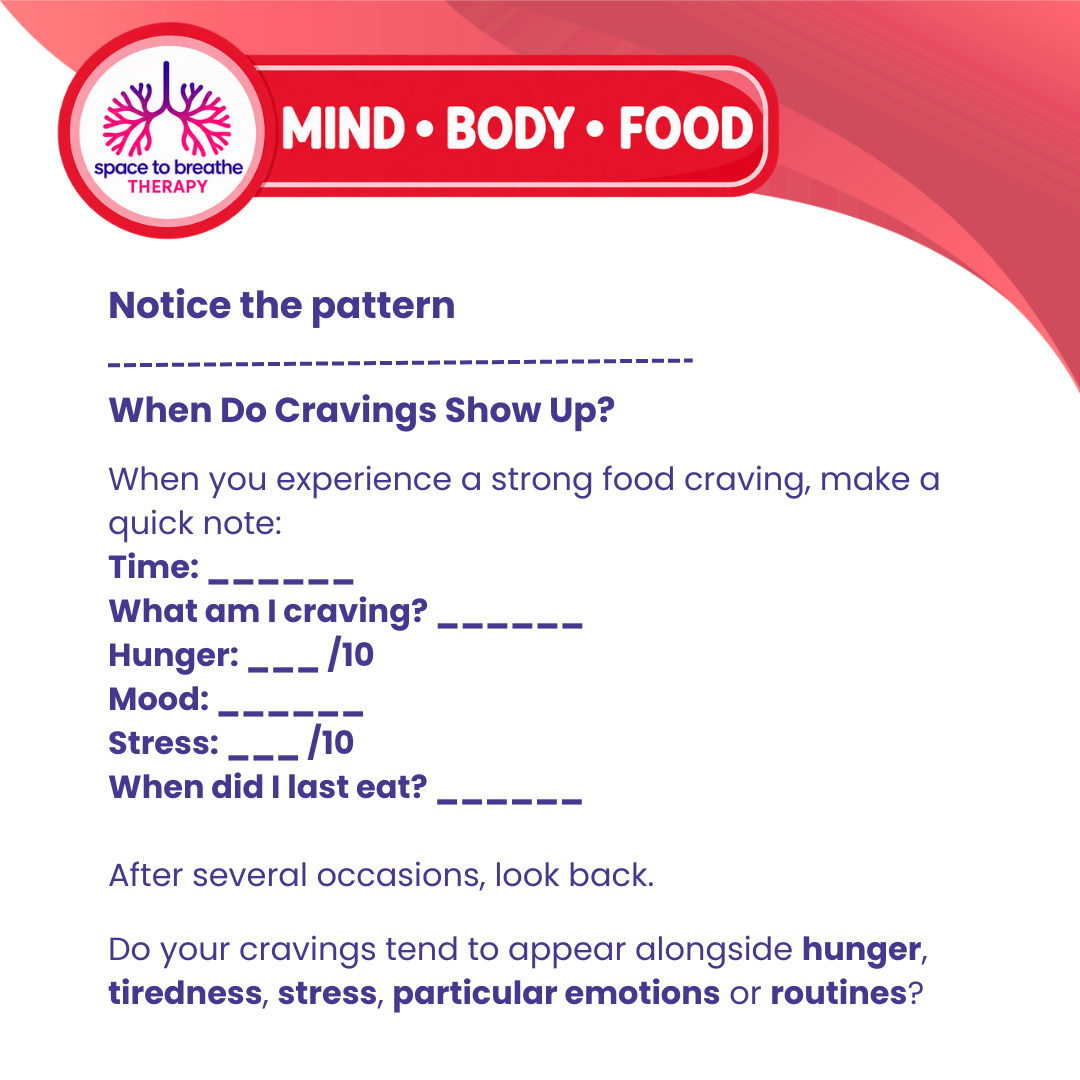
Notice the Pattern: When Do Cravings Show Up?
Cravings are normal. They don't automatically mean that you're lacking a particular nutrient, that you're addicted to a food, or that you have poor self-control.
A craving can be influenced by physical hunger, emotions, habits, restriction, sensory needs, tiredness, stress and our environment.
Rather than trying to immediately stop a craving, it can be useful to become curious about when it appears and what was happening beforehand.
What might be influencing it?
When a craving appears, consider:
- Hunger: Have you eaten enough today?
- Time since eating: Has there been a long gap since your last meal or snack?
- Restriction: Have you been telling yourself you aren't “allowed” a particular food?
- Sleep: Are cravings stronger when you're tired?
- Stress: Has today been particularly demanding?
- Emotions: Are you bored, anxious, upset, lonely, excited or looking for comfort?
- Sensory needs: Are you seeking something crunchy, cold, sweet, salty, smooth or strongly flavoured?
- Routine: Does the craving regularly appear at a particular time or alongside an activity?
- Environment: Did seeing, smelling or talking about a food trigger interest in it?
Sometimes the simplest explanation is also completely valid:
You like the food and you want to eat it.
Keep a quick craving record
When you notice a strong craving, write down:
Time: __________
What am I craving? __________
Hunger: ___ /10
Craving strength: ___ /10
Mood: __________
Stress: ___ /10
Energy: ___ /10
When did I last eat? __________
What was I doing beforehand? __________
You don't need to analyse the craving immediately. Record it and carry on with your day.
Look back after several occasions
Are there any repeated patterns?
Perhaps cravings appear more often when you've gone too long without eating, after a stressful day, when you're tired, while watching television, during certain routines, or after you've been trying to avoid a particular food.
You might also discover there isn't an obvious pattern.
That's useful information too.
A craving isn't a problem to solve
Sometimes responding to a craving by eating the food is perfectly reasonable. At other times, noticing the craving might help you recognise another need alongside it — perhaps hunger, rest, comfort, stimulation or connection.
The aim isn't to create another set of food rules.
It's to understand your individual patterns without judgement.
Space to Breathe Therapy