





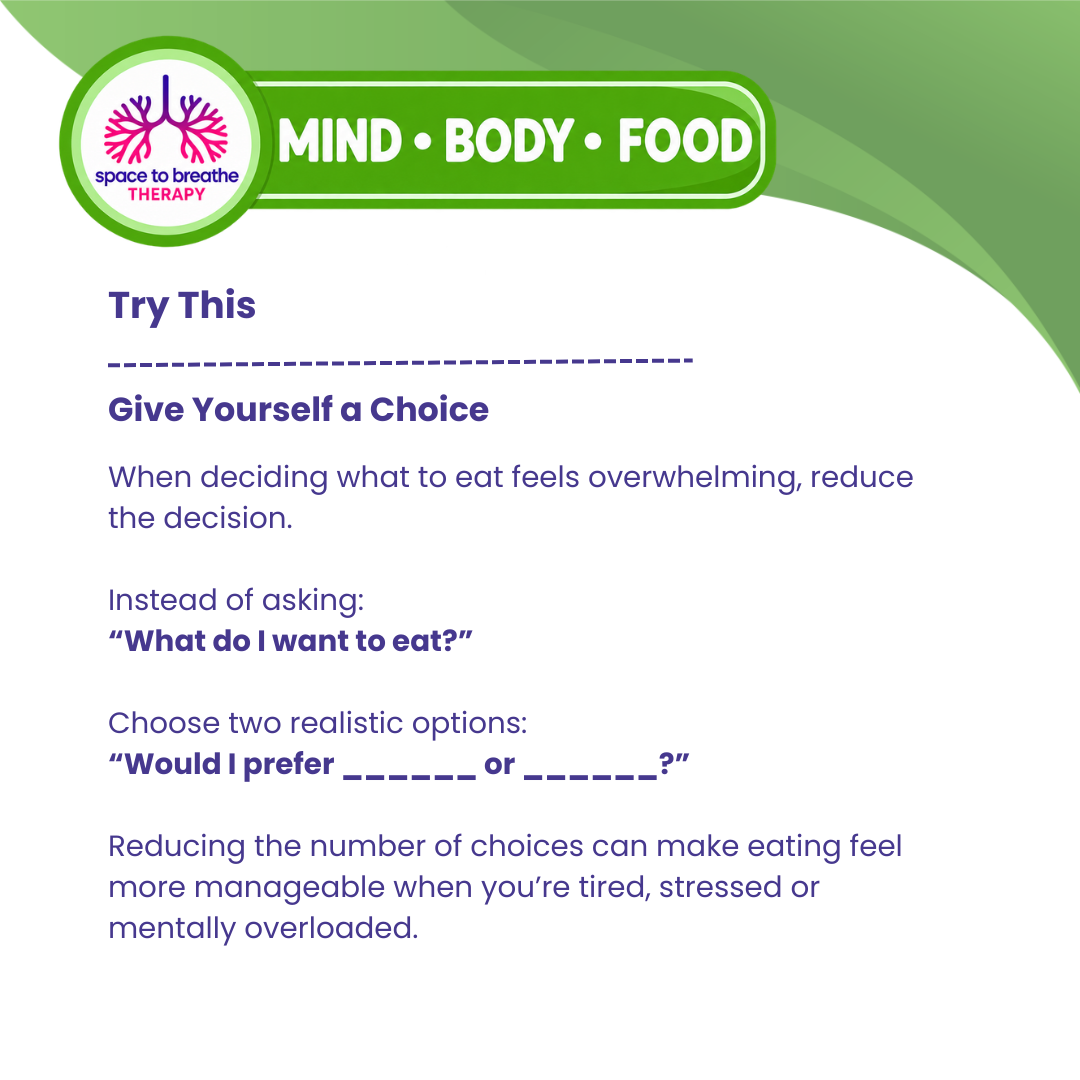
Try This
Give Yourself a Choice
Deciding what to eat can sometimes become more difficult than actually eating.
When you are tired, stressed, overwhelmed, distracted or already hungry, a question as open as:
“What do I want to eat?”
can require a surprising amount of mental work.
You may need to think about what food is available, what needs preparing, what texture you can tolerate, how hungry you are, what sounds appealing and how much energy you have to make it.
Sometimes the answer becomes:
“I don't know.”
And eating gets delayed.
Reduce the Decision
Instead of choosing from everything available, give yourself two realistic options.
Rather than:
“What do I want for lunch?”
try:
“Would I prefer a sandwich or soup?”
Instead of:
“What should I have for breakfast?”
try:
“Would I prefer cereal or toast?”
Instead of:
“What snack do I want?”
try:
“Would I prefer something crunchy or something soft?”
A smaller decision can feel much more manageable.
Why Can Choosing Food Feel So Difficult?
Food decisions involve several different processes at once.
You may be considering:
- Hunger and fullness
- Taste
- Texture
- Smell
- Temperature
- Preparation time
- Available ingredients
- Washing up
- Cost
- Nutrition
- Previous experiences with the food
- How much energy you currently have
- Whether the food actually feels safe or appealing
For someone experiencing ADHD, autism, ARFID, sensory differences, anxiety, fatigue or executive functioning difficulties, these decisions can become particularly demanding.
Try the Two-Choice Method
When you notice yourself becoming stuck, stop searching for the “perfect” option.
Choose two foods that are:
Available • Manageable • Familiar • Realistic
Then ask:
“Would I prefer ______ or ______?”
You are not asking yourself to choose the best meal.
You are simply choosing between two possible meals.
Use Sensory Choices Too
Sometimes you may not know exactly what food you want, but you may know what kind of sensory experience feels manageable.
Ask:
Hot or cold?
Crunchy or soft?
Sweet or savoury?
Dry or with sauce?
Light or more filling?
Familiar or something different?
Your answer can help narrow the options.
Think About Your Energy
Your choice can also depend on how much capacity you have.
Higher-Energy Day
You may feel able to cook, prepare ingredients or try something different.
Medium-Energy Day
You might assemble something simple or heat a prepared meal.
Low-Energy Day
You may need something you can open, heat or eat immediately.
Choosing according to your available energy is not laziness.
It is adapting the task to your current capacity.
Create a Personal Food Menu
Write down a few reliable choices before you need them.
Breakfast
Option 1: ____________________
Option 2: ____________________
Lunch
Option 1: ____________________
Option 2: ____________________
Dinner
Option 1: ____________________
Option 2: ____________________
Snacks
Option 1: ____________________
Option 2: ____________________
When decision-making is difficult, return to your list instead of starting from scratch.
If Neither Option Feels Right
You are allowed to change the options.
Try asking:
“What is putting me off these foods?”
Perhaps the food is too hot, too complicated, too strong-smelling, too much effort or simply not something your body can manage at that moment.
That information can help you choose something more suitable.
Safe and Familiar Is Still a Choice
You do not have to choose something different every day.
Repeating meals can reduce decision fatigue and provide predictability.
For someone with sensory differences or ARFID, familiar foods may also provide important sensory and emotional safety.
Variety can be explored when it feels manageable — it does not need to be forced at every meal.
Try This Today
The next time you become stuck deciding what to eat:
1. Stop searching through every possibility.
2. Choose two realistic options.
3. Ask: “Which feels easier right now?”
4. Choose one and allow that choice to be good enough.
You can always add something else afterwards if you want to.
Remember
Eating does not have to begin with finding the perfect meal.
Sometimes reducing the number of decisions is exactly what makes eating possible.
Fewer choices • Less pressure • Easier decisions • More accessible nourishment
Space to Breathe