





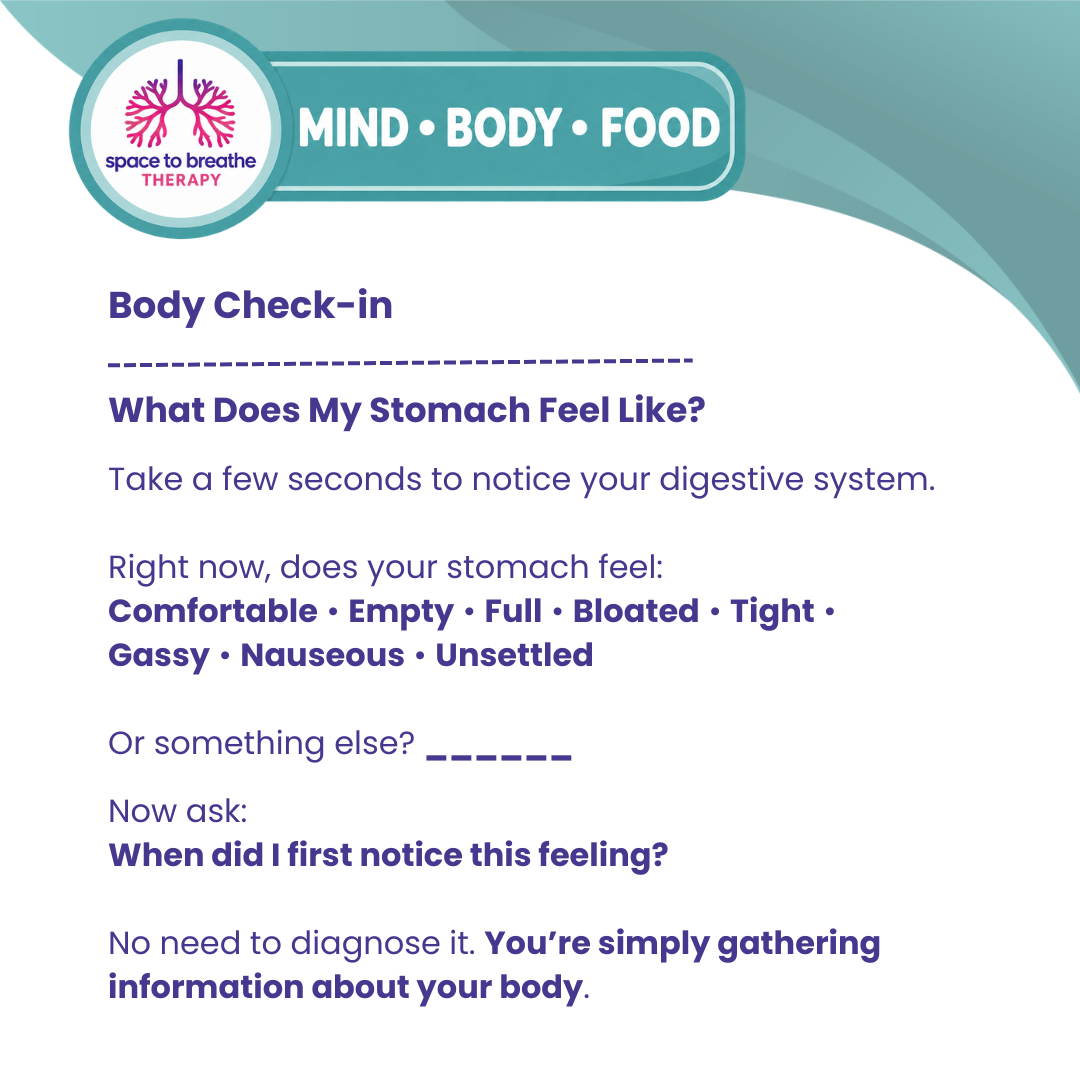
Body Check-In: What Does My Stomach Feel Like?
We often notice our stomach only when something feels uncomfortable. But taking a few seconds to check in when things feel ordinary too can help us become more familiar with our body's signals.
The aim isn't to diagnose what you're feeling. It's simply to notice, describe and become curious about it.
Start with the sensation
Pause and bring your attention gently towards your stomach.
Does it feel:
Comfortable? Empty? Full? Bloated? Tight? Gassy? Nauseous? Unsettled?
Or perhaps none of those words quite fit.
You might notice rumbling, pressure, warmth, heaviness, butterflies, movement or very little sensation at all.
There isn't a correct answer.
When did I first notice it?
Think about when the sensation began.
Was it there when you woke up?
Did you notice it before eating, during a meal or afterwards?
Did it appear during a stressful situation?
Has it gradually changed throughout the day?
You're not trying to prove what caused it. You're simply collecting information.
Food isn't always the explanation
It's easy to experience a digestive sensation and immediately think:
“What did I eat?”
Food can certainly influence digestion, but it isn't the only factor.
Our digestive system can also be affected by stress, anxiety, hormones, illness, medication, constipation, movement, sleep and changes in routine.
This is why noticing patterns over time is often more useful than blaming one particular food.
Your nervous system and digestive system communicate
Our brain and gut are constantly communicating.
You might notice butterflies before something important, nausea when anxious, changes in appetite during stress or digestive changes when you're overwhelmed.
These sensations are real physical experiences. Understanding the mind–body connection doesn't mean assuming every digestive symptom is psychological.
Interoception can make this harder
For some people — particularly those with autism, ADHD or sensory-processing differences — internal body signals may feel very strong, very faint or difficult to interpret.
You might know that something feels different without being able to explain exactly what it is.
That's okay.
Body awareness can develop gradually through repeated, pressure-free check-ins.
Try noticing without fixing
You don't necessarily have to respond immediately.
Try:
“My stomach feels tight right now.”
rather than:
“Something must be wrong.”
That small difference can help turn the check-in into observation rather than worry.
If digestive symptoms are persistent, severe, worsening, regularly interfering with eating or everyday life, or accompanied by concerning symptoms, speak with a healthcare professional.
You don't have to understand every sensation your body gives you. Sometimes noticing it is enough to begin learning your body's individual language.
Space to Breathe Therapy




