





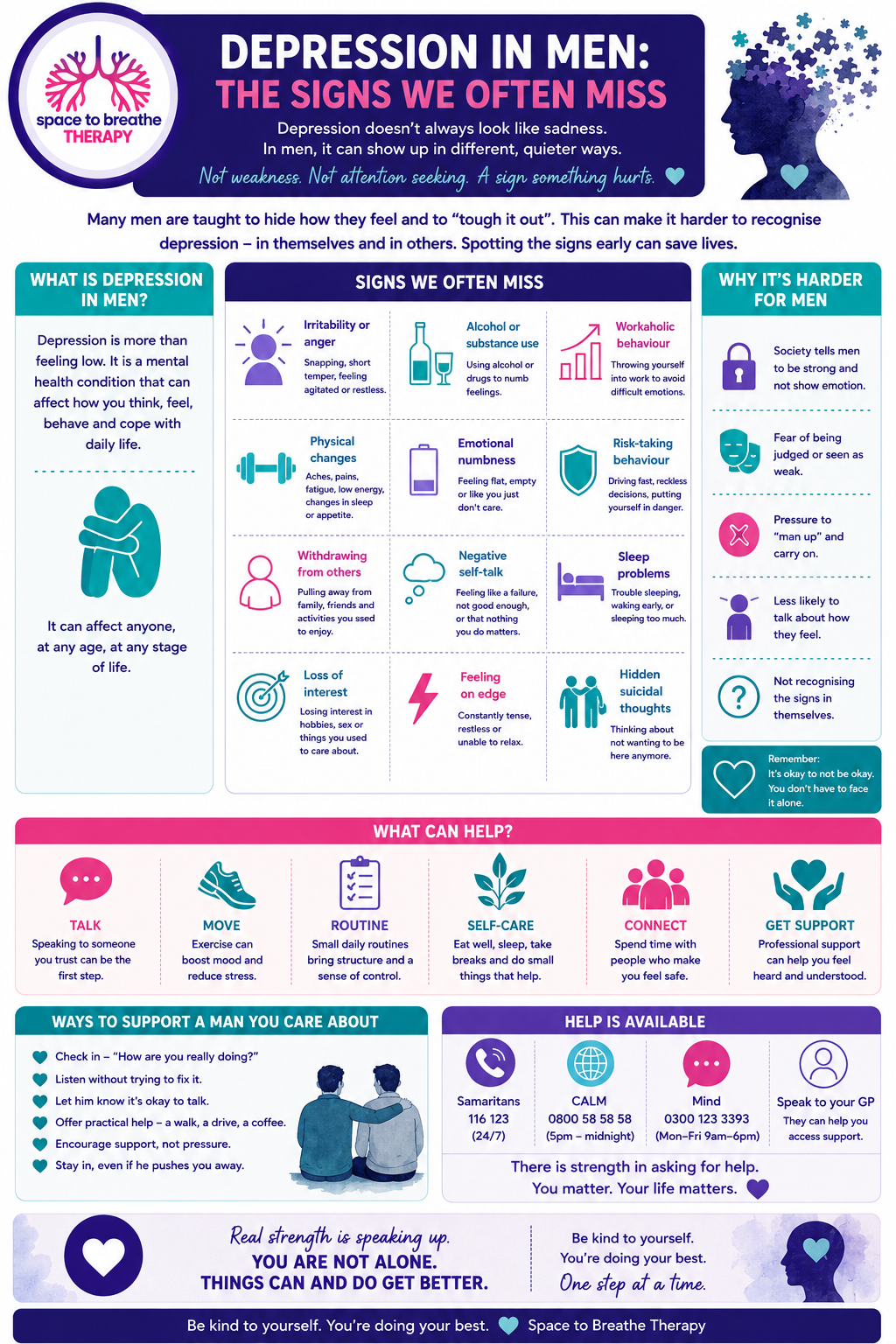
Depression in Men
When Struggling Doesn't Look Like Sadness
When we think about depression, we often imagine somebody looking visibly sad, crying or saying that they're feeling low.
But depression doesn't always look like that.
For some men, it can appear as anger, irritability, exhaustion, withdrawing, working constantly, drinking more, taking risks or simply becoming emotionally numb.
Sometimes the person themselves doesn't recognise that they're struggling.
They may just think:
“I'm tired.”
“I'm stressed.”
“I need to get on with it.”
“Other people have it worse.”
And they keep going.
When “I'm Fine” Doesn't Mean Fine
Many men have grown up hearing messages about being strong, getting on with things and not showing vulnerability.
So instead of saying:
“I'm struggling.”
they may become quieter.
Stay at work longer.
Stop seeing friends.
Become impatient with people they love.
Drink more.
Lose interest in things.
Or throw themselves into something that keeps them from having to think.
This is why it's important to look beyond the stereotype of what depression is supposed to look like.
Notice Changes, Not Just Symptoms
One of my biggest tips is to notice what has changed for that person.
Has someone who normally enjoys seeing friends started cancelling everything?
Has a usually patient person become constantly irritable?
Has somebody who enjoyed hobbies stopped caring about them?
Are they working every possible hour?
Are they drinking more?
Do they repeatedly say they're exhausted but never seem able to slow down?
Sometimes the change from someone's usual behaviour tells us more than any checklist.
Anger Can Sometimes Be the Emotion We See
If someone is struggling underneath, what we see on the outside may be frustration or anger.
That doesn't mean harmful behaviour should simply be accepted.
But it can be worth asking:
“What's underneath this?”
There may be fear.
Pressure.
Shame.
Exhaustion.
Grief.
Hopelessness.
Or the feeling that they should be able to cope alone.
A Few Tips From Me If You're Worried About Someone
Don't feel you need to begin with:
“I think you're depressed.”
Try something more natural.
“You haven't seemed yourself recently. How are you really doing?”
Then listen.
If they brush you off, you don't necessarily have to push — but you can leave the door open.
“That's okay. You don't have to talk now, but I'm here if you want to.”
And check in again.
Sometimes it takes more than one invitation before somebody feels able to talk.
Offer Something Practical
Not every supportive conversation has to happen sitting face-to-face.
For some people, talking while walking, driving, doing something practical or having a coffee can feel much easier.
You could say:
“Fancy going for a walk?”
“Want to grab a coffee?”
“I'll come with you if you want to speak to someone.”
Practical support can sometimes open the door to emotional support.
If You're the Person Struggling
You don't need to wait until things become unbearable before asking for help.
And you don't need to be able to explain everything perfectly.
You can start with:
“I'm not feeling like myself.”
“I'm struggling more than people realise.”
“I don't really know what's wrong, but I know something isn't right.”
That's enough to begin a conversation.
A Message From Me
Strength isn't pretending nothing affects you.
And asking for help doesn't take away your independence, masculinity or ability to cope.
Sometimes real strength is recognising:
“I can't keep doing this on my own.”
If someone you care about has changed, notice them.
Ask.
Listen.
Stay connected.
Encourage support.
And if you're the one struggling, please remember that you don't have to reach breaking point before you're allowed help.
You are not wasting anybody's time.
You don't have to have the right words.
And you don't have to face everything alone.
Real strength can be speaking up.
Things can change. Things can get better.
Until next time, give yourself Space to Breathe.
Maggie
Space to Breathe Therapy




