





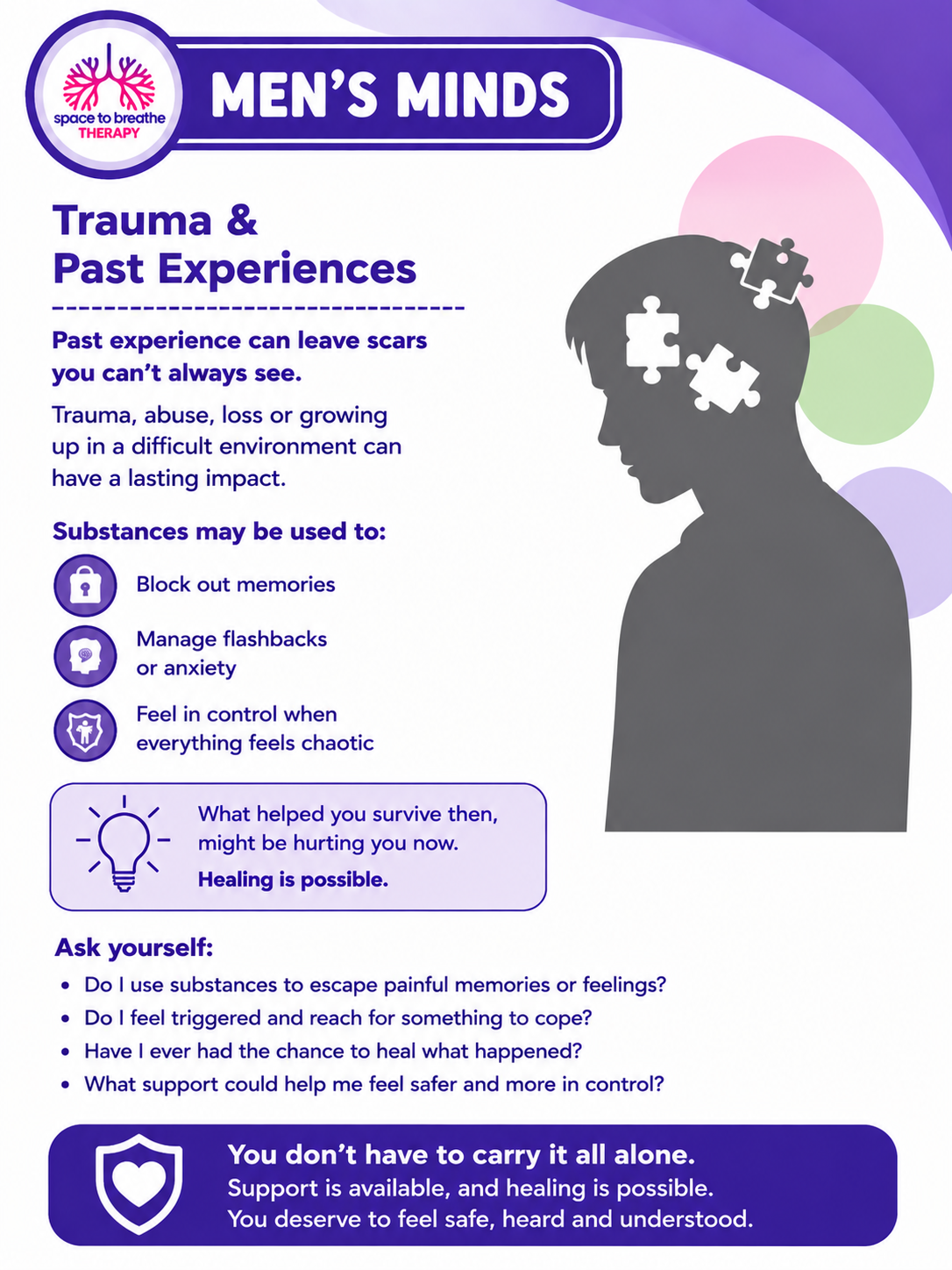
Men’s Minds: Trauma & Past Experiences
When the Past Is Still Affecting the Present
Some experiences don't simply disappear because time has passed.
Trauma can come from many places — abuse, loss, neglect, violence, difficult relationships, childhood experiences, accidents or living for a long time in an environment where you never really felt safe.
You may have learned to get on with it, push it down and keep moving.
That may have helped you survive at the time.
But years later, your mind and body can still carry parts of what happened.
Trauma Doesn't Always Look Like Trauma
You don't necessarily spend every day thinking about the past.
Instead, you might notice yourself becoming angry very quickly.
You struggle to trust people.
Certain situations make you feel uncomfortable without knowing why.
You avoid particular places or conversations.
You constantly feel on guard.
You struggle with sleep.
You shut down emotionally.
Or you keep yourself permanently busy because slowing down means having time to think.
Sometimes we become so used to protecting ourselves that we don't recognise these behaviours as survival responses.
When Substances Become a Way of Numbing
Alcohol or other substances can sometimes become a way of turning down feelings that seem too difficult to manage.
They might temporarily help you:
Switch your thoughts off.
Sleep.
Feel less anxious.
Block painful memories.
Feel more confident around other people.
Or simply feel nothing for a while.
If that's happening, it can be helpful to look beyond the substance itself and ask:
“What am I trying not to feel?”
The answer may tell you where support is really needed.
A Tip From Me – You Don't Have to Tell the Whole Story
One thing that can stop people seeking support is believing they'll immediately have to explain everything that happened.
You don't.
You can begin with:
“Something happened in my past and I think it's still affecting me.”
That's enough.
You decide what you share, when you share it and who you share it with.
Feeling safe and having choice are important parts of trauma-informed support.
Your Reactions May Have Once Protected You
Some behaviours that cause difficulties today may have made perfect sense at another point in your life.
Keeping people at a distance may once have kept you safe.
Staying alert may once have helped you anticipate danger.
Shutting down emotions may have helped you cope.
Using alcohol or substances may have provided temporary relief when you didn't have another way.
Understanding this doesn't mean those coping strategies still serve you.
It means you can begin replacing them without hating yourself for developing them in the first place.
Healing Isn't About Forgetting
Healing doesn't require pretending something didn't happen.
And it doesn't mean you'll never think about it again.
It can mean the past begins to have less control over your present.
You recognise triggers earlier.
You understand your reactions.
You develop safer ways to regulate yourself.
You build relationships where you feel secure.
And gradually, you begin making choices based on where you are now rather than what happened then.
A Message From Me
If you've spent years telling yourself:
“I'm over it.”
but something inside you still reacts as though it isn't over, pay attention to that.
You don't need to prove that your experience was “bad enough” to deserve support.
You don't need to compare your experience with somebody else's.
And you don't have to carry it quietly simply because you've managed to carry it this far.
What helped you survive one chapter of your life doesn't have to become the way you live the rest of it.
The past may explain some of your responses, but it doesn't have to decide your future.
Take your time.
Find safe support.
And allow yourself to heal at your own pace.
Until next time, give yourself Space to Breathe.
With love, Maggie
Space to Breathe Therapy