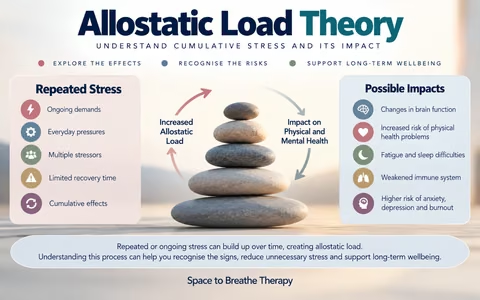
Allostatic Load Theory – Understanding the Cumulative Effects of Stress
Discover how repeated stress can affect the body and mind through Allostatic Load Theory. Explore an interactive stress simulator, recognise cumulative pressures, understand recovery and support systems, and develop practical adjustments to protect wellbeing and manage ongoing everyday demands.
Allostatic Load Theory | Space to Breathe TherapyThe psychology behind stress & anxiety
Allostatic Load Theory
Explore how repeated demands and limited recovery can contribute to cumulative strain — and what might help.
Based on work by McEwen and Stellar (1993). Educational illustration, not a diagnostic test.
What does allostatic load mean?
Allostasis describes how the body adjusts to challenges through systems such as stress hormones, the autonomic nervous system and immune responses. Allostatic load refers to cumulative physiological wear associated with repeated or poorly regulated adaptation.
It is not simply a count of stressful events. Health, resources, recovery, environment and individual differences all matter. A personal stress score cannot measure actual allostatic load.
1. Build a visual stress-load tower
Move the sliders and watch the illustration change. The result is a learning metaphor, not a clinical measurement.
Reducing unnecessary demands and improving access to support may be as important as individual coping strategies. The model does not suggest that people can prevent illness simply by relaxing.
2. Explore body systems
Select a system to discover possible connections with chronic stress.
Choose a topic above.
3. Choose a real-life situation
Select a scenario to explore demands, resources and a possible adjustment.
4. My practical support plan
Focus on achievable adjustments and sources of support, rather than trying to eliminate all stress.
Your entries can be saved in this browser. Avoid entering highly sensitive details on a shared device.
This guide is for education and reflection, not diagnosis or treatment. Persistent or concerning symptoms deserve individual medical advice. Reference: McEwen, B. S., & Stellar, E. (1993). Stress and the individual: mechanisms leading to disease. Archives of Internal Medicine, 153(18), 2093–2101.