



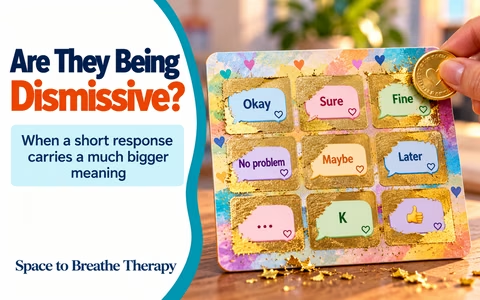

ARE THEY BEING DISMISSIVE?When a short response carries a much bigger meaning

Scratch away colourful cards to uncover the hidden possibilities behind short messages. Explore rejection sensitivity, anxiety and neurodivergent communication through interactive scenarios, thought-checking activities, gentle reflections and practical ways to seek clarity without automatically assuming someone is being dismissive.


‍

Are they being dismissive? | Space to Breathe Therapy

Interactive wellbeing experience

Are they being dismissive?

When a short response carries a much bigger meaning

A short message can leave lots of room for interpretation. Scratch the cards to explore possibilities, then practise separating what you know from what you fear.

Space to Breathe Therapy

Scratch beneath the message

Use your finger or mouse to rub away the golden surface. Every card reveals one possible explanation, not a verdict about the sender. You can also use the accessible reveal buttons.

0 of 9 cards revealed

What's the story your mind is telling?

Choose a message and compare the observation with possible interpretations. A feeling is important information, but it is not proof of somebody else's intention.

What I actually know

Other possible explanations

Try a real-life scenario

You share something important with a colleague. They reply “Okay.” You feel dismissed, but you do not know their intention. What could you do next?

One moment or a repeated pattern?

Tap each statement to decide whether it is an observation or an interpretation.

Choose a gentle clarification

Clear communication can help, especially when text removes facial expressions, timing and tone. Pick a situation to see a script you can adapt.

My personal check-in

These prompts are optional. You can download your reflections to keep privately.

Reflections are saved in this browser when storage is available. Avoid entering sensitive information on shared devices.

Space to Breathe Therapy · This educational resource does not diagnose rejection sensitivity or establish another person's intent. If replies are repeatedly belittling, hostile or dismissive, consider the pattern, your safety and appropriate support.

‍



