





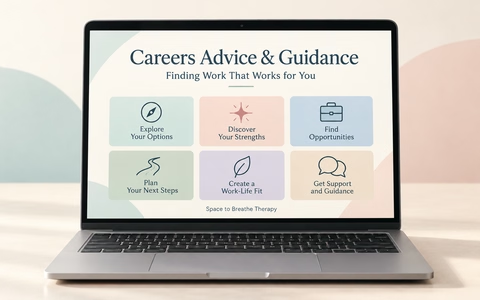
Careers Advice & Guidance
Finding Work That Works for You
Career support can help you understand what kind of work, environment and working pattern may suit you as an individual. Your strengths, interests, needs, health, skills and circumstances all belong in the conversation.
You do not need a finished job title before asking for advice. Start with a question, a difficulty, or an idea you want to explore.
Start with what you want work to do for you
Career guidance is not only about naming a job. It can help you compare possibilities, understand the steps into a role and decide whether a particular kind of work could fit your life now.
Strengths can come from many places
Think beyond formal job titles. Study, volunteering, caring, hobbies, community roles and lived experience may all build useful skills. A strength can be something you do well, something you have learned to manage, or a condition that helps you notice what support makes a task accessible.
Small reflection
Look at the whole work fit
The same occupation can feel very different depending on its tasks, team, pace, location and management. Compare the work itself with the conditions that help you do it sustainably.
Separate the role from the barrier
If a requirement feels difficult, ask what is essential to the outcome and what is simply the usual way the task is done. For example, a job may need accurate records; it may not require handwriting them. Explore the essential duties and possible adjustments with an adviser or employer.
Quick fit check
Explore ideas before committing
You can test a career idea in small, low-pressure ways. Begin with information, then move toward experience if it is useful and accessible.
- Read the day-to-day picture. Look at typical tasks, entry routes, skills, settings and progression. Compare more than one employer because roles with the same title can differ.
- Talk to someone who does the work. Ask what a normal week looks like, what is hardest to learn and how the work changes through the year.
- Try a small sample. A short course, project, taster day, volunteering task, work experience or supported placement may help you notice what fits.
- Check the route in. Find out which qualifications or experience are essential, which can be gained later, and whether there are alternative entry routes.
Compare options without needing a perfect answer
Rate each idea against what matters most to you: interest, access, training time, hours, travel, pay and room to grow. These are prompts, not a score that decides for you. A lower score can point to a question to investigate or support to request.
Make careers advice work for you
A careers adviser can help you identify skills, explore job profiles and courses, compare routes, prepare applications and plan next steps. You can ask for information in a format and pace that works for you.
Before a conversation
- Write down what you want help with, even if it is “I do not know where to start.”
- Bring examples of tasks you enjoy, can do well or would like to avoid.
- Explain any access needs for the meeting: format, breaks, communication, time of day or a supporter joining.
- Ask what will be recorded, who can see it and what the next contact will be.
Questions you might ask
- Which roles use these strengths and interests?
- What do people actually do during a typical shift or working week?
- Which requirements are essential, and what alternative routes are available?
- How can I explore this role in a way that accounts for my health, access or energy needs?
- Where can I get help with training, job search, applications or workplace adjustments?
National Careers Service: careers advice, job profiles and skills assessment
National Careers Service: disability and health support
GOV.UK: Access to Work
GOV.UK: reasonable adjustments
My next-step plan
Keep the plan small enough to use. Your notes save in this browser on this device. Include only details you are comfortable storing here; you can download, print or clear them whenever you choose.
General information for reflection and discussion, not individual careers, medical or legal advice. Service eligibility and support routes vary across the UK.




