





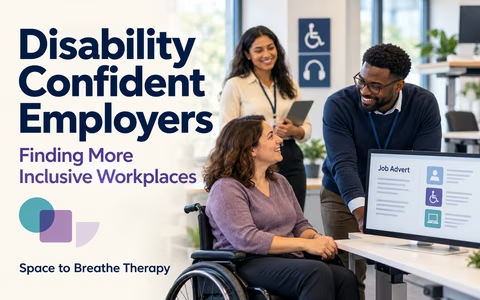
Disability Confident Employers
Finding more inclusive workplaces
This interactive guide explains what the Disability Confident scheme can tell you, how to explore an employer’s approach and how to ask about adjustments. Use it as a starting point for your own questions and priorities.
What is Disability Confident?
It is a voluntary UK government scheme intended to help employers recruit, retain and develop disabled people. The scheme has three levels. Employers progress through them in order, and each level has commitments or evidence requirements.
Accreditation lasts up to three years at each level. Status can change, so check the current employer listing and date rather than relying on an old logo or statement.
Using the symbol while job searching
The Disability Confident symbol can help you identify employers who have signed up. At Level 1, an employer commits to offering an interview to a disabled applicant who meets the minimum criteria, subject to the scheme guidance and how that commitment is set out for the vacancy.
- Read the advert and identify its essential criteria.
- Look for the employer’s current scheme level and the wording for this vacancy.
- If you want to use the interview offer, show clearly how you meet the stated minimum criteria.
- Ask early about adjustments to the application, assessment or interview if you need them.
- Keep a copy of the advert and any response so you can refer back to the wording.
What to notice in an advert
- Are essential requirements clear and proportionate?
- Does it explain how to request an adjustment and who to contact?
- Are working pattern, location, travel, sensory demands or communication expectations described?
- Is the interview commitment explained for this specific vacancy?
Look for evidence beyond the badge
Use the questions that matter to you. You do not need to disclose a diagnosis to ask about the recruitment process or how the role works.
Questions for a recruiter or hiring manager
- “Could you explain what the essential criteria are and how they will be assessed?”
- “What adjustments can you offer for the interview or any work task?”
- “How can I share access needs, and who will see that information?”
- “What does a typical week look like, including meetings, deadlines and changes?”
- “How are new starters supported during induction and the first few months?”
- “How are workplace adjustments reviewed if someone’s needs or duties change?”
Clues to notice
Notice whether the employer answers clearly, welcomes questions, explains next steps and follows through. One conversation cannot prove what the whole workplace is like, but it can help you decide what to explore further.
Support can take different forms
Reasonable adjustments may reduce or remove a work-related barrier. They can be considered at recruitment, induction and during employment. The right option depends on the person, role and situation.
- Communication: agendas in advance, written follow-up, clear instructions or a named contact.
- Time and organisation: predictable scheduling, adjusted start times, task prioritisation or planned check-ins.
- Environment: a quieter space, lighting changes, equipment or flexibility over location.
- Process: accessible application formats, alternative interview formats or extra time where appropriate.
- Support: job coaching, assistive technology or a gradual induction where suitable.
A simple conversation structure
Barrier: “I find rapid verbal instructions difficult to retain.”
Work impact: “I may miss steps when tasks change quickly.”
Possible support: “Could key instructions also be provided in writing, with a brief check-in when priorities change?”
Review: “Could we try this for four weeks and then see what is working?”
My inclusive-workplace plan
Use this page to collect the information that helps you make a decision. Your answers are saved in this browser on this device.




