





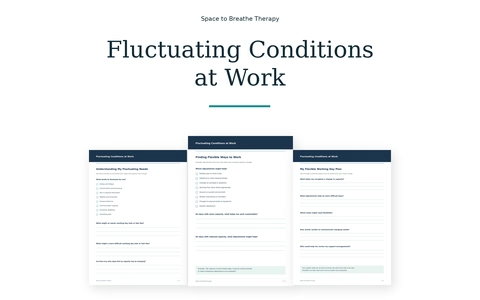
Fluctuating Conditions at Work - A practical workplace worksheet for understanding changing needs, identifying flexible adjustments and planning more manageable working days
Living with a fluctuating health condition or disability can mean that your abilities, energy levels and support needs change from day to day, or even throughout the same day.
Some days, you may find particular tasks relatively manageable. On others, fatigue, pain, sensory demands, concentration difficulties or changes in mobility may make those same tasks more challenging.
These changes are not always predictable, and experiencing a more manageable day does not mean that support is no longer needed.
This three-page PDF worksheet provides a gentle, structured way to recognise changing needs, identify helpful workplace adjustments and consider how to communicate those needs.
Rather than focusing on productivity or expecting you to maintain the same capacity every day, the worksheet encourages flexibility, accessibility and sustainable working practices.
What’s included?
1. Understanding My Fluctuating Needs
Begin by recognising which aspects of your working experience may change over time.
A practical tick-box activity encourages you to consider areas such as energy, concentration, pain, mobility, sensory tolerance, communication and emotional wellbeing.
Guided reflection questions help you identify what more manageable and more difficult working days may look like for you.
You’ll also have space to consider any early signs that your capacity may be changing.
Not everyone experiences predictable patterns, so this activity is intended to support awareness rather than suggest that changes can always be anticipated.
2. Finding Flexible Ways to Work
Consider adjustments that could make your working environment more accessible when your needs change.
A tick-box activity introduces possible approaches, including flexible working hours, additional breaks, workload adjustments, quieter environments, written instructions and changes to physical tasks.
Further reflection questions encourage you to consider:
- What helps you work sustainably on days when you have more capacity.
- Which adjustments might help when your capacity is reduced.
- How you could communicate changing needs in a way that feels comfortable.
A short example statement provides a starting point for discussing temporary adjustments or reviewing priorities.
The focus is on identifying supportive approaches rather than expecting you to compensate for difficult days by doing more on better days.
3. My Flexible Working Day Plan
Bring your reflections together into a personalised plan that can be revisited as your circumstances change.
The final worksheet provides dedicated writing spaces to consider:
- What helps you recognise changes in capacity.
- Adjustments that support you on more difficult days.
- Tasks that may require additional flexibility.
- How you would prefer to communicate changing support needs.
- Who could help you review your workplace support arrangements.
Each question includes three writing lines, providing consistent space for personal responses.
This page can also be used independently when reviewing workplace adjustments or preparing for a conversation about changing needs.
Who is this worksheet for?
This worksheet may be particularly helpful for employees living with fluctuating disabilities, long-term health conditions or changing support needs.
It may support people experiencing variable fatigue, pain, mobility difficulties, sensory sensitivities, cognitive changes or other symptoms that affect their working day.
The worksheet may also be useful for:
- Disabled and neurodivergent employees.
- People returning to work or reviewing existing adjustments.
- Employees preparing to discuss flexible working arrangements.
- Managers and supervisors seeking to understand changing support needs.
- Occupational health and workplace wellbeing practitioners.
You do not need to have a predictable pattern of symptoms or a fully developed support plan to benefit from reflecting on what might help.
A supportive reminder
Your ability to complete a task on one day does not mean you will necessarily be able to complete it in the same way on another.
Fluctuating needs are not a reflection of motivation, commitment or willingness to work.
Supportive workplaces recognise that accessibility may require flexibility, regular communication and adjustments that respond to changing circumstances.
Where the relevant legal requirements apply, employers may have a duty to make reasonable adjustments for disabled employees under the Equality Act 2010.
You should not have to continually prove that your needs are genuine simply because they vary.
Your support needs do not have to remain the same every day to be valid. Flexibility can help make work more accessible, manageable and sustainable.
This worksheet provides general information and reflective guidance. It does not replace individual medical, occupational health or legal advice.
Maggie,
Space to Breathe Therapy




