





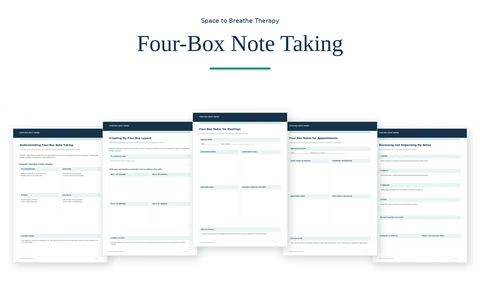
Four-Box Note Taking - A clear, flexible approach to organising information
Taking notes can be challenging when information is shared quickly, several topics are discussed at once or you’re trying to listen, process and write simultaneously.
Traditional note-taking methods don’t always suit everyone. Long paragraphs, extensive lists and unstructured information can make it difficult to identify important details or remember what needs to happen next.
Four-Box Note Taking is a six-page guide and practical workbook designed to help you organise information into four clear, manageable sections.
Using a simple visual layout, this resource encourages you to capture key information, record questions, identify actions and organise follow-up details without needing to write everything down.
The method can be adapted to suit different situations, including workplace meetings, healthcare appointments, studying, coaching sessions and everyday planning.
Rather than introducing a complicated organisational system, the workbook focuses on creating a flexible approach that works with your individual needs and preferences.
What you’ll find inside
1. Understanding Four-Box Note Taking
Begin by learning how the four-box method works and why separating information into distinct sections can make notes easier to organise and review.
This section introduces a simple layout using four categories:
Key Information: Important facts, instructions and details worth remembering.
Questions: Things you would like to clarify, ask or investigate further.
Actions: Tasks, decisions and practical next steps.
Follow-Up: Reminders, deadlines and information to revisit.
A completed example demonstrates how information can be organised without needing lengthy notes.
2. Creating My Four-Box Layout
Everyone processes and organises information differently, so the four-box method doesn’t need to follow one fixed structure.
This worksheet helps you personalise your layout by choosing headings that feel most useful.
You might prefer categories such as important information, questions, actions, ideas, decisions or support needed.
You’ll have space to create your own four-box arrangement and practise using it with an everyday situation.
The aim is to develop a system that feels natural and manageable rather than following unnecessary rules.
3. Four-Box Notes for Meetings
Meetings can involve discussions, decisions, instructions and follow-up responsibilities, sometimes all within a short period.
This worksheet provides a ready-to-use four-box layout designed specifically for meetings.
The sections help you organise:
- Discussion points and important information.
- Questions or details requiring clarification.
- Decisions made during the meeting.
- Actions and responsibilities to follow up afterwards.
Additional spaces allow you to record the meeting topic and date.
The layout can be used during workplace discussions, team meetings, training sessions or other situations where information needs to be recorded clearly.
4. Four-Box Notes for Appointments
Appointments often involve remembering questions, processing new information and keeping track of recommendations or next steps.
This worksheet adapts the four-box method to support appointment preparation and note-taking.
The sections include:
What I Want to Discuss: Topics, concerns or information you would like to raise.
Important Information: Key details shared during the appointment.
Questions: Anything you would like explained or clarified.
Next Steps: Actions, recommendations or follow-up arrangements.
The worksheet can be used for healthcare appointments, coaching sessions, professional discussions or other important conversations.
It also encourages you to ask for clarification or written information when needed.
5. Reviewing and Organising My Notes
Taking notes is most useful when you can return to the information and understand what needs your attention.
This section introduces a simple four-stage review process:
Review: Read through your notes and identify important details.
Identify: Recognise questions, decisions and actions that need attention.
Transfer: Move relevant tasks or reminders into a calendar, planner or another system you already use.
Store: Keep your notes somewhere accessible so you can find them again.
The accompanying worksheet helps you organise important information and consider how your note-taking approach could be improved.
6. My Reusable Four-Box Template
The final page provides a spacious, adaptable four-box worksheet that can be printed and used repeatedly.
Each section includes room for a personalised heading and handwritten notes.
You can choose different categories depending on the situation, allowing the same template to support meetings, appointments, learning activities and everyday organisation.
There is no requirement to fill every box or use the sections in a particular order.
The template is designed to be flexible, allowing you to record as much or as little information as you need.
Who is this resource for?
Four-Box Note Taking may be particularly helpful for:
- ADHD and autistic individuals who benefit from structured visual organisation.
- People who experience working-memory or information-processing difficulties.
- Individuals who find traditional note-taking methods overwhelming.
- Employees attending meetings, training sessions or workplace discussions.
- Students and learners looking for alternative ways to organise information.
- People preparing for healthcare appointments or other important conversations.
- Anyone wanting a simple, reusable system for capturing and reviewing information.
The worksheets can be completed at your own pace and adapted to suit different environments, responsibilities and preferences.
You don’t need to use every template or follow the suggested headings exactly.
Finding a note-taking approach that works for you
Effective note-taking isn’t necessarily about recording every word or creating perfectly organised pages.
Sometimes a few important details, a question to revisit or a clearly identified next step can be more useful than extensive notes.
The four-box method provides a visual structure that can reduce the effort involved in deciding where information belongs.
It also allows you to separate different types of information, making notes easier to revisit when needed.
The aim of this workbook is to help you develop a practical, personalised note-taking approach that supports understanding, memory and organisation without creating unnecessary additional demands.
Maggie,
Space to Breathe Therapy




