





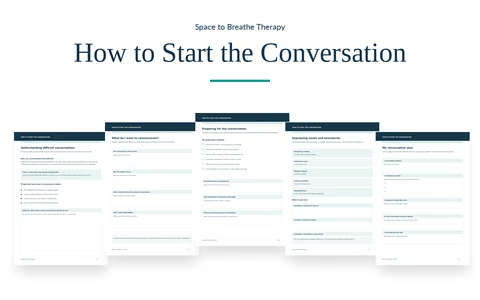
How To Start The Conversation - Preparing for meaningful conversations with confidence and clarity
Starting an important conversation can sometimes feel challenging, particularly when discussing personal experiences, expressing needs, establishing boundaries or addressing a difficult situation.
You might know what you want to communicate but struggle to organise your thoughts, find the right moment or anticipate how another person may respond.
For some individuals, communication differences, sensory demands, previous experiences or the pressure to respond immediately can make these conversations particularly difficult.
Having an opportunity to prepare can help make the process feel more manageable.
How to Start the Conversation is a six-page practical workbook designed to help you organise your thoughts, identify your communication needs and prepare for meaningful or challenging discussions.
Through guided reflection, practical examples and structured worksheets, you’ll have opportunities to consider what you want to say, how you would prefer to communicate and what support might help.
The workbook recognises that effective communication doesn’t always need to happen through spontaneous spoken conversation. Written communication, prepared notes and additional processing time can be equally valuable.
What’s included in the workbook?
Page 1: Understanding Difficult Conversations
Begin by considering why certain conversations may feel uncomfortable, overwhelming or difficult to approach.
This section introduces common challenges, including fear of being misunderstood, uncertainty about another person’s response, previous negative experiences and difficulties organising thoughts.
A spacious reflection activity encourages you to identify what makes particular conversations challenging for you.
You’ll also be reminded that communication can take different forms and that preparation is a valid and useful approach.
Page 2: What Do I Want to Communicate?
Before beginning an important conversation, it can help to identify what matters most.
This worksheet provides space to reflect on:
- The conversation you would like to have.
- Why the subject matters to you.
- What you would like the other person to understand.
- What a helpful outcome might look like.
These reflections can help you organise your thoughts and identify the information you most want to communicate.
The emphasis is on developing clarity rather than expecting every conversation to produce an immediate resolution.
Page 3: Preparing for the Conversation
The timing, environment and method of communication can influence how comfortable a conversation feels.
This section encourages you to consider practical preparations, including choosing an appropriate moment, reducing distractions, preparing notes and allowing sufficient time.
You’ll also have opportunities to identify your preferred communication method and any sensory, emotional or practical adjustments that may help.
For example, you might prefer communicating in writing, having questions in advance or taking breaks when needed.
Page 4: Expressing Needs and Boundaries
Communicating personal needs and boundaries can feel difficult, particularly when you’re uncertain how someone else might respond.
This section introduces examples of clear, respectful language that can be adapted to different situations.
You’ll have space to practise:
- Expressing a feeling or personal experience.
- Explaining something you need.
- Making a practical request.
- Communicating a personal boundary.
- Asking for additional time or clarification.
The examples are intended as flexible starting points rather than scripts that must be followed.
You’ll also be encouraged to recognise that communicating a boundary does not require another person to agree with it.
Page 5: My Conversation Plan
This practical worksheet brings together your preparation into a personalised conversation plan.
You’ll have space to record:
- How you would like to begin the conversation.
- Three important points you want to communicate.
- Questions you would like to ask.
- What might help if the conversation becomes difficult.
- Your preferred next step.
The completed worksheet can be used as a reference before or during a conversation.
It may be particularly useful if you find it difficult to remember important points when feeling anxious, overwhelmed or under pressure.
Page 6: Reflecting and Moving Forward
After an important conversation, it can be helpful to reflect on the experience without judging yourself or focusing solely on the outcome.
This worksheet encourages you to consider how the conversation felt, what you were able to communicate and whether anything unexpected occurred.
You’ll also have space to recognise what went well, identify anything you might approach differently and consider whether further support or follow-up is needed.
The aim is to encourage compassionate reflection rather than expecting every conversation to go perfectly.
Who might find this resource helpful?
This workbook may be useful for individuals who:
- Find starting important conversations difficult.
- Want to communicate personal needs or establish boundaries.
- Experience anxiety or uncertainty around challenging discussions.
- Prefer additional preparation or processing time.
- Have communication differences or accessibility needs.
- Are preparing for workplace, healthcare, relationship or support-related conversations.
- Want to organise their thoughts before discussing a sensitive subject.
The worksheets can be completed at your own pace and adapted to different circumstances.
You can also revisit individual pages whenever you’re preparing for another conversation.
Supporting different communication needs
There is no single correct way to communicate.
Some people feel most comfortable speaking face to face, while others prefer written communication, additional preparation or opportunities to process information before responding.
The ability to communicate effectively can also depend on whether others are willing to listen, respect boundaries and accommodate different communication needs.
Preparing for a conversation can help you feel more organised, but you are not responsible for controlling another person’s reaction.
The aim of this workbook is to provide a supportive, structured space for organising your thoughts, expressing your needs and approaching important conversations in a way that feels appropriate for you.
Meaningful communication isn’t always about finding the perfect words. Sometimes it begins with understanding what you need and giving yourself permission to communicate differently.
Maggie,
Space to Breathe Therapy




