



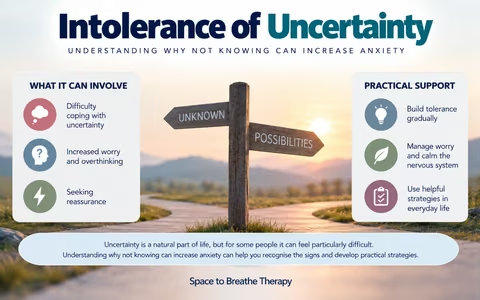

Intolerance of Uncertainty – Understanding Why Not Knowing Can Increase Anxiety

Explore why uncertainty can increase anxiety, worry and reassurance seeking. Discover the Intolerance of Uncertainty Model through interactive scenarios, practical experiments and personal reflections. Learn to recognise unhelpful patterns, develop flexible responses and build confidence when facing everyday unknown situations.

Download
Intolerance of Uncertainty | Space to Breathe Therapy
THE PSYCHOLOGY BEHIND STRESS & ANXIETY

Intolerance of Uncertainty

Why not knowing can increase anxiety

Explore the difference between useful preparation and the exhausting search for guarantees. Choose scenarios, experiment with uncertainty and build your own supportive plan.

1 · Understand the pattern

When an outcome is unknown, the mind may predict danger. Repeated checking or reassurance can offer short-term relief, but the doubt may return.

Uncertainty → Worry → Checking or avoidance → Brief relief → More uncertainty

This is a learning illustration, not a diagnosis. Clear communication and accessibility adjustments are valuable supports.

2 · The “What if?” explorer

Automatic prediction

More balanced possibility

Try this: identify one fact, one prediction and one helpful action you can take today.

3 · Uncertainty experiment

Explore how different responses can affect a fictional worry cycle. This is not a clinical score.

Illustrative worry-cycle intensity

These controls are educational metaphors, not validated measures. Essential checking and disability-related supports should not be removed.

4 · Explore the reassurance loop

You notice uncertainty. What will you try next?

Try both routes and notice the difference between temporary certainty and a manageable next step.

5 · Build your personal plan

6 · A compassionate reminder

You do not have to feel certain before taking a small, considered step. Equally, asking for predictable information, clear instructions and support is reasonable. The goal is flexibility, not forcing yourself to tolerate avoidable barriers.

Research-informed educational material drawing on work by Dugas and colleagues and Carleton. Not a diagnostic assessment or replacement for professional care.



