





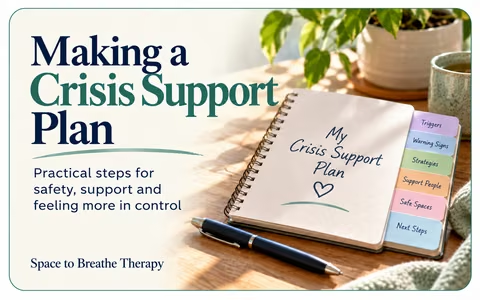
Making a Crisis Support Plan
A gentle, practical space to understand your needs, prepare for difficult moments and create a plan that feels right for you.
You can work through this in your own time. You do not have to complete everything at once.
This is a planning and wellbeing resource, not an emergency response service. If you or someone else is in immediate danger in the UK, call 999 or go to A&E. For urgent mental health support that is not an emergency, contact NHS 111 and select the mental health option where available. You can also call Samaritans free on 116 123.
01. Understanding a Crisis Support Plan
A crisis support plan is a personalised guide that records what can help when you feel overwhelmed, distressed, unsafe, disconnected or unable to cope in the way you usually would.
It is not about predicting every difficult experience or expecting yourself to manage everything alone. It is about making useful information easier to find when concentration, communication or decision-making become harder.
A crisis may look different for everyone
Some people experience panic, racing thoughts or intense distress. Others withdraw, become quiet, shut down, feel numb or find it difficult to communicate. Distress is not always outwardly visible.
For autistic and ADHD individuals, sensory overload, unexpected changes, burnout, communication demands or accumulated stress may play an important role.
What makes a helpful plan?
- It uses clear, simple language.
- It reflects your own needs and preferences.
- It includes practical actions rather than vague expectations.
- It identifies when and how to seek additional support.
- It is easy to access and update.
You do not have to earn support by reaching breaking point. Recognising that things are becoming difficult is enough reason to ask for help.
02. Recognising My Warning Signs
Early warning signs are changes that may tell you your capacity is decreasing or your distress is increasing. They can be physical, emotional, behavioural, sensory or related to communication.
03. Understanding My Triggers
A trigger is something that may contribute to distress. It could be an experience, environment, thought, memory, demand or accumulation of smaller pressures.
Recognising triggers is not about avoiding everything. It can help you plan adjustments, identify patterns and understand when additional support may be useful.
What might another person misunderstand about me when I am distressed?
04. Calming and Grounding Strategies
Grounding techniques may help you connect with the present moment. They do not work for everybody or every situation. Your plan should include strategies that you personally find useful.
Sensory grounding
Notice the chair beneath you, hold a familiar object, wrap yourself in a comfortable blanket or move somewhere quieter.
Reducing demands
Pause non-essential tasks, minimise conversation, turn off notifications or ask another person to take over a decision.
Gentle breathing
If comfortable, allow your breathing to slow naturally. Do not force deep breaths if these make you feel worse.
Connection
Contact someone trusted, use a support card or request quiet company without needing to explain everything.
05. People, Communication and Support
During distress, it may be difficult to explain your needs or work out who to contact. Writing this information beforehand can make asking for support easier.
Ready-to-use communication message
You can copy or adapt this message if speaking is difficult.
06. My Step-by-Step Safety Plan
This section is about making the next useful action clear. Different levels of distress may call for different responses, and professional help may be needed even if you have tried personal coping strategies.
- Notice
Recognise my early signs without judging myself.
- Reduce demands
Pause non-essential tasks and move to a safer or more manageable environment where possible.
- Use something supportive
Try a strategy I already know is helpful.
- Connect
Contact a trusted person and explain what support I need.
- Get additional help
Contact professional or urgent services when needed. Seek emergency help immediately if there is immediate danger.
- Recover and review
Allow time to recover, then update the plan when I am ready.
Emergency: 999 if someone is in immediate danger.
Urgent mental health support: NHS 111, selecting the mental health option where available.
Samaritans: 116 123, free, any time.
Shout: Text SHOUT to 85258 for free, confidential text support.
Availability and suitability of services may vary depending on circumstances and location.
07. My Personal Crisis Support Plan
This is your personal summary. You can print it, save it as a PDF through your browser, or download a text copy. Keep it somewhere accessible.
Keeping your plan useful
Review it when your circumstances, support arrangements or needs change. You might choose to share a copy with someone you trust.
Allow recovery time after a crisis. You do not have to examine everything immediately.
Entries are stored in this browser on this device, not sent to Space to Breathe Therapy by this tool. Anyone with access to the same browser profile may be able to view them. Browser storage can be cleared, and private browsing may not retain your plan. Download a copy if you wish to keep it.