





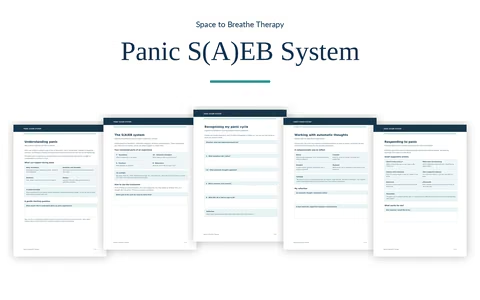
Panic S(A)EB System - Understanding panic, recognising patterns and developing supportive responses
Panic can be an intense and frightening experience, often involving physical sensations, distressing thoughts, emotional responses and changes in behaviour.
When these experiences occur together, they can sometimes reinforce one another, making it difficult to understand what is happening or how to respond.
The Panic S(A)EB System is a six-page CBT-informed guide and collection of practical worksheets designed to help you explore these experiences with curiosity, understanding and compassion.
The framework focuses on four interconnected elements: sensations, automatic thoughts, emotions and behaviours.
By recognising how these elements may influence one another, you can begin to understand your personal experiences of panic and identify responses that feel supportive and manageable.
What you’ll find inside
Understanding panic
Learn about common experiences of panic, including physical sensations, changes in breathing, heightened awareness and feelings of fear or discomfort.
The guide explains how the body’s threat response can contribute to these experiences and why panic symptoms can sometimes feel overwhelming.
The S(A)EB framework
Discover how sensations, automatic thoughts, emotions and behaviours can interact during moments of panic.
Practical examples help illustrate how interpretations of physical sensations may influence emotional responses and subsequent behaviour.
Recognising your panic cycle
Use guided reflection exercises to identify situations, sensations, thoughts and behaviours that may occur during your own experiences of panic.
These activities encourage observation without judgement, helping you recognise recurring patterns.
Working with automatic thoughts
Explore how automatic interpretations can affect feelings of fear or uncertainty.
The worksheets introduce ways to consider alternative perspectives without dismissing or minimising what you are experiencing.
Responding to panic
Consider gentle coping strategies, grounding approaches and compassionate responses that may help during difficult moments.
The emphasis is on discovering what feels useful for you rather than expecting every technique to work for everyone.
Creating your personal support plan
Bring together your reflections to identify early warning signs, helpful responses, sources of support and practical steps you may wish to try.
Who is this resource for?
This guide may be useful for people who experience panic symptoms, want to understand their responses more clearly or are looking for structured exercises to complement existing therapeutic support.
The worksheets can be completed at your own pace, and there is no expectation to answer every question or revisit experiences that feel overwhelming.
Understanding panic is not about eliminating every uncomfortable sensation or controlling every thought. It is about developing awareness, recognising patterns and finding ways to respond to difficult experiences with greater compassion and confidence.
Maggie,
Space to Breathe Therapy
This resource is intended for educational and self-reflection purposes and is not a substitute for professional assessment or treatment. New, severe or unexplained physical symptoms should not automatically be assumed to be caused by panic.




