





People-Pleasing
What's Below the Iceberg?
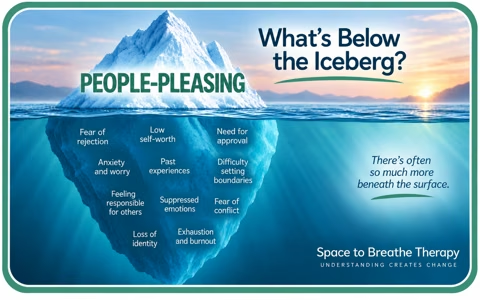
People-pleasing may look like kindness, reliability, helpfulness and always being agreeable. Underneath, there can be fear of rejection, guilt, anxiety, learned responses, masking and exhaustion.
This is a place to explore what may be happening for you, without judgement or pressure to change everything at once.
Before You Begin
Being thoughtful, helpful or generous does not automatically mean you are people-pleasing. The important difference is whether you feel able to choose, refuse, negotiate and have needs of your own.
There may also be good reasons for adapting your behaviour. In unequal or unsafe relationships, saying no may carry genuine consequences. Safety matters more than forcing assertiveness.
The People-Pleasing Iceberg
Select any label on the iceberg to explore it. These are possibilities, not assumptions about you or anybody else.
What the Iceberg Represents
Above the water: Behaviours that may be positively received, such as agreeing quickly, helping frequently and avoiding conflict.
Below the water: Experiences that may be less visible, including fear, unmet needs, sensory or emotional overload, learned expectations and difficulty expressing preferences.
Important distinction: Not everybody who people-pleases has trauma, rejection sensitivity or low self-worth. These are possibilities to explore, not diagnoses.
Build My Own Iceberg
Choose the experiences that resonate. Your selection does not produce a score or diagnosis; it simply helps organise your reflections.
Above the Surface
Below the Surface
Where Might This Come From?
Fear of Rejection
Agreeing or overextending yourself may become a way to reduce the fear of disapproval, conflict or losing connection.
Past Experiences
If disagreement previously led to criticism, punishment or unpredictability, keeping others happy may have become an understandable protective response.
Rejection Sensitivity
Some people experience intense distress around perceived criticism or rejection. This experience can occur for many reasons and is not, by itself, a diagnosis.
Neurodivergence & Masking
Autistic and ADHD people may experience social expectations, communication differences and pressure to conceal their needs. People-pleasing is not universal to neurodivergence.
Responsibility for Others
You may have learned to treat somebody else's disappointment, anger or discomfort as yours to prevent or fix.
Guilt & Exhaustion
Even reasonable boundaries may feel uncomfortable at first, particularly when you have spent a long time prioritising other people.
The Yes–No Pause
If saying yes has become automatic, a pause can create space to consider what you actually want and can manage.
1. Notice
Have I agreed automatically? What happens in my body or thoughts when somebody asks?
2. Check
Do I have the time, energy, capacity and genuine willingness?
3. Choose
Yes, no, not now, a different offer, or more time to decide.
4. Respond
Use a simple answer that fits the circumstances, without assuming you owe a long explanation.
Practise Boundary Language
A boundary can be firm and respectful. You are allowed to make requests, decline invitations and communicate your capacity without giving everyone access to private details.
“I can't answer immediately. I'll let you know once I've had time to think.”
“I don't have capacity to do that.”
“I can't do the whole thing, but I can help with this part.”
“I understand this is disappointing. My answer is still no.”
“Written instructions and more processing time would help me respond.”
Consider seeking support and making a safety plan rather than confronting someone directly.
Rediscovering My Preferences
When you are used to adjusting yourself around others, it can become difficult to know what you prefer, enjoy or need.
You do not need to discover one fixed “true self”. Preferences can vary with context, capacity and relationships.
Supporting Someone Who People-Pleases
People-pleasing is not helped by demanding that someone “just say no”. It may be important to create the conditions in which a genuine no is safe and respected.
Give Genuine Choice
Make it clear that saying no will not lead to punishment, withdrawal or repeated persuasion.
Allow Processing Time
Offer written options and time to respond without putting someone on the spot.
Respect the First Boundary
Do not require lengthy explanations or challenge every refusal.
Notice Unequal Expectations
Review workloads, emotional labour and assumptions about who should always help.
Value the Person Beyond Usefulness
Show appreciation for their presence, perspective and autonomy, not only what they do for others.
Make Support Accessible
Consider sensory needs, communication differences, masking and privacy.
My People-Pleasing Change Plan
You do not need to become less caring or suddenly set difficult boundaries. A small, safe change can be enough to begin exploring choice.
A Personal Message from Maggie
For some people, keeping others happy becomes something they do almost without thinking. Saying yes can feel easier than facing somebody's disappointment, and asking for something for yourself can feel uncomfortable or even frightening.
I wanted this iceberg to show that what looks like kindness on the outside may sometimes involve a much more complicated experience underneath.
There is nothing wrong with being a caring person. But your needs matter as well. You are allowed to have preferences, limits, emotions and a voice of your own.
You do not have to change everything at once. Understanding why a pattern developed can be an important beginning.
Maggie
Space to Breathe Therapy
Books, Professional Context & Further Reading
Suggested books: Set Boundaries, Find Peace by Nedra Glover Tawwab; The Assertiveness Workbook by Randy J. Paterson; and Self-Compassion by Kristin Neff. These offer different approaches to boundaries, communication and self-acceptance.
Professional context: People-pleasing is a descriptive pattern, not a standalone psychiatric diagnosis. It can relate to anxiety, learned relational experiences, masking, social pressure or other factors. The iceberg is a reflection metaphor, not a validated psychological assessment.
Further information: NHS mental health information, Mind and NICE guidance.




