





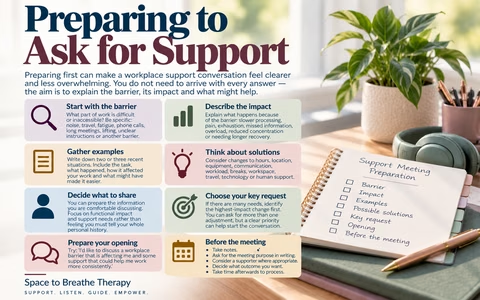
Preparing to Ask for Support
Prepare for a workplace support conversation at your own pace. Explore the barriers you experience, the impact on your work and the changes that might help.
Interactive Preparation WorkbookStart with the Barrier
Think about what makes your working day more difficult or less accessible. You do not need to begin by explaining a diagnosis. Focus on the task, system, environment or expectation.
Common workplace barriers
Noise, lighting, travel, fatigue, pain, phone calls, long meetings, heavy lifting, unclear instructions, interruptions, rapid task switching or unpredictable schedules.
Describe the Impact
The next step is explaining what happens because of the barrier. Practical examples help the conversation stay focused on access and effective working arrangements.
Possible impacts
Slower processing, missed information, pain, exhaustion, difficulty concentrating, sensory overload, communication difficulties, reduced capacity or needing longer recovery after work.
Gather Real Examples
Choose two or three situations that show the difficulty. You do not have to prove every experience or recount your personal history.
A useful structure
Task → What happened → Impact → What might have helped
Example 1
Example 2
Example 3
Your examples are information for a constructive workplace conversation, not a test of whether you deserve help.
Think About Possible Solutions
Consider changes that could remove or reduce the barrier. You do not need to find the perfect solution before asking for support.
Decide What You Feel Comfortable Sharing
Workplace support discussions can involve private information. Think about what is relevant and what you wish to communicate.
You can explain the practical impact of a barrier without beginning with every detail of your medical, disability or personal history. Sometimes particular information will be needed to assess adjustments; sensitive information should be handled appropriately.
You can prepare boundaries
Choose Your Key Request
If several things are difficult, choosing one high-impact request can help start the conversation. You can still discuss more than one adjustment.
Ask yourself
Which change would remove the biggest barrier? Which could be arranged most quickly? What would allow me to work more consistently or with less unnecessary effort?
Prepare What You Want to Say
Having an opening phrase ready can make a difficult conversation easier to begin. Choose whichever style feels most comfortable.
Use barrier → impact → support
Explain what is difficult, what happens because of it and which practical change may help.
Before and After the Meeting
A clear preparation checklist can help you feel more organised and make it easier to follow up afterwards.
Before the meeting
After the meeting
Remember
You do not need to arrive with every answer. Your experience matters, and a constructive support conversation should allow space for questions, practical changes and collaborative problem-solving.




