





Space to Breathe Therapy
Starting a Supportive Conversation
A practical, respectful guide for managers who want to check in about disability, health, barriers at work and possible support.
A manager’s conversation guide
Begin with curiosity and respect
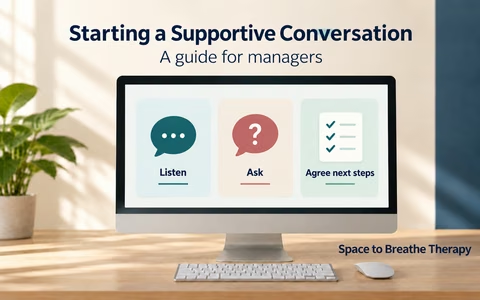
A supportive conversation can make it easier to understand what is getting in the way at work and what might help. It does not need to solve everything in one meeting. The aim is to listen, agree a useful next step and follow through.
Before you meet
Prepare the conditions for a good conversation
Planning helps keep the meeting focused on the employee’s experience and the support that may help. Consider access needs before you send the invitation.
Choose a workable format
- Offer a private place or a remote meeting, and ask which feels easier.
- Share the purpose and topics in advance; avoid surprising the person with a sensitive discussion.
- Ask whether they would like someone with them, where workplace policy allows.
- Allow breaks, extra processing time, captions, written questions or another communication method if helpful.
- Arrange an interpreter or communication support if requested and appropriate.
Check your own assumptions
- Describe an observable work barrier, not a judgement about character or motivation.
- Do not assume that a diagnosis explains every difficulty or that the same adjustment works for everyone.
- Be ready to hear that a previous attempt did not help, or that needs have changed.
- Know your role and what you may need to take to HR, occupational health or another decision-maker.
Opening the conversation
Use an invitation, not an interrogation
Explain what you have noticed in a neutral way, say why you are checking in, then give the employee time to respond. Avoid pressure to disclose a diagnosis or explain everything immediately.
“I wanted to check in because I’ve noticed [specific work situation]. How has that been feeling for you?”
“Is there anything about the way work is arranged that is making this harder than it needs to be?”
“You don’t have to tell me anything you’re not comfortable sharing. I’d like to understand what would help you do your work.”
Helpful responses
- Listen without interrupting; allow silence and thinking time.
- Reflect back what you heard: “Have I understood that correctly?”
- Ask one question at a time and offer a written follow-up if useful.
- Thank them for explaining, without treating disclosure as a problem.
- Ask what can be shared, with whom, and for what purpose before passing on personal information, subject to your organisation’s policies and any safety duties.
Try to avoid
- “You seem fine to me” or “We all struggle sometimes.”
- “What exactly is your diagnosis?” as the opening question.
- “Why didn’t you tell us sooner?” or “Everyone has to do it this way.”
- Promising an adjustment before checking what is possible and who needs to decide.
Understand the barrier
Explore what would help at work
Keep questions specific, open and linked to the person’s role. The employee may already have ideas, or may need time to explore options together. Ask permission before suggesting solutions.
“What has helped before, even a little? Is there something you would like us to try?”
Possible supports vary by person and role. Examples to explore might include a change in how instructions are given, adjustments to scheduling or breaks, equipment or software, a different workspace, a quieter way to take part in meetings, or a temporary trial with a review date. These are conversation starters, not a checklist of what every person needs.
Practice with a scenario
Pause, notice, respond
Choose a situation and consider how you could open the conversation. There may be several good responses; the aim is to stay curious, specific and collaborative.
What have you noticed that you can describe neutrally? What do you need to understand before deciding on next steps?
Check your response
- Did I name something observable rather than label the person?
- Did I leave room for the employee’s perspective?
- Did I avoid demanding health details or promising an outcome?
- Did I offer a clear, practical next step?
Close with clarity
Turn the conversation into a plan
Before ending, summarise what you understood and invite corrections. Agree what happens next, who will do it and when you will check in. Keep a proportionate record in line with your organisation’s policies.
Further information
For current UK workplace guidance, see Acas: Supporting disabled people at work, Acas: Reasonable adjustments and GOV.UK: Reasonable adjustments for disabled workers.




