





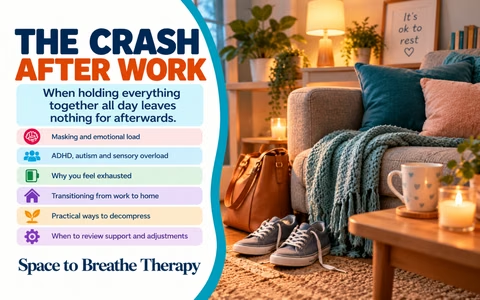
The Crash After Work
When holding everything together all day leaves nothing for afterwards
Space to Breathe Therapy | Workplace Wellbeing Collection
When the working day ends but the exhaustion begins
You arrive home after work.
You put your keys down, take off your shoes and finally sit.
Perhaps you have spent the day talking to colleagues, managing responsibilities, attending meetings, responding to questions and appearing calm and capable.
From the outside, everything may have looked completely ordinary.
But now that you are home, something changes.
You may suddenly feel exhausted, overwhelmed or unable to tolerate another conversation.
You might become tearful, irritable or unusually quiet.
Simple decisions, such as what to eat or whether to answer a message, may feel unexpectedly difficult.
Sometimes you just need to sit in silence.
This experience is often described as the crash after work.
It can happen when someone has used considerable physical, cognitive, sensory or emotional energy to manage their working day, leaving very little capacity for anything afterwards.
For some people, this happens occasionally following a particularly demanding day.
For others, it becomes a recurring pattern that affects relationships, everyday responsibilities, leisure time and overall wellbeing.
Appearing to cope at work does not necessarily mean that coping has been easy.
The difference between ordinary tiredness and feeling completely depleted
Most people experience tiredness after a busy working day.
A demanding shift, difficult meeting or long commute can leave anyone needing some rest.
However, some people experience something more intense than ordinary tiredness.
They may feel unable to process further information, respond to questions or manage activities that would normally feel straightforward.
For example, someone might spend the day successfully supporting customers but find that even a friendly conversation at home feels overwhelming.
Another person may complete a full day of work and then feel unable to prepare dinner, complete household tasks or participate in activities they usually enjoy.
These experiences can be confusing, particularly when the person appeared confident and productive earlier.
The important distinction is not simply how tired someone feels.
It is how much the experience affects their ability to function, recover and enjoy life outside work.
A post-work crash is a description of an experience rather than a medical diagnosis. Persistent or severe exhaustion can have several causes and may warrant medical assessment.
The hidden energy involved in holding everything together
Workplaces require much more than completing assigned tasks.
Employees may also need to manage social expectations, regulate emotional responses, interpret communication, adapt to unexpected changes and cope with environmental demands.
Some of this effort is visible.
Much of it is not.
Someone may be concentrating on a task while simultaneously trying to ignore surrounding conversations.
They may be responding politely to colleagues while managing anxiety.
They might be monitoring their facial expressions, remembering instructions, coping with pain or trying to avoid becoming overwhelmed.
Each demand may seem manageable in isolation.
However, the combined effort can become exhausting.
By the end of the day, there may be very little energy remaining.
Masking and the exhaustion of appearing fine
Masking can involve changing or suppressing natural behaviour to meet social expectations.
It is often discussed in relation to autism and ADHD, although people may mask aspects of themselves for many different reasons.
An employee might carefully monitor their facial expressions, eye contact, tone of voice or body language.
They may suppress movements that help them regulate attention.
They might hide confusion, anxiety or sensory discomfort because they worry about being misunderstood.
Some people rehearse conversations or work hard to appear sociable when interaction requires considerable effort.
This can happen consciously or without the person fully recognising how much energy they are using.
At work, masking may help someone navigate situations that feel demanding or unpredictable.
But when they reach home and no longer need to maintain the same presentation, the accumulated exhaustion may become more noticeable.
A person who seemed cheerful throughout the day may become quiet.
Someone who managed difficult conversations calmly may suddenly feel tearful.
This does not mean their earlier behaviour was dishonest.
It may mean they were working exceptionally hard to manage their experience.
ADHD and the cost of constant self-management
For some employees with ADHD, everyday workplace demands can require sustained executive-function effort.
This may include organising tasks, managing time, prioritising responsibilities, remembering instructions, switching attention and resisting distractions.
A busy workplace can involve frequent interruptions.
An employee might begin one task, receive a message about another, attend a meeting and then return to find that they need to reconstruct where they left off.
Each transition can create additional demands.
Someone may spend the day working hard to remain organised, meet expectations and manage their attention.
When they get home, there may be little capacity left for domestic planning or decision-making.
They might struggle to choose what to eat, respond to messages or begin a household task.
This can sometimes be mistaken for laziness or a lack of motivation.
However, the difficulty may be related to the amount of cognitive effort already used during the day.
Not everyone with ADHD experiences this pattern, and other factors can contribute.
The most helpful approach is to understand the individual's experience rather than make assumptions based on a diagnosis.
Autism and accumulated sensory demands
For some autistic employees, the working environment can involve significant sensory and social demands.
Bright lighting, background conversations, strong smells, unpredictable interruptions and crowded spaces may all require additional effort to manage.
Social communication can also involve interpreting tone, facial expressions, indirect instructions and unwritten expectations.
An employee may cope with these demands throughout the day but need substantial recovery afterwards.
For example, someone might work in an open-plan office where several conversations are happening simultaneously.
They may appear to concentrate successfully, yet spend considerable energy filtering out unwanted information.
By the time they return home, ordinary household sounds may feel much more difficult to tolerate.
They might need a quiet room, reduced lighting or time without conversation.
Other autistic people may prefer familiar activities, movement or time with someone they trust.
Sensory and recovery needs are individual.
The aim is not to prescribe one particular method of decompression but to recognise that different people need different environments to recover.
Emotional regulation and the pressure to remain professional
Many jobs require employees to manage their emotional responses throughout the day.
Someone working with customers may need to remain polite while dealing with complaints.
A manager may support colleagues through difficult situations while managing their own stress.
A healthcare worker may move between emotionally demanding conversations without much opportunity to process them.
An employee experiencing anxiety may spend considerable energy appearing calm.
This emotional effort can accumulate.
Sometimes the emotional response only becomes apparent when the person reaches a place where they feel safer.
They may cry after work despite not feeling able to cry during the day.
They might become frustrated by a small inconvenience or feel unable to explain why they are upset.
The final event is not necessarily the cause of the entire reaction.
It may simply be the moment when their remaining capacity has been exhausted.
Why the transition from work to home can be difficult
Moving between environments requires adjustment.
At work, there may be clear roles, expectations and routines.
At home, the demands are different.
There may be conversations, household responsibilities, caring commitments or decisions waiting to be made.
For someone who has spent the day managing significant demands, the transition itself can feel overwhelming.
They may need time to move from a highly structured, socially demanding environment into a different rhythm.
Without that transition period, even welcome interactions can feel difficult.
For example, a partner may ask a simple question about dinner.
The question is reasonable.
But the person arriving home may have spent the entire day making decisions, responding to requests and managing interruptions.
They may need a short period without additional demands before they can respond comfortably.
Recognising this difference can help reduce misunderstandings at home.
How the crash can affect relationships
Post-work exhaustion can affect the people around us.
Someone may become withdrawn, less communicative or more sensitive to noise and questions.
Family members or partners may interpret this as disinterest, irritation or rejection.
The exhausted person may then feel guilty for needing space.
This can create a difficult cycle.
They may push themselves to remain sociable when they need recovery, only to become more overwhelmed.
Open communication can help.
For example:
"I've had a very demanding day and I need some quiet time before I can properly talk. I do want to spend time with you, but I need to settle first."
Or:
"If I seem quiet after work, it isn't necessarily because something is wrong between us. Sometimes I need time to recover from the day."
These conversations can help others understand that needing decompression is not the same as rejecting connection.
It is also important to consider household members' needs and agree arrangements that are realistic for everyone.
Building a gentler transition home
A helpful transition does not need to involve a complicated wellbeing routine.
In fact, turning recovery into another list of tasks can create additional pressure.
Sometimes the most useful approach is to make the first part of arriving home simpler.
You might choose to:
- Change into comfortable clothing.
- Reduce lighting or background noise.
- Sit quietly for a few minutes.
- Have water or something to eat.
- Spend time outdoors.
- Listen to familiar music.
- Engage in gentle movement.
- Delay non-urgent decisions.
- Let others know that you need a short period of quiet.
The most suitable strategy depends on what feels restorative for you.
Some people need silence.
Others recover through movement, music, conversation or a familiar activity.
There is no single correct way to decompress.
Recognising early warning signs
One useful step is learning to recognise when your energy is beginning to run low before the working day ends.
Early warning signs might include:
- Finding ordinary conversations increasingly difficult.
- Becoming more sensitive to noise or interruptions.
- Struggling to make decisions.
- Feeling unusually tense or irritable.
- Developing headaches or muscle tension.
- Losing concentration more easily.
- Needing greater effort to complete familiar tasks.
These signs do not automatically mean that someone is experiencing burnout or sensory overload.
However, noticing recurring patterns may help identify which workplace demands are contributing to exhaustion.
You might discover that particular meetings, environments or responsibilities consistently leave you depleted.
That information can be useful when considering workplace changes.
When decompression is not enough
Rest and recovery are important.
But there is a difference between needing some time to unwind and repeatedly becoming so exhausted that you cannot participate in life outside work.
If work consistently leaves you without enough energy for basic needs, relationships or activities that matter to you, it may be necessary to review the demands themselves.
For example, an employee may use every evening and weekend recovering from their working week.
They may gradually stop seeing friends, exercising or pursuing interests because they do not have the capacity.
They might begin each new working day without feeling fully recovered.
In these circumstances, additional self-care may not address the underlying problem.
Workload, working arrangements, sensory demands, emotional pressures or accessibility barriers may need reviewing.
Persistent, worsening or unexplained exhaustion should also be discussed with an appropriate healthcare professional, as physical and mental health conditions can contribute to fatigue.
Workplace adjustments that may help
Practical workplace changes can sometimes reduce the amount of energy required simply to get through the day.
Depending on individual circumstances, possibilities include quieter working areas, protected concentration time, clearer written instructions, fewer unnecessary meetings or more predictable schedules.
Some employees may benefit from regular breaks, flexibility around working hours or changes to how tasks are prioritised.
Others may need adjustments to lighting, equipment, communication or the volume and complexity of work.
The most helpful adjustment is not necessarily the most visible one.
A small change to how instructions are communicated may significantly reduce cognitive demands.
Reducing repeated interruptions may make concentration more manageable.
A structured transition between demanding tasks may help someone regulate their energy.
The aim is to identify which barriers are creating unnecessary strain and explore realistic ways to reduce them.
Reasonable adjustments and disability
In Great Britain, the Equality Act 2010 places duties on employers to make reasonable adjustments for disabled employees where the relevant legal requirements apply.
For some employees, difficulties with sensory processing, concentration, fatigue or emotional regulation may be connected to a disability.
Adjustments should be considered according to the individual's circumstances rather than assumptions about a diagnosis.
An employee may find it useful to describe the workplace barrier and the impact it has on their ability to work sustainably.
For example:
"I'm finding that the combination of frequent interruptions and long meetings leaves me significantly exhausted by the end of the day. Could we explore protected focus periods and more regular breaks?"
This approach focuses on practical needs and possible solutions.
Occupational health advice may also help employers and employees understand which changes could be beneficial.
How managers can respond supportively
Managers may not realise how much effort an employee is using to remain productive.
Someone who meets deadlines, participates in meetings and appears composed may be assumed to be coping comfortably.
However, visible performance does not always reveal the personal cost of maintaining that performance.
A supportive manager can ask about the demands of the working day rather than relying only on whether tasks are being completed.
Helpful questions include:
"What parts of the working day are most demanding for you?"
"Are there particular tasks or environments that leave you especially exhausted?"
"Would changes to meetings, communication or workload make the day more manageable?"
"Are the adjustments we've agreed still helping?"
Managers should also consider the cumulative impact of workplace demands.
One meeting may be manageable.
Six consecutive meetings, combined with interruptions and a demanding workload, may create a very different experience.
The importance of a sustainable working life
Workplace wellbeing is not only about whether someone can complete their duties.
It also involves considering whether working arrangements are sustainable.
A person may be performing well while experiencing significant exhaustion outside work.
They may continue meeting expectations by using their evenings and weekends to recover.
Over time, this can reduce their opportunities for relationships, recreation and personal wellbeing.
A supportive workplace recognises that employees have lives beyond their jobs.
The goal should not simply be to help someone keep performing at any cost.
It should be to create working conditions that are as manageable, accessible and sustainable as reasonably possible.
A personal reflection
If the crash after work feels familiar, consider these questions:
What am I spending the most energy managing during my working day?
Is it concentration, communication, sensory demands, physical symptoms, social expectations or emotional regulation?
When do I first notice my energy dropping?
Does it happen after particular meetings, environments or tasks?
What helps me recover?
Do I need quiet, movement, food, rest, predictable routines or connection?
How is my current pattern affecting life outside work?
Am I regularly missing activities or struggling with everyday responsibilities because I need so much recovery time?
What is one workplace change that might reduce the strain?
You do not need to identify every answer immediately.
Noticing one repeated pattern can be a useful starting point.
Explore the full downloadable guide
The accompanying The Crash After Work PDF provides a detailed workplace wellbeing resource for employees, managers, supporters and practitioners.
It includes explanations of masking, ADHD, autism, sensory overload, emotional demands and the transition from work to home.
There are practical decompression ideas, examples of workplace conversations, guidance about reasonable adjustments and questions for managers.
The printable workbook pages also help readers track their energy, recognise recurring patterns, identify early warning signs and develop a personalised after-work support plan.
The guide is intended to encourage reflection and constructive conversations rather than diagnose the cause of exhaustion.
A message from Space to Breathe Therapy
Some people spend their working day holding everything together.
They smile when they feel overwhelmed.
They concentrate despite distractions.
They manage social expectations, uncomfortable environments, emotional demands and responsibilities that require considerable energy.
Then they arrive home and finally stop.
The exhaustion that follows can be difficult to explain, particularly when everyone else believes they have been coping well.
But needing recovery does not mean someone is weak, incapable or unmotivated.
It may mean that the demands of the day have been greater than others realise.
And while finding helpful ways to decompress matters, so does recognising when the working environment needs to change.
You deserve a working life that leaves room for a life outside work.
Space to Breathe Therapy
Support • Understand • Belong
This article provides educational workplace wellbeing information and does not replace individual medical, occupational-health, HR or legal advice. For further UK guidance, relevant resources include ACAS, the Health and Safety Executive, the NHS, the Equality and Human Rights Commission and Access to Work.




