



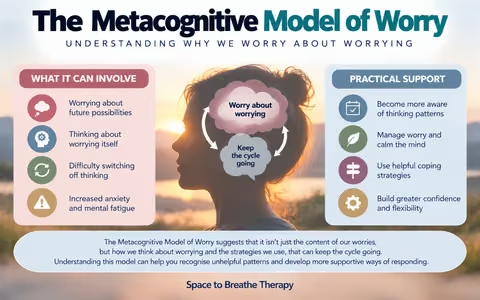

The Metacognitive Model of Worry – Understanding Why We Worry About Worrying

Explore why worrying about worry can increase anxiety and mental exhaustion. Discover the Metacognitive Model through interactive thought cycles, everyday scenarios and practical reflections. Recognise unhelpful thinking patterns, explore supportive responses and develop greater flexibility in managing persistent worry.

Download
Metacognitive Model of Worry | Space to Breathe Therapy
Interactive psychology guide

The Metacognitive Model of Worry

Understanding why we worry about worrying

Discover the worry cycle, explore beliefs about thinking, and create a realistic support plan.

1. Explore the worry cycle

According to Adrian Wells's model, beliefs about worry and repeated threat-focused attention can keep worry going.

1. A worry appears
“What if something goes wrong?”
2. Beliefs about worry
“I must worry to prepare.”
4. Worry continues
More monitoring and distress
3. Coping attempts
Checking or reassurance

This is a simplified educational illustration, not a diagnostic assessment.

2. What happens in your situation?

Select the button to explore an alternative.

3. Beliefs about worrying

Tap a statement to see how a belief might affect the worry cycle.

Choose a statement above.

4. The attention experiment

Adjust how much attention is being directed toward checking for threats. This illustrative meter is not a measure of anxiety.

What might help?

Notice when your attention is locked on possible danger. Where safe and appropriate, gently shift toward a chosen task rather than repeatedly checking whether the worry has disappeared. Practical action is still important when a problem needs solving.

5. Your personalised reflection

Your notes stay in this browser when local storage is available.

6. Understand the model

What is meta-worry?

Meta-worry is worry about worrying itself, such as fearing that worry is uncontrollable or harmful.

Does the model mean worries are imaginary?

No. Real pressures and threats need practical responses. The model focuses on the ways beliefs about thinking and coping responses can sometimes maintain distress.

What is metacognitive therapy?

It is a structured psychological treatment associated with Adrian Wells. This educational guide is not a substitute for therapy or individual assessment.

Where can I read more?

Wells, A. (1995), “Meta-cognition and worry: A cognitive model of generalized anxiety disorder,” Behavioural and Cognitive Psychotherapy, 23(3), 301–320; Wells, A. (2009), Metacognitive Therapy for Anxiety and Depression.

Space to Breathe Therapy
For education and reflection; not diagnosis or treatment.



