





Workplace Conflict & Disability
Understanding Workplace Disagreements, Disability-Related Barriers and Routes to Resolution
Workplace conflict can be difficult for anyone, but when disability, health conditions or accessibility needs are involved, disagreements can become particularly complicated.
A misunderstanding about communication, a refusal to consider an adjustment, a disagreement over workload or a colleague's response to someone's disability may create tension that affects both working relationships and emotional wellbeing.
For some disabled employees, workplace conflict can involve additional challenges.
They may need to explain difficulties that are not immediately visible, correct inaccurate assumptions about their abilities or repeatedly request support that has already been discussed.
Others may worry that raising concerns will damage their professional relationships, affect career opportunities or lead to further unfair treatment.
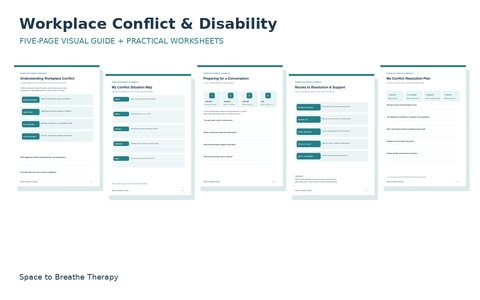
Workplace Conflict & Disability is a five-page visual guide and practical workbook designed to help individuals understand workplace conflict, identify disability-related barriers, prepare constructive conversations and explore appropriate routes to resolution.
Through visual diagrams, situation-mapping exercises, communication planning and personalised worksheets, the resource encourages a structured approach to workplace difficulties.
The aim is not to suggest that disabled employees must take responsibility for resolving discrimination or inaccessible working conditions.
Instead, it supports individuals in understanding what has happened, identifying their needs, considering their options and deciding what support may be appropriate.
Understanding Workplace Conflict
Workplace conflict occurs when disagreements, competing expectations, communication difficulties or unresolved concerns create tension between individuals or groups.
Conflict may involve:
- Colleagues.
- Line managers.
- Supervisors.
- Human resources.
- Senior management.
- Clients or customers.
- Other workplace professionals.
Not every disagreement is discrimination, and not every conflict involves deliberate wrongdoing.
However, disability-related conflict can arise when workplace expectations, practices or environments fail to accommodate an individual's needs.
For example, an employee may be criticised for not responding quickly during meetings when their disability affects auditory processing.
Another person may be accused of being uncooperative because they request written instructions rather than relying on verbal communication.
A worker with chronic pain may experience tension when requesting changes to physically demanding duties.
In each situation, understanding the underlying barrier is important.
Page 1 – Understanding Workplace Conflict
The first page introduces a visual breakdown of four common contributors to workplace conflict.
These are:
Misunderstandings
Unmet Disability Needs
Workplace Pressures
Unfair Treatment
The diagram encourages individuals to consider whether a disagreement is primarily about communication, accessibility, organisational demands or potentially discriminatory behaviour.
1. Misunderstandings
Communication differences can sometimes contribute to conflict.
People may interpret the same interaction differently.
For example, someone who communicates directly may be perceived as abrupt, even when they intend to be clear and factual.
An employee who needs additional processing time may be viewed as hesitant or disengaged.
A colleague may interpret reduced eye contact as disinterest without understanding that eye contact can be uncomfortable for some neurodivergent people.
Misunderstandings can often be reduced through clearer expectations, accessible communication and opportunities for clarification.
However, communication differences should not automatically be treated as personal shortcomings.
2. Unmet Disability Needs
Conflict may develop when disability-related needs are not understood or adequately supported.
Examples include:
- A request for accessible equipment being delayed.
- A manager questioning the need for additional breaks.
- A colleague challenging a flexible working arrangement.
- Meetings being arranged without appropriate communication support.
- An employee being expected to complete tasks that create avoidable physical barriers.
In these circumstances, the underlying problem may be an accessibility issue rather than a disagreement about attitude or effort.
Identifying the unmet need can help clarify what requires attention.
3. Workplace Pressures
Workload, staffing shortages, unclear responsibilities and organisational changes can increase workplace tension.
For disabled employees, these pressures may interact with existing barriers.
For example, an employee with ADHD may struggle when several urgent tasks are assigned without clear priorities.
Someone with chronic fatigue may experience difficulties when workload expectations do not account for agreed adjustments.
A person with sensory processing differences may find that increased office activity creates substantial additional demands.
Reducing unnecessary workplace pressures can sometimes prevent conflict from escalating.
4. Unfair Treatment
Some workplace conflicts involve behaviour that may be discriminatory, harassing or otherwise inappropriate.
Examples may include:
- Disability-related insults.
- Repeated mocking of communication differences.
- Unjustified exclusion from opportunities.
- Refusal to consider reasonable adjustments.
- Punitive treatment connected with disability-related needs.
- Hostile responses to raising concerns.
- Unwanted conduct related to disability that creates a degrading or offensive environment.
These situations should not simply be treated as ordinary interpersonal disagreements.
Formal workplace procedures and specialist advice may be appropriate.
Why Disability-Related Conflict Can Feel Particularly Difficult
Workplace conflict may be more emotionally demanding when someone feels that their disability or health condition is being questioned.
An individual may already have spent considerable time explaining their needs, gathering evidence or requesting adjustments.
When those needs are challenged, they may experience frustration, anxiety or exhaustion.
Some people may also have previous experiences of not being believed or being treated unfairly.
This can influence how safe they feel raising concerns.
For example, someone may avoid reporting a problem because they worry they will be labelled difficult.
Another person may repeatedly apologise for requesting an adjustment that they genuinely need.
The workbook encourages individuals to recognise these experiences without assuming that they are responsible for the behaviour of others.
Page 2 – My Conflict Situation Map
The second page provides a structured worksheet for understanding a workplace conflict.
It separates the situation into five areas:
Events
Impact
Accessibility Barriers
Evidence
Support Needs
This helps individuals move from a general feeling of distress towards a clearer understanding of what has happened.
Identifying the Events
Begin by recording what occurred.
Where possible, focus on observable details.
For example:
"During the team meeting on Monday, I was told that I must attend all future meetings in person, despite my previously agreed remote attendance arrangement."
This is more specific than:
"My manager never supports me."
Both statements may reflect genuine experiences, but the first provides clearer information for discussing the concern.
Useful details may include:
- Dates.
- Times.
- Locations.
- People involved.
- What was said.
- What was requested.
- What happened afterwards.
Understanding the Impact
The next stage involves considering how the situation affected the individual.
The impact may be practical, emotional, physical or professional.
For example:
- Increased anxiety.
- Difficulty completing work.
- Physical pain.
- Fatigue.
- Reduced concentration.
- Loss of confidence.
- Feeling excluded.
- Difficulty communicating.
- Concern about job security.
Recording the impact helps explain why the situation requires attention.
Identifying Accessibility Barriers
Consider whether disability-related barriers contributed to the disagreement.
For example:
- Were instructions inaccessible?
- Was an agreed adjustment overlooked?
- Did the environment create unnecessary difficulties?
- Was communication support unavailable?
- Were disability-related needs misunderstood?
- Was a policy applied without considering individual circumstances?
This can help distinguish the underlying accessibility issue from the conflict that developed around it.
Recording Evidence
Relevant information may include:
- Emails.
- Meeting notes.
- Written instructions.
- Adjustment agreements.
- Workplace policies.
- Occupational health recommendations.
- Relevant messages.
- A dated personal record of events.
Evidence should be recorded accurately and handled in accordance with appropriate confidentiality and data-protection requirements.
The purpose is to establish a clear record rather than encourage unnecessary monitoring of colleagues.
Identifying Support Needs
The final section asks what would help the individual address the situation.
This might include:
- Written communication.
- A support person at meetings.
- Additional processing time.
- Clarification of expectations.
- Occupational health involvement.
- A review of reasonable adjustments.
- Human resources support.
- Independent advice.
The worksheet can help individuals prepare before entering a potentially difficult conversation.
Page 3 – Preparing for a Conversation
The third page introduces a four-step communication pathway.
Prepare → Explain → Request → Agree Next Steps
This structure supports conversations where individuals want to raise concerns, clarify misunderstandings or request changes.
Step 1 – Prepare
Before the conversation, consider:
- What happened?
- What is the main concern?
- What outcome would help?
- What information is relevant?
- What support might be needed?
- Is an informal conversation appropriate and safe?
Preparation may involve writing down key points.
For someone with ADHD, autism, dyslexia, processing differences or anxiety, a written outline may help reduce the demands of remembering information during the meeting.
Step 2 – Explain
Try to describe the concern clearly.
For example:
"I would like to discuss the difficulties I have experienced during team meetings."
Or:
"I am concerned that the current working arrangements are creating disability-related barriers."
The aim is to communicate the issue without needing to explain every detail immediately.
Step 3 – Request
Identify what would help.
For example:
"Could we review the communication arrangements and agree how instructions will be provided?"
Or:
"I would like my previously agreed adjustments to be reviewed and confirmed in writing."
A request may involve a practical change, clarification, further assessment or formal consideration of reasonable adjustments.
Step 4 – Agree Next Steps
Where appropriate, clarify:
- What has been agreed?
- Who will take responsibility?
- When will changes be considered?
- How will progress be communicated?
- When will the arrangement be reviewed?
Written confirmation can help prevent further misunderstandings.
Example Conversation: Communication Differences
An autistic employee has been told that their communication style is too direct.
They feel distressed because they have been trying to communicate clearly.
A possible response might be:
"I understand that my communication style may sometimes be interpreted differently from how I intend it. I would appreciate specific examples so I can understand the concern. It would also help to discuss communication expectations that work for everyone."
This approach allows the concern to be explored without assuming that the autistic employee is solely responsible for changing their communication.
Workplace inclusion involves mutual understanding and appropriate adjustments.
Example Conversation: Physical Disability
An employee with a mobility impairment has been asked to attend meetings in a room that is difficult to access.
They might say:
"I would like to raise an accessibility concern about the meeting location. Reaching that room creates significant physical difficulties for me. Could we arrange meetings in an accessible space or consider another suitable option?"
This focuses on the practical barrier and possible solutions.
Example Conversation: ADHD and Workload
An employee with ADHD is regularly given several urgent tasks without clear priorities.
They might explain:
"When multiple tasks are assigned as urgent, I find it difficult to identify which should take priority. Could we agree a clear order of tasks and confirm changes in writing?"
The conversation focuses on making expectations more accessible.
When Informal Conversations May Not Be Appropriate
An informal conversation is not always the right starting point.
For example, an employee may be experiencing serious harassment, threats, retaliation or repeated discriminatory treatment.
They may also feel unsafe speaking directly with the person involved.
In these circumstances, seeking advice or using a formal reporting route may be more appropriate.
The workbook encourages individuals to consider their safety, circumstances and available support before deciding how to proceed.
Page 4 – Routes to Resolution & Support
The fourth page introduces a visual guide to possible workplace resolution routes.
These may include:
Informal Discussion
Management Support
Human Resources
Formal Grievance
Specialist Advice
The appropriate route depends on the nature and seriousness of the concern.
Informal Discussion
Some misunderstandings can be resolved through a respectful conversation.
This may be appropriate when:
- The issue is relatively minor.
- Both parties feel safe discussing it.
- There is no serious harassment or threatening behaviour.
- The concern can realistically be addressed through clarification.
Informal resolution should be voluntary and appropriate to the circumstances.
Management Support
A line manager may be able to clarify responsibilities, review working arrangements or address accessibility concerns.
However, where the manager is directly involved in the conflict, another appropriate person may need to be contacted.
Human Resources
Human resources may provide information about workplace procedures, policies and internal support options.
Employees may wish to ask about:
- Grievance procedures.
- Disability policies.
- Reasonable adjustment processes.
- Occupational health referrals.
- Workplace mediation.
- Support during meetings.
Human resources represents the employer, so individuals may also benefit from independent advice.
Formal Grievance
A formal grievance is a written workplace complaint raised through the employer's grievance procedure.
It may be appropriate where concerns cannot be resolved informally or where the seriousness of the issue requires formal consideration.
A grievance should generally explain:
- What happened.
- The main concern.
- Relevant dates.
- The impact.
- Supporting information.
- The outcome being requested.
Employers should follow applicable grievance procedures and relevant employment law.
Specialist Advice
Independent support may be particularly important where discrimination, harassment, dismissal, victimisation or unresolved reasonable-adjustment concerns are involved.
In Great Britain, useful sources of information may include:
- Acas – workplace rights, dispute resolution and employment procedures.
- Citizens Advice – general guidance about employment and discrimination concerns.
- Equality Advisory and Support Service (EASS) – information and assistance concerning discrimination and equality rights.
- Trade unions – workplace representation and support for members.
- Employment solicitors – individual legal advice where appropriate.
Official information is available through Acas at www.acas.org.uk and the Equality and Human Rights Commission at www.equalityhumanrights.com.
Understanding the Equality Act 2010
The Equality Act 2010 provides protection against disability discrimination in Great Britain.
Depending on the circumstances, relevant legal issues may include:
Direct Disability Discrimination
This involves treating someone less favourably because of disability.
Discrimination Arising from Disability
This may occur when someone is treated unfavourably because of something arising in consequence of their disability, subject to the legal conditions and potential justification provisions.
Failure to Make Reasonable Adjustments
Employers have duties to make reasonable adjustments where the relevant legal requirements are met.
Disability Harassment
This involves unwanted conduct related to disability that has the purpose or effect, assessed under the statutory test, of violating dignity or creating an intimidating, hostile, degrading, humiliating or offensive environment.
Victimisation
This may arise where someone is subjected to a detriment because they have done, or are believed to have done or may do, a protected act under equality law.
Not every workplace disagreement falls within these legal categories.
However, recognising the distinction between ordinary conflict and potentially unlawful treatment can help individuals seek appropriate advice.
Employment Tribunal Time Limits
Employment disputes can involve strict legal deadlines.
For many employment tribunal claims, the usual time limit is three months less one day from the relevant act or event, although the precise rules and exceptions depend on the claim.
Internal grievances do not normally stop the tribunal time limit from running.
Acas early conciliation can affect the calculation of time limits.
Anyone considering a legal claim should obtain prompt, up-to-date advice rather than waiting for an internal process to finish.
Page 5 – My Conflict Resolution Plan
The fifth page brings together the information explored throughout the workbook.
It provides a personalised planning worksheet covering:
- The concern.
- Disability-related barriers.
- Requested adjustments.
- Agreed actions.
- Follow-up arrangements.
Identifying the Main Concern
Begin by summarising the issue.
For example:
"My agreed communication adjustments are not consistently being followed."
A concise summary can make it easier to explain the concern.
Identifying the Disability-Related Barrier
Consider what makes the current situation difficult.
For example:
"Verbal-only instructions are difficult for me to process and remember."
Identifying the Requested Adjustment
Consider what might reduce the barrier.
For example:
"Written instructions following meetings."
Recording Agreed Actions
Where an agreement is reached, record:
- What will change.
- Who is responsible.
- When the change will begin.
- Whether equipment or assessment is required.
- How the arrangement will be communicated.
Planning Follow-Up
A review may be useful to determine whether the agreed change has resolved the concern.
For example:
"Review the communication arrangement after four weeks."
The purpose of follow-up is to establish whether the barrier has been reduced and whether further action is required.
Conflict, Emotional Wellbeing and Psychological Safety
Workplace conflict can affect emotional wellbeing.
For disabled employees, repeated misunderstandings or challenges to accessibility needs may contribute to:
- Anxiety.
- Stress.
- Reduced confidence.
- Emotional exhaustion.
- Difficulty concentrating.
- Sleep disruption.
- Avoidance of workplace interactions.
- Feeling isolated.
- Reduced trust in management.
Some individuals may begin masking their difficulties to avoid further conflict.
Others may stop requesting support because previous attempts have been unsuccessful.
A psychologically safer workplace encourages employees to raise concerns without fear of humiliation or retaliation.
This does not mean that every disagreement can be avoided.
It means that concerns are addressed respectfully, fairly and with appropriate consideration of individual needs.
Supporting Neurodivergent Employees During Conflict
Autistic employees and people with ADHD may experience particular difficulties during workplace disagreements.
These can include:
- Processing rapid verbal information.
- Managing interruptions.
- Understanding ambiguous expectations.
- Organising thoughts under pressure.
- Remembering what was said.
- Responding to emotionally demanding conversations.
- Managing sensory distractions.
- Recovering after difficult interactions.
Possible adjustments may include:
- Providing meeting topics in advance.
- Allowing written responses.
- Offering additional processing time.
- Reducing sensory distractions.
- Providing written summaries.
- Allowing appropriate support or representation.
- Avoiding unnecessary pressure for immediate answers.
These arrangements can help individuals participate more effectively in discussions.
Supporting Employees With Physical Disabilities or Chronic Conditions
Employees living with physical disabilities, chronic pain, fatigue or fluctuating health conditions may experience conflict when their needs are misunderstood.
For example, colleagues may question why someone receives additional breaks or works different hours.
Managers may underestimate the physical impact of certain tasks.
A person may also feel pressure to disclose more medical information than is necessary.
A constructive approach focuses on the workplace barrier and relevant functional needs.
For example:
"The current arrangement creates difficulties with prolonged standing. I would like to discuss an adjustment that allows me to complete the role safely."
Employees should be able to discuss relevant support needs without being subjected to unnecessary personal questioning.
The Role of Managers
Managers have an important role in preventing and addressing workplace conflict.
Helpful practices include:
- Listening without immediately dismissing concerns.
- Avoiding assumptions about disability.
- Clarifying expectations.
- Reviewing reasonable adjustments.
- Providing accessible communication.
- Addressing inappropriate behaviour.
- Following workplace procedures.
- Maintaining appropriate confidentiality.
- Recording agreed actions.
- Reviewing whether changes are effective.
Managers should also recognise when a concern requires specialist advice or formal investigation.
A disability-related concern should not automatically be reframed as a personality clash.
What Colleagues Can Do
Colleagues can contribute to a more inclusive working environment by:
- Respecting communication differences.
- Avoiding assumptions about someone's abilities.
- Not questioning or challenging agreed adjustments unnecessarily.
- Respecting privacy.
- Addressing concerns professionally.
- Avoiding gossip.
- Challenging inappropriate behaviour safely.
- Following inclusive workplace practices.
Colleagues do not need to know someone's diagnosis or medical history to respect their workplace adjustments.
When Mediation May Help
Workplace mediation is a voluntary process in which an impartial mediator helps people explore a disagreement and consider possible solutions.
It may be useful for certain communication difficulties or relationship conflicts.
However, mediation is not appropriate for every situation.
For example, serious allegations of harassment or discrimination may require formal investigation or other procedures.
Mediation should not be used to pressure a disabled employee into accepting inaccessible working arrangements or giving up legal rights.
Where mediation is considered, accessibility needs should be accommodated throughout the process.
Using the Workbook in Counselling or Workplace Support
The worksheets may be useful within counselling, psychotherapy, ADHD coaching, occupational support or employment guidance.
They can help individuals explore:
- What happened.
- How the situation affected them.
- Whether disability-related barriers were involved.
- What support they need.
- How to communicate their concerns.
- Which resolution routes may be appropriate.
- How to prepare for meetings.
- How to record agreed actions.
- How to manage emotional wellbeing during the process.
A practitioner may use the situation map to help someone organise a confusing or distressing experience.
The communication pathway may support preparation for a difficult meeting.
The resolution guide can help identify where independent advice may be needed.
The personalised action plan provides a practical summary for the individual to use afterwards.
Therapeutic support can help someone process the emotional impact of workplace conflict, but it should not replace appropriate employment, legal or organisational action.
What Is Included in the Five-Page PDF?
Page 1 – Understanding Workplace Conflict
A visual breakdown of misunderstandings, unmet disability needs, workplace pressures and unfair treatment.
Page 2 – My Conflict Situation Map
A structured worksheet separating events, impact, accessibility barriers, evidence and support needs.
Page 3 – Preparing for a Conversation
A four-step communication pathway with practical space to prepare what to say and request.
Page 4 – Routes to Resolution & Support
A visual guide to informal discussions, management, human resources, grievances and specialist advice.
Page 5 – My Conflict Resolution Plan
A personalised worksheet for recording concerns, reasonable adjustments, agreed actions and follow-up arrangements.
The five pages can be used individually or together to create a structured approach to understanding and addressing workplace conflict.
Who Is This Resource For?
Workplace Conflict & Disability may be helpful for:
- Disabled employees.
- Autistic adults.
- People with ADHD.
- Individuals with communication or processing differences.
- Employees with chronic health conditions.
- People with physical disabilities.
- Individuals experiencing workplace misunderstandings.
- Employees requesting reasonable adjustments.
- People concerned about unfair treatment.
- Individuals preparing for workplace meetings.
- People returning to work after conflict or absence.
- Self-employed individuals managing professional disagreements.
- Managers and employers.
- Workplace support workers.
- Counsellors and psychotherapists.
- Employment and disability advisers.
The visual format may be particularly useful for individuals who prefer structured diagrams, practical worksheets and clear preparation tools.
A Gentle Reminder
Workplace conflict can be emotionally difficult, especially when it involves disability-related needs or experiences of not being understood.
Not every disagreement can be resolved through better communication alone.
Sometimes the underlying issue is an inaccessible environment, an unmet adjustment, inappropriate behaviour or a failure to follow workplace procedures.
Disabled employees should not have to continually justify their needs or accept unfair treatment in order to maintain positive working relationships.
Clear communication, appropriate adjustments, fair procedures and respectful workplace cultures can all contribute to resolving difficulties.
It is reasonable to ask questions, seek clarification, request support and obtain independent advice when needed.
The purpose of this resource is to help individuals understand their circumstances and consider their options with greater clarity and confidence.
Space to Breathe Therapy
This resource is intended for education, personal reflection and practical workplace planning. It is not legal advice, an employment tribunal assessment, mediation or a substitute for independent professional guidance. Workplace concerns involving discrimination, harassment, victimisation, dismissal or other legal issues may require prompt specialist advice. Employment law and tribunal time limits can vary according to the circumstances. Individuals should consult current official guidance and seek appropriate support when necessary.




