





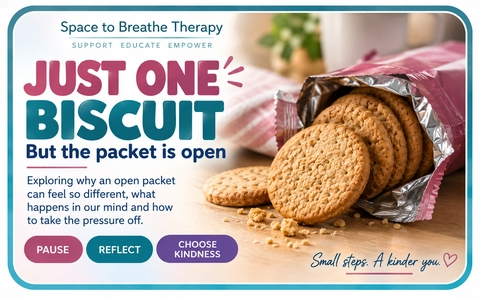
Just One Biscuit — But the Packet Is Open
An interactive exploration of food cues, inner rules, scarcity thinking and the pressure that can turn an ordinary decision into an exhausting conversation.
The packet is open. What happens next?
You planned to have one biscuit. Now the packet is open, and suddenly you may be noticing every biscuit still inside.
For one person, the packet might be an ordinary object. For someone else, it may bring up thoughts about permission, control, guilt, uncertainty or what happens next.
What might be happening?
Explore environmental cues, food rules, hunger, restriction, distracted eating and scarcity thinking.
Pause without pressure
Try optional reflections that invite curiosity rather than asking you to resist or prove anything.
Understand your responses
Explore different experiences of the same open packet, with compassionate explanations.
Keep a personal record
Save reflections and download your journal to revisit later if that feels useful.
Who is this resource for?
Adults experiencing food anxiety, restrictive food rules, guilt, scarcity thinking, automatic eating or feelings of losing control around food.
It may also be helpful for people exploring disordered eating or rebuilding their relationship with food. No particular eating pattern is assumed.
Before you begin
You do not need biscuits or any other food for this activity. Nothing here asks you to delay food, restrict intake, monitor quantities or challenge a clinical eating plan.
If eating is already difficult or distressing, professional support can help you explore this safely and at your own pace.
Understanding the Open Packet
Eight sections explore different ways food can become entangled with thoughts, emotions and surroundings.
0 of 8 sections exploredThe Packet Moment
Explore what may be happening internally when a packet is open. There are no right or wrong feelings to select.
What might the packet bring up?
Choose anything that feels familiar.
What others might see
Tap each perspective to reveal how the same moment may feel from the inside.
A cue is not a command
Seeing, smelling or noticing food may increase attention or desire. That does not mean a person must respond in one particular way.
Equally, wanting food does not mean someone has failed or lost control. Eating can be a reasonable, appropriate response to hunger, enjoyment or need.
A Gentle Packet Check-In
This check-in can be used after a real experience, with an imagined situation, or simply as a reflection. You do not have to be eating while completing it.
Before
During
After
A gentle reminder
You do not need to turn this into a record of how many biscuits were eaten.
The focus is the experience surrounding food, not measuring or grading eating.
My Reflection Journal
Use this space to explore food rules, your own needs and ways to make decisions feel less pressured.
Saved reflections and check-ins
When additional support might help
If food decisions are frequently accompanied by significant distress, strict rules, compensatory behaviours, persistent restriction or episodes that feel out of control, consider talking with your GP or an eating-disorder-informed professional.
Support may be especially important if eating patterns are affecting your physical health, relationships, daily routines or emotional wellbeing.
You deserve help without having to prove how much you are struggling.
A personal message
Food can carry far more than hunger. Sometimes the most difficult part is not what is in front of us, but the conversation happening inside our minds.
You do not need to approach every eating moment as a test of control. You are allowed to be curious, uncertain and compassionate towards yourself.
Progress isn't perfection. It's understanding yourself a little more and learning to respond with a little more kindness.
Until next time, give yourself Space to Breathe.
With love, Maggie
Space to Breathe Therapy




