



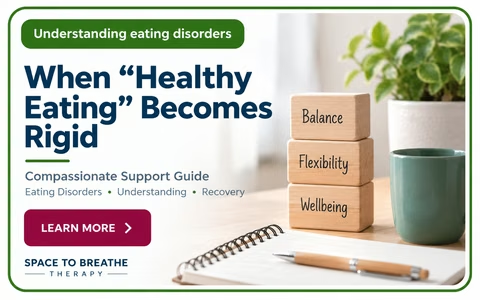

When “Healthy Eating” Becomes Rigid

Download

When “Healthy Eating” Becomes Rigid

Understanding orthorexic patterns without moralising food

I wanted to include this resource because orthorexia is a term commonly used for an unhealthy preoccupation with eating foods judged to be pure, clean or healthy. It is not currently a standalone diagnosis in major diagnostic manuals, but the distress, restriction and impairment can be very real and may overlap with recognised eating disorders.

This guide looks gently and clearly at the experiences people may not always feel able to talk about. It explains what may sit underneath the behaviour or physical sensation, what can make it feel so convincing, and why the person should never be reduced to a diagnosis, a number or what others can see from the outside.

Inside this resource, we explore:
• Possible warning signs
• Why it can be hard to notice
• A more balanced direction

The guide also offers practical ideas that can sit alongside professional support:
• Discuss the full pattern with a GP, therapist or eating-disorder dietitian.
• Notice which rules are clinically necessary and which are fear-driven.
• Reduce repeated ingredient checking or wellness content with support.
• Practise flexible choices gradually rather than forcing a sudden challenge alone.

The aim is not to criticise an interest in nutrition. It is to notice when rules are taking away safety, adequacy and life.

Please take what feels useful and go gently. Eating disorders are serious mental health conditions and can affect physical health at any body size. This resource is for understanding and reflection; it is not a substitute for assessment, medical monitoring, a dietetic plan or specialist treatment. If you are worried about yourself or someone else, please contact a GP or eating-disorder service.

If there is fainting, chest pain, confusion, severe weakness, uncontrolled vomiting, blood, serious dehydration or immediate danger, seek urgent help. In the UK call 999 or attend A&E in an emergency, or contact NHS 111 for urgent advice. Beat also offers confidential eating-disorder information and support.

You do not have to prove that things are bad enough before asking for help. You deserve to be listened to with warmth, dignity and without judgment.

With warmth,
Maggie
Space to Breathe Therapy