





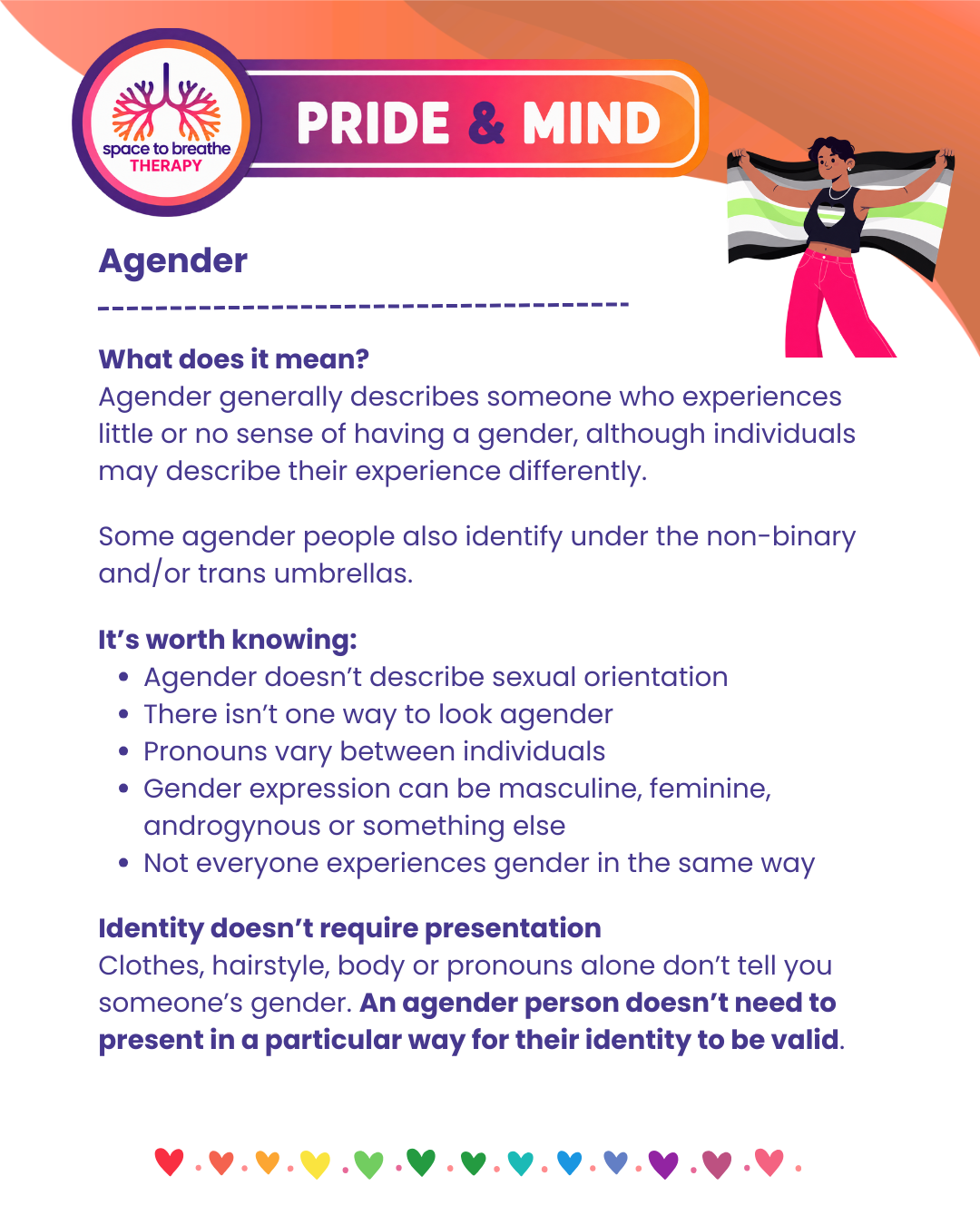
Agender – Understanding an Identity Without Gender
For many people, gender is an important part of how they understand themselves. They may feel strongly that they are a man, a woman, non-binary, or another gender.
For an agender person, that experience can be different.
Agender generally describes someone who experiences little or no sense of having a gender.
Some people describe it as feeling genderless. Others may feel neutral about gender, disconnected from the idea of gender altogether, or simply feel that none of the usual gender categories describe their internal experience.
There isn't one universal way to experience being agender.
“But what does having no gender feel like?”
This can be difficult to explain — particularly because we often understand gender through our own experience of it.
An agender person might say:
“I don't feel like a man or a woman. I just feel like me.”
Another person may describe gender as something they understand exists for other people but don't particularly experience themselves.
Someone else might feel that the concept of gender simply isn't relevant to how they understand who they are.
All of these experiences can be valid.
Agender doesn't tell you someone's sexuality
Gender identity and sexual orientation are different things.
Being agender doesn't tell you who somebody is attracted to.
An agender person might be gay, lesbian, bisexual, pansexual, asexual, straight, queer or use another description entirely.
Their gender identity is about who they are, while sexual orientation relates to patterns of attraction.
There is no agender “look”
An agender person doesn't have to appear androgynous.
They may present in a masculine way.
They may present in a feminine way.
They might enjoy changing their appearance or have absolutely no interest in gender expression at all.
Clothes, hair, make-up and body shape don't automatically tell us somebody's gender identity.
Identity and presentation are not the same thing.
What about pronouns?
There aren't specific pronouns that every agender person uses.
Some people use they/them.
Others may use she/her, he/him, combinations of pronouns, neopronouns, or have no strong preference.
The simplest approach is not to assume.
If you're unsure and it's appropriate to ask, you can simply say:
“What pronouns would you like me to use?”
Then respect the answer.
Agender, non-binary and trans
Some agender people consider themselves non-binary because their identity sits outside the traditional categories of exclusively male or female.
Some also identify as transgender.
Others don't use either of those words for themselves.
Umbrella terms can help people find language and community, but individuals should be able to decide which terms describe their own experience.
You don't need to decide for somebody else.
Supporting someone who is agender
You don't need to completely understand another person's experience of gender before you can respect it.
Listen to how they describe themselves.
Use their name and pronouns.
Avoid repeatedly asking them to justify or prove their identity.
Try not to make assumptions based on their appearance.
And remember that if somebody shares their identity with you, it doesn't automatically give you permission to share that information with other people.
A message from me
Sometimes we become so focused on finding the perfect definition that we forget there's a person behind the word.
A label such as agender can help somebody finally put language around an experience they've struggled to describe.
For somebody else, it may simply be the closest word they've found for now.
We don't need everybody's experience to look the same before we're willing to respect it.
If someone tells you who they are, perhaps one of the most supportive things you can do is listen rather than immediately trying to fit them into another box.
And if you're exploring whether agender might describe you, you don't have to rush.
Read.
Explore.
Notice what feels comfortable.
Try language privately if you want to.
And give yourself permission to discover what being you means without feeling that you have to present yourself in any particular way.
You don't have to perform an identity for it to belong to you.
Until next time, give yourself space to breathe.
With love,
Maggie