




Bisexual – Attraction, Identity and Being Enough
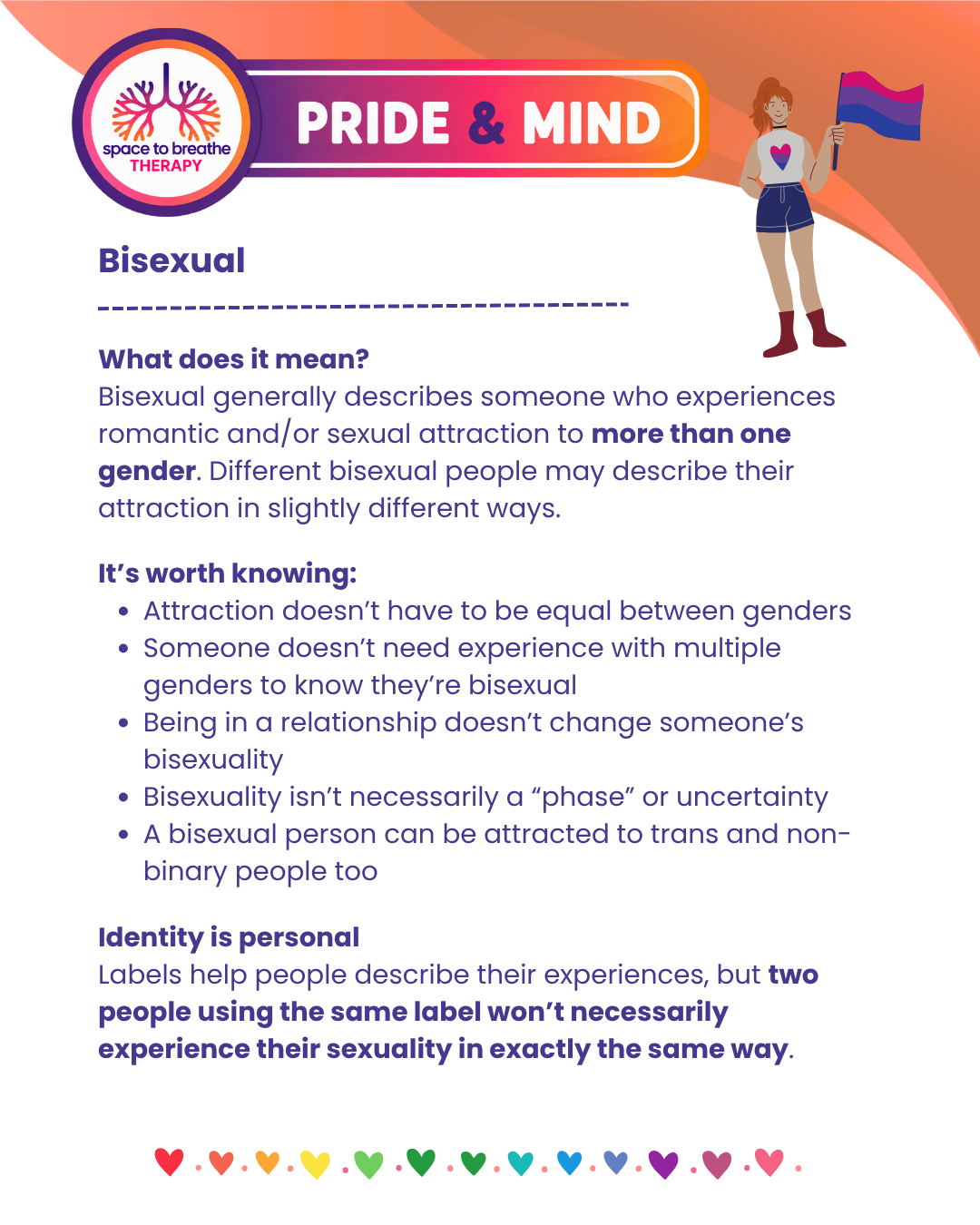
Being bisexual generally means experiencing romantic and/or sexual attraction to more than one gender. That attraction does not have to be equal, happen at the same time or look the same throughout someone's life.
For some people, recognising their bisexuality feels straightforward. For others, it can involve years of questioning, particularly when their experiences don't match the stereotypes they have heard about bisexuality.
You don't have to prove you're bisexual
One of the most important things to understand is that sexuality is about attraction, not your relationship history.
You don't need to have dated people of different genders. You don't need equal experience with men and women. You don't need to have had a relationship at all.
A bisexual person in a relationship with someone of a different gender is still bisexual.
A bisexual person in a same-gender relationship is still bisexual.
Your current partner doesn't redefine your sexuality.
Attraction doesn't have to be 50/50
Bisexuality doesn't mean experiencing exactly equal attraction to different genders.
Someone might feel stronger romantic attraction towards one gender and stronger sexual attraction towards another. Attraction might also shift throughout life.
There isn't a percentage you have to reach before you're “bisexual enough.”
Bisexuality isn't confusion
Bisexual people can sometimes hear comments such as:
“It's just a phase.”
“You'll eventually choose.”
“You're really gay.”
“You're really straight.”
These assumptions can leave people feeling that they constantly need to explain or defend their sexuality.
But bisexuality is a valid identity in its own right, not necessarily a stepping stone towards another identity.
Bisexuality can include attraction to trans and non-binary people
Bisexuality isn't limited to attraction to cisgender men and women.
Many bisexual people understand “bi” as attraction to more than one gender, and bisexual people may be attracted to transgender and non-binary people too.
The exact way someone understands and describes their bisexuality is personal to them.
Sometimes you can feel invisible
Bisexual people can experience a particular kind of invisibility.
Other people may assume you're heterosexual because of the person you're dating. In another relationship, they may assume you're gay or lesbian.
That can leave someone feeling that an important part of themselves disappears depending upon who happens to be standing beside them.
You don't stop being bisexual because other people can't see your bisexuality.
You are allowed to choose the language that fits you
Bisexual, pansexual, queer and other labels can sometimes overlap in how people describe their attraction.
You don't need to find the technically “perfect” word.
Language is there to help you understand and communicate your experience — not to put you into another box.
A message from me
If you've ever wondered whether you're “bisexual enough,” I want you to remember that there is nothing you have to prove.
You don't need a particular dating history.
You don't need equal attraction.
You don't need anyone else's permission.
And you certainly don't need to explain your identity every time somebody makes an assumption about you.
You are allowed to use the language that feels right for you, and you're also allowed for that understanding to develop over time.
Your experiences belong to you.
Until next time, give yourself space to breathe.
With love,
Maggie




