





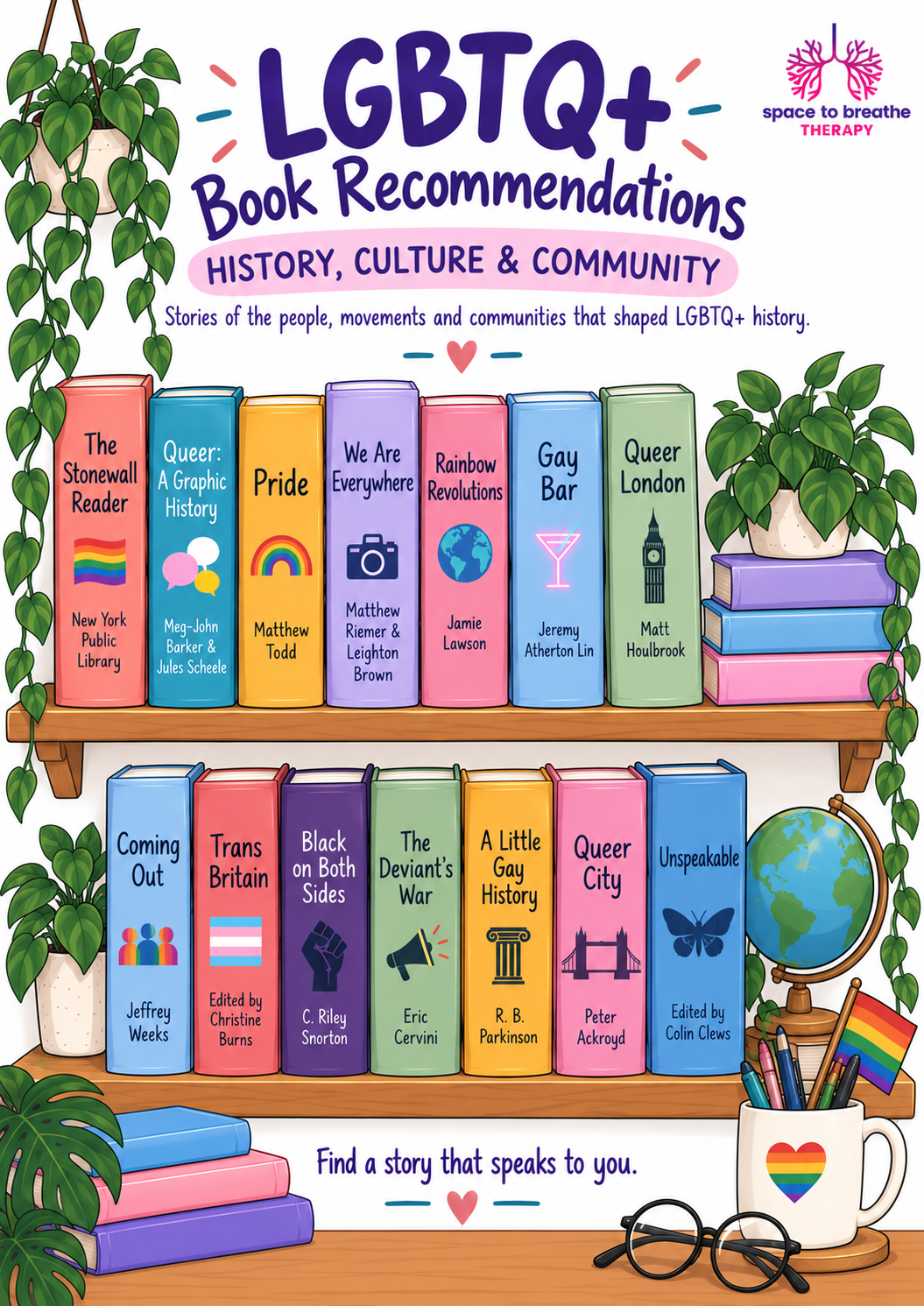
LGBTQ+ Book Recommendations: History, Culture & Community
LGBTQ+ history is made up of far more than individual milestones or changes in the law. It is also the story of people finding one another, creating communities, challenging expectations, building movements and shaping culture. These books explore LGBTQ+ history from a range of perspectives, from activism and liberation to nightlife, identity and everyday queer life.
The Stonewall Reader — New York Public Library
A collection of writing from before, during and after the 1969 Stonewall uprising. Through first-hand accounts, articles and reflections, it introduces some of the people, organisations and experiences surrounding a pivotal period in LGBTQ+ liberation.
Queer: A Graphic History — Meg-John Barker & Jules Scheele
An illustrated introduction to queer thought, history and theory. Complex ideas about sexuality, gender, identity and society are presented in an accessible graphic format, making this a useful starting point for readers curious about how ideas around queerness developed.
Pride — Matthew Todd
Explores LGBTQ+ history through the people, campaigns and events that contributed to greater visibility and equality. It also considers the challenges LGBTQ+ communities have faced and the work that remains.
We Are Everywhere — Matthew Riemer & Leighton Brown
A visually rich photographic history of queer liberation and activism. Drawing upon photographs and archival material, it documents LGBTQ+ people organising, protesting, celebrating and creating communities across generations.
Rainbow Revolutions — Jamie Lawson
An accessible illustrated journey through LGBTQ+ history, introducing important people, events and movements from around the world. Particularly approachable for readers wanting a broad introduction rather than a dense historical account.
Gay Bar — Jeremy Atherton Lin
Part memoir and part cultural history, this book explores gay bars and queer nightlife across different cities and periods. It considers why these spaces have mattered for connection, identity, freedom and community, as well as how queer social spaces have changed.
Queer London — Matt Houlbrook
Explores queer life in London during the early twentieth century, looking at the places, relationships and communities that existed at a time when homosexuality between men was criminalised. It offers a fascinating glimpse into LGBTQ+ life beyond official historical records.
Coming Out — Jeffrey Weeks
Examines the development of modern lesbian and gay identities and communities in Britain. It looks at changing attitudes, politics, social movements and the ways LGBTQ+ people organised and became increasingly visible.
Trans Britain — Edited by Christine Burns
A collection documenting decades of British trans history through the experiences of people who helped shape it. Contributors discuss activism, healthcare, community, visibility and changing attitudes towards trans people in the UK.
Black on Both Sides — C. Riley Snorton
An academic exploration of Black trans history and the relationship between race and gender. It examines how histories of Blackness and transness intersect and challenges readers to think beyond simplified accounts of transgender history.
The Deviant’s War — Eric Cervini
Tells the story of astronomer and activist Frank Kameny and his role in the early American gay-rights movement. Through his experiences, the book explores activism, discrimination and the organised fight for equality before Stonewall.
A Little Gay History — R. B. Parkinson
Uses objects from the British Museum to uncover LGBTQ+ lives and experiences across different cultures and periods of history. Art, artefacts and everyday objects provide an unusual and accessible way of discovering how diverse sexuality and gender have appeared throughout human history.
Queer City — Peter Ackroyd
A wide-ranging history of queer life in London stretching across centuries. It explores changing language, meeting places, relationships, subcultures, persecution and the many ways LGBTQ+ people found spaces for themselves within the city.
Unspeakable — Edited by Colin Clews
Explores overlooked aspects of LGBTQ+ history in Britain, bringing attention to experiences that have not always appeared in mainstream accounts. It provides another perspective on how queer people lived, formed relationships and created community in less accepting periods.
A little note for readers
LGBTQ+ history is enormous, diverse and sometimes contested. No single collection can represent every country, culture, identity or period, and historical language and attitudes can differ considerably from those used today.
Some of these books also discuss criminalisation, discrimination, persecution, racism, transphobia and other difficult aspects of LGBTQ+ history. Alongside those experiences, however, they document something equally important: resilience, creativity, activism, friendship, celebration and the communities LGBTQ+ people have built across generations.
Understanding where LGBTQ+ communities have come from can help us appreciate not only how much has changed, but also the people whose lives and actions helped make that change possible.
Find a story that speaks to you.
By Gemma Learoyd MNCPS
Therapist & Coach | Space to Breathe Therapy




