




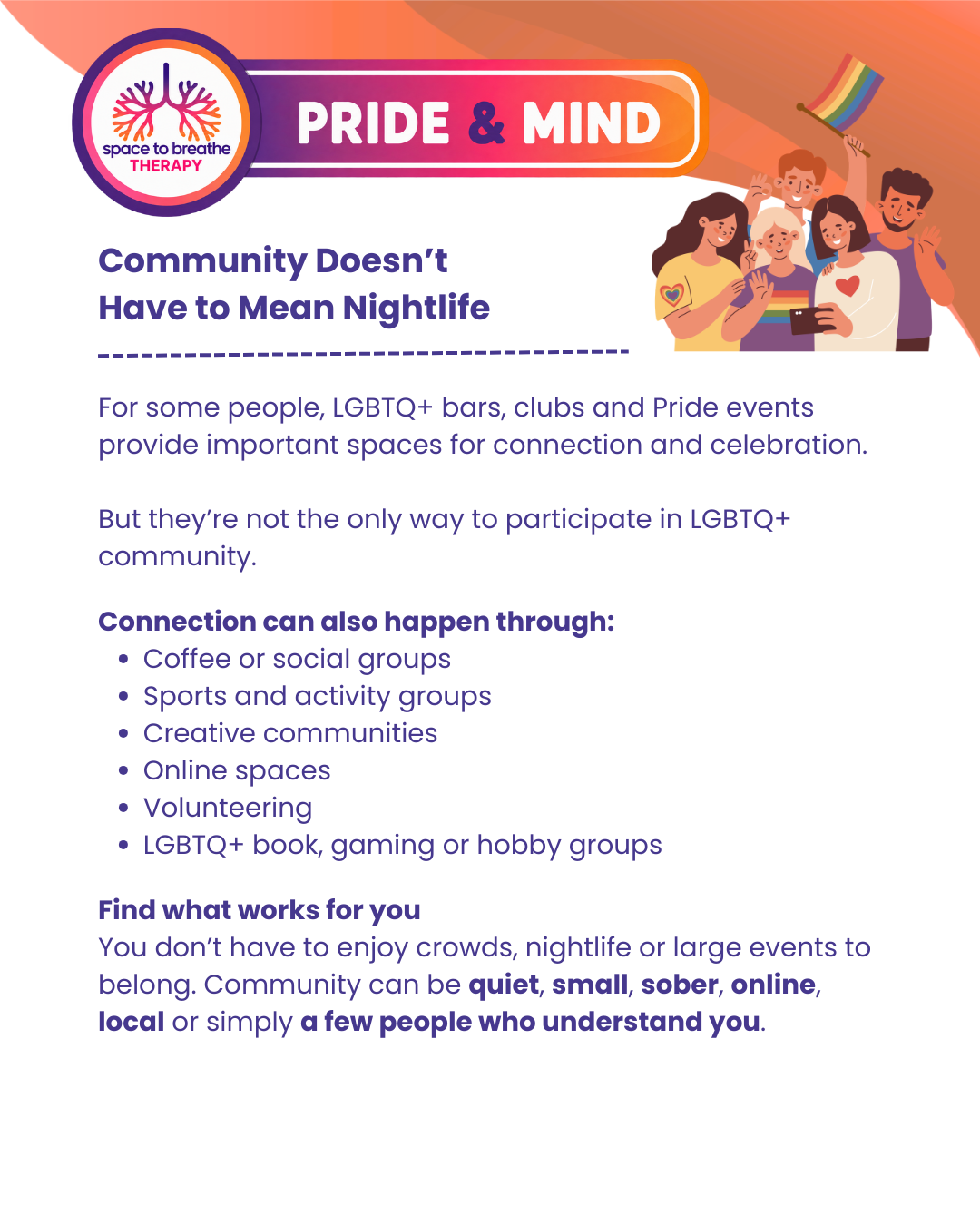
Community Doesn’t Have to Mean Nightlife
When we talk about LGBTQ+ community, the images we see are often colourful Pride celebrations, busy bars, clubs and large social events.
For many people, these spaces are incredibly important. They can provide freedom, celebration, visibility and the opportunity to meet people with shared experiences.
But they aren't for everyone.
And not enjoying nightlife doesn't mean you're disconnected from the LGBTQ+ community.
There isn't one way to belong
You might be someone who finds large crowds overwhelming.
You might not drink alcohol.
You may be introverted, neurodivergent, disabled, living with a health condition or simply happier somewhere quieter.
Perhaps you're newly exploring your identity and walking into a busy LGBTQ+ venue feels like far too big a step.
Or maybe you'd simply rather meet somebody for coffee than spend an evening in a club.
None of those things make you any less part of the community.
Find connection in a way that suits you
Community can look like two people sitting together having a cup of tea.
It can be a walking group, book club, sports team, craft group, gaming community or volunteering project.
It might be an online space where you can participate from home.
It could be a small local support group where people actually have time to talk.
For some people, community isn't a group at all.
It might simply be one or two people around whom you don't have to explain yourself.
That counts too.
Online community can be real community
For people who live rurally, have mobility difficulties, experience social anxiety or simply don't have LGBTQ+ spaces nearby, online communities can provide an important sense of connection.
They can also allow you to observe before participating.
You can read other people's experiences, discover language that helps you understand yourself and gradually decide whether you'd like to become more involved.
As with any online space, it's worth choosing communities carefully and protecting your privacy, but meaningful relationships absolutely can begin online.
You don't have to prove that you belong
Sometimes people worry they're not "involved enough" in LGBTQ+ life.
Perhaps you've never been to Pride.
Maybe you don't have many LGBTQ+ friends.
You might not follow LGBTQ+ organisations or attend community events.
There is no membership requirement.
Your identity isn't measured by how visibly you participate in a community.
You can celebrate loudly.
You can connect quietly.
You can participate occasionally.
Or you can simply know that the community is there when you need it.
Think about what connection means to you
Instead of asking:
“Where am I supposed to fit in?”
try asking:
“Where do I feel comfortable being myself?”
Maybe you need people who share your identity.
Perhaps shared interests matter more.
Maybe you'd prefer an intergenerational group, somewhere specifically for older LGBTQ+ people, a neurodivergent LGBTQ+ space, a sober community or something completely unrelated to sexuality or gender where you simply know you'll be accepted.
Finding your people can take time.
A message from me
Please don't look at somebody else's version of LGBTQ+ community and assume yours needs to look the same.
You don't need to enjoy crowds.
You don't need to drink.
You don't need to go clubbing.
You don't need to attend every Pride event.
And you certainly don't have to become more outgoing than you naturally are just to feel that you belong.
Community can be quiet, small, sober, online, local, creative, active or simply a few people who understand you.
What matters isn't how it looks from the outside.
It's whether somewhere — or with someone — you can relax a little and feel:
“I don't have to hide here.”
That is community too.
Until next time, give yourself space to breathe.
With love,
Maggie