





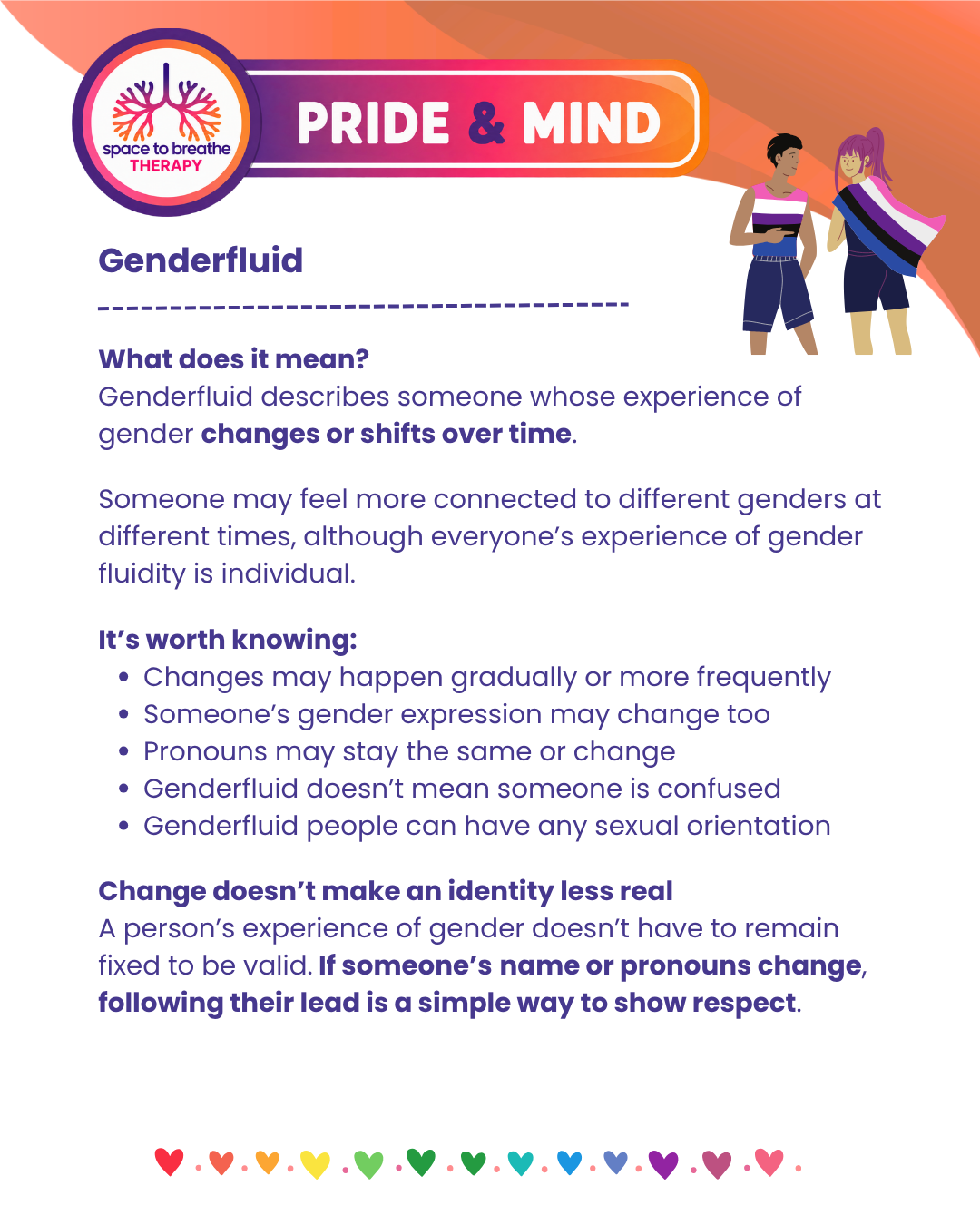
Genderfluid – When Gender Can Shift and Change
For some people, gender feels consistent throughout their lives. For others, their experience of gender can change, move or shift over time.
Genderfluid is a term some people use to describe this experience.
A genderfluid person might feel more connected to one gender at one time and another gender at another. At other times, they may feel somewhere between genders, connected to several genders, or not particularly connected to gender at all.
There is no single pattern that genderfluidity has to follow.
What does “fluid” mean?
The word fluid is important because it recognises that someone's internal experience doesn't necessarily remain fixed.
For one person, shifts in gender might happen relatively frequently. For another, they may happen over months or years.
Some people notice clear changes, while others describe something much more subtle.
There doesn't have to be a predictable pattern.
And importantly, changing doesn't mean someone is confused or hasn't worked out who they are.
Fluidity itself can be part of their identity.
Gender identity and gender expression
Someone's internal experience of gender and the way they present themselves aren't necessarily the same.
A genderfluid person might change their clothing, hairstyle, make-up or other aspects of their appearance as their gender shifts.
Another person might look very similar every day regardless of how they're experiencing their gender internally.
Neither experience is more genuinely genderfluid than the other.
You cannot reliably determine someone's gender simply by looking at them.
Names and pronouns may change – or they may not
Some genderfluid people use the same name and pronouns all the time.
Others may use different pronouns at different times.
Someone might use she/her one day, he/him another, they/them, a combination of pronouns or something else entirely.
If somebody tells you that their pronouns have changed, following their lead is a straightforward way of showing respect.
You can also ask:
“What pronouns would you like me to use today?”
You don't need to turn it into a complicated conversation.
Genderfluidity isn't about sexuality
Gender identity and sexual orientation are separate.
A genderfluid person can be lesbian, gay, bisexual, pansexual, heterosexual, asexual, queer or use another description.
Genderfluid describes something about someone's experience of their own gender, not who they're attracted to.
Supporting someone who is genderfluid
You don't have to completely understand somebody's internal experience before you can support them.
What matters is being willing to listen.
Try not to challenge someone with questions such as “But yesterday you said…” or suggest that changing language means they're being inconsistent.
Instead, recognise that the change may be exactly what they're trying to communicate.
Respect their name and pronouns, avoid making assumptions and allow the person themselves to guide you.
If you're wondering whether you might be genderfluid
You don't have to prove anything.
You don't need a certain number of gender changes before you're “allowed” to use the word.
You don't have to change your clothes.
You don't have to use different pronouns.
And you don't have to tell anybody until you're ready.
You can simply begin by noticing.
How do I experience my gender today?
Does that feeling ever change?
Which words feel comfortable to me?
You may eventually decide that genderfluid describes you beautifully. You may discover another word fits better. You may decide you don't want a label at all.
Exploration isn't failure. It is one of the ways we come to understand ourselves.
A message from me
We often expect people to be consistent because consistency makes things easier for us to understand.
But people aren't forms with boxes that have to stay permanently ticked.
Sometimes understanding yourself means recognising that something genuinely does change.
If someone tells you their experience of gender is different today from how it was yesterday, you don't have to question whether yesterday or today was the “real” version.
Perhaps both were real.
And if this is your own experience, give yourself permission to notice it without immediately having to explain it.
You are allowed to change.
You are allowed to explore.
And you are allowed to understand yourself differently as you learn more about who you are.
Until next time, give yourself space to breathe.
With love,
Maggie




