





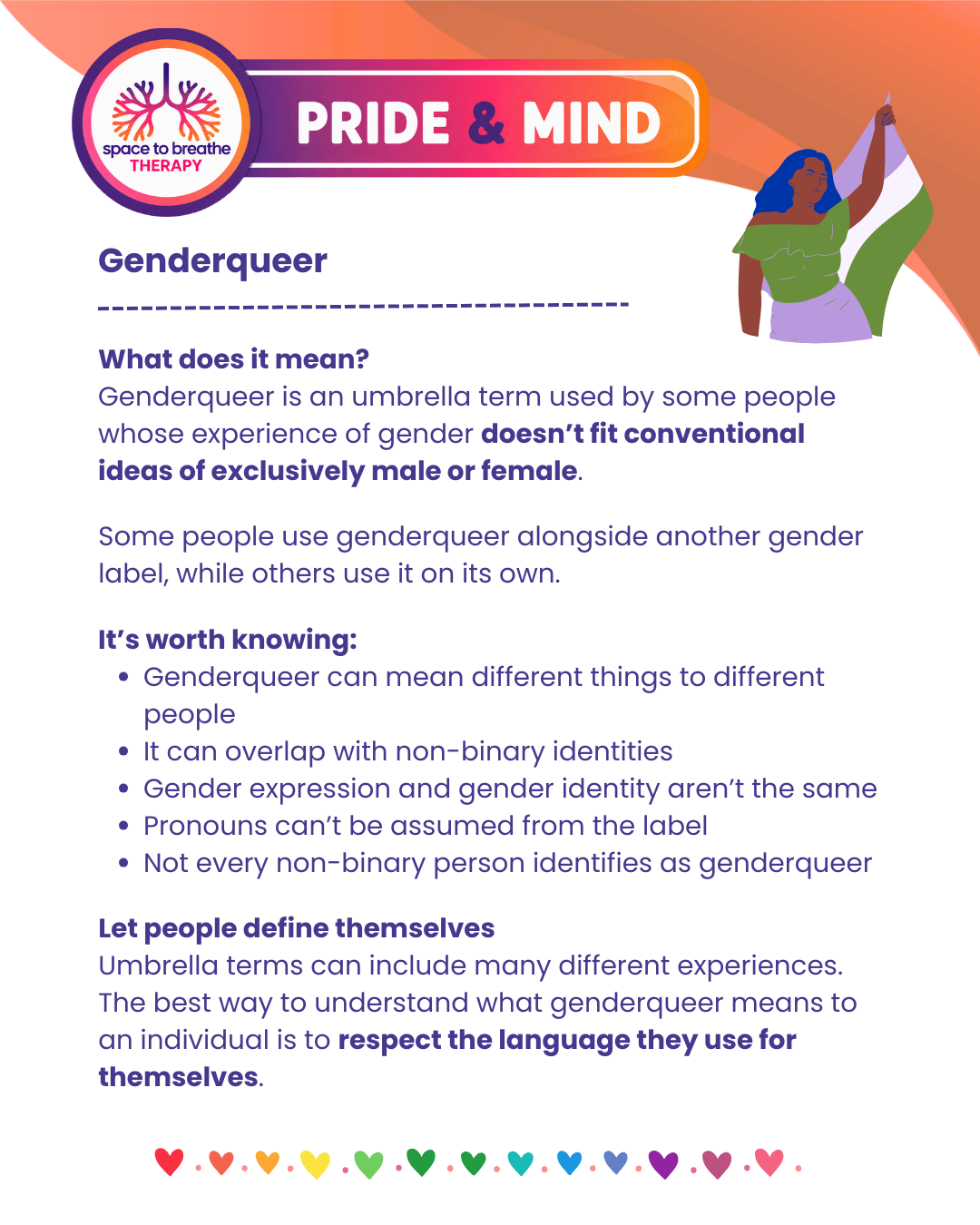
Genderqueer – Understanding Gender Beyond Traditional Categories
Gender is often presented as though there are only two clear possibilities: male or female. But for many people, their experience of gender is more complex than this.
Genderqueer is a term some people use when their gender identity doesn’t fit comfortably within conventional ideas of being exclusively male or exclusively female.
For some, genderqueer is an identity in its own right. For others, it sits alongside words such as non-binary, trans, genderfluid or another identity that helps them describe their experience.
What can genderqueer mean?
There isn’t one definition that will describe every genderqueer person.
Someone might experience themselves as having elements of different genders, being somewhere between traditional gender categories, moving between experiences of gender, or experiencing gender in a way that simply doesn’t fit established expectations.
That individuality is important. Two people can both describe themselves as genderqueer and experience their gender very differently.
Identity and expression are different
Being genderqueer doesn’t require somebody to dress, behave or present themselves in a particular way.
A genderqueer person may appear masculine, feminine, androgynous, a mixture of these, or none of them.
Their appearance doesn't determine whether their identity is genuine.
The same applies to pronouns. Some genderqueer people use they/them, while others use she/her, he/him, multiple pronouns or other pronouns.
Rather than guessing, listen to the language the individual uses for themselves.
Genderqueer and non-binary
The terms genderqueer and non-binary can overlap, but they aren't automatically interchangeable.
Some people identify with both terms. Some prefer genderqueer but not non-binary, while others identify as non-binary and don't consider themselves genderqueer.
Labels are tools people can use to communicate something about themselves — they aren't boxes everyone has to fit neatly inside.
You don't have to understand everything to be supportive
Sometimes people worry about saying the wrong thing, particularly when gender terminology is unfamiliar.
You don't need to know every term before you can treat somebody with dignity.
Listening, being willing to learn, using someone's chosen name and pronouns, and avoiding assumptions can make a significant difference.
If you make a genuine mistake, correct yourself and move forward rather than making the person responsible for reassuring you.
If you're questioning your own gender
You may have found this page because you're wondering whether genderqueer describes something you've been feeling yourself.
There is no test you need to pass.
You don't have to change your appearance.
You don't have to immediately tell anyone.
And you don't need to find the perfect label today.
You might try a word and later discover that another fits you better. That doesn't mean you were pretending or that your earlier understanding was wrong. Sometimes understanding ourselves is a process rather than a single moment of discovery.
A message from me
I think one of the most important things we can offer each other is room to be individual.
We can become very focused on definitions — What does this label mean? What does that label mean? Which box does somebody belong in? — when sometimes the person in front of us simply needs to know that they don't have to justify themselves.
If genderqueer is the word that helps you understand yourself today, you are allowed to use it.
If you're still exploring, you're allowed to do that too.
And if somebody you care about tells you they're genderqueer, you don't need to have all the answers. Listen to what the word means to them.
Sometimes acceptance begins with something very simple:
“Thank you for telling me. How would you like me to support you?”
Until next time, give yourself space to breathe.
With love,
Maggie




