





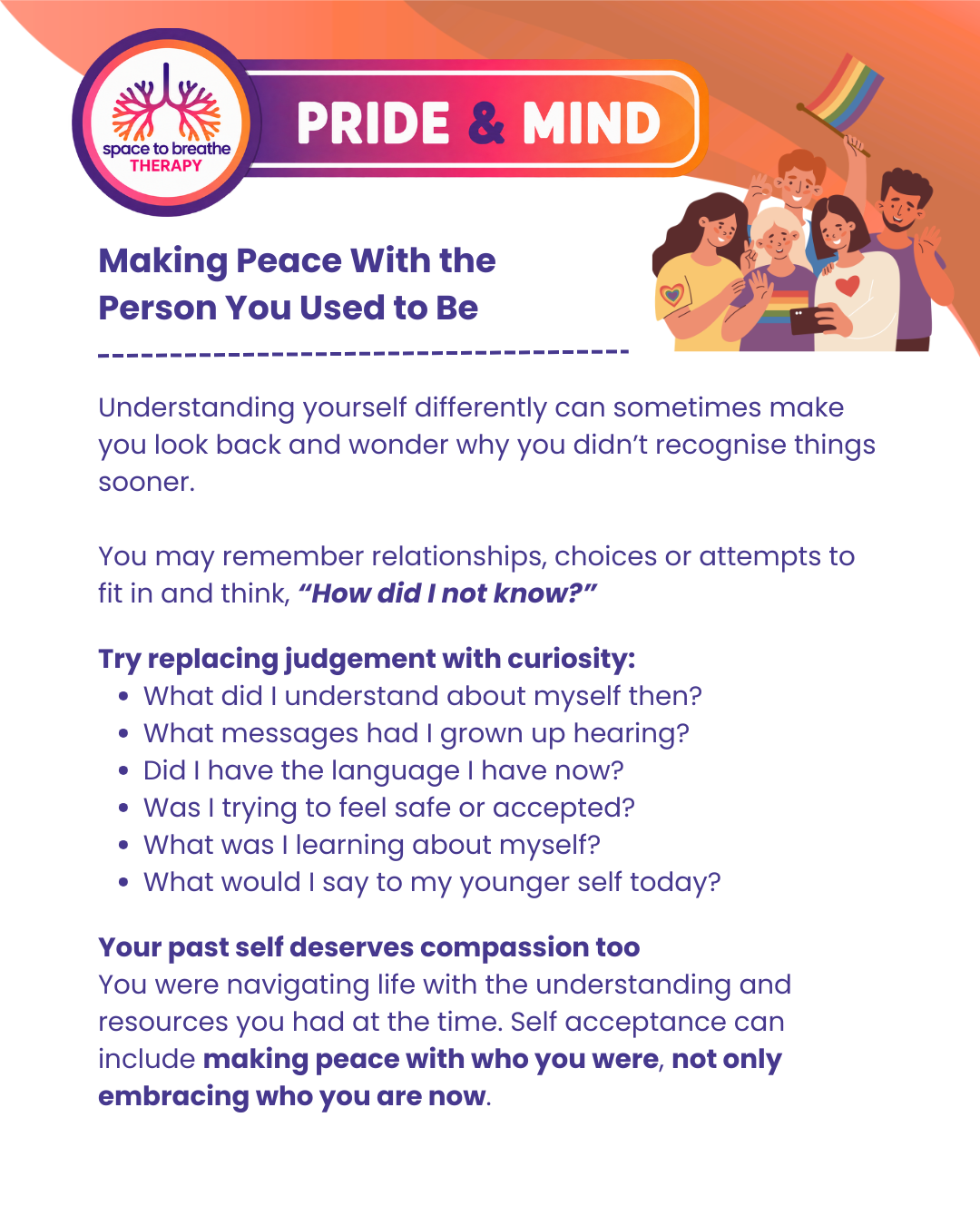
Making Peace With the Person You Used to Be
Understanding your LGBTQ+ identity can sometimes change the way you look back at your life.
Things that once seemed confusing may suddenly make more sense. Relationships might look different through the lens of what you understand about yourself today. Feelings you couldn't explain at the time may finally have words.
And alongside that understanding can come a difficult question:
“How did I not know?”
Looking backwards with today's knowledge
It is very easy to judge our younger selves using information we only have now.
You might look back at relationships you entered, people you tried to please, feelings you ignored or the ways you changed yourself to fit in and wonder why you couldn't see what now feels obvious.
But your younger self didn't have today's understanding.
Perhaps you didn't have the language to describe what you were experiencing.
Perhaps LGBTQ+ identities weren't openly discussed around you.
Perhaps you were trying to meet family, cultural or social expectations.
Perhaps fitting in felt safer than questioning things.
Or perhaps you simply weren't ready to understand that part of yourself yet.
You don't need to punish your past self for not knowing something they hadn't yet learned.
There may be grief as well as pride
Discovering or accepting yourself later can bring enormous relief and happiness, but it can also bring grief.
You may wonder what life might have looked like if you had understood yourself sooner.
You might think about relationships you could have had, experiences you missed or years spent trying to become somebody you thought you were supposed to be.
Those feelings deserve space too.
You can celebrate who you are now and feel sadness for the person who struggled before you understood why.
The two don't cancel each other out.
Try curiosity instead of judgement
When you find yourself criticising the person you used to be, try asking something different.
Instead of:
“Why did I do that?”
try:
“What did I need at that time?”
Instead of:
“Why didn't I just tell people?”
ask:
“Did I feel safe enough to tell people?”
Instead of:
“How could I not have known?”
perhaps ask:
“Did I have the words, examples and understanding that I have now?”
Curiosity allows us to understand our past without putting it on trial.
Your past doesn't have to be erased
Accepting yourself doesn't mean rejecting everything that came before.
The person you used to be survived situations, made decisions with the information available and brought you to where you are now.
Some choices may no longer fit you.
Some relationships may look different.
Some memories may still be painful.
But that earlier version of you is still part of your story.
A message from me
If you could sit beside your younger self today, I wonder what you would say.
Would you criticise them for not knowing?
Or would you tell them:
“You're going to understand yourself one day.”
“You don't have to have all the answers yet.”
“There is nothing wrong with you.”
“You deserve to be loved as yourself.”
Sometimes self-acceptance isn't only about learning to love who we are today.
It's also about looking backwards with compassion and recognising that we were doing the best we could with the understanding, safety and resources we had at the time.
You don't need to rewrite your past to honour your present.
You can make peace with who you were while continuing to become who you are.
Until next time, give yourself space to breathe.
With love,
Maggie